
Sigma Computing
VerifiedWarehouse-first analytics with a spreadsheet interface and write-back to live data
Is this your product? Rent a top-5 spot in Operational Analytics Software from $219 a month.
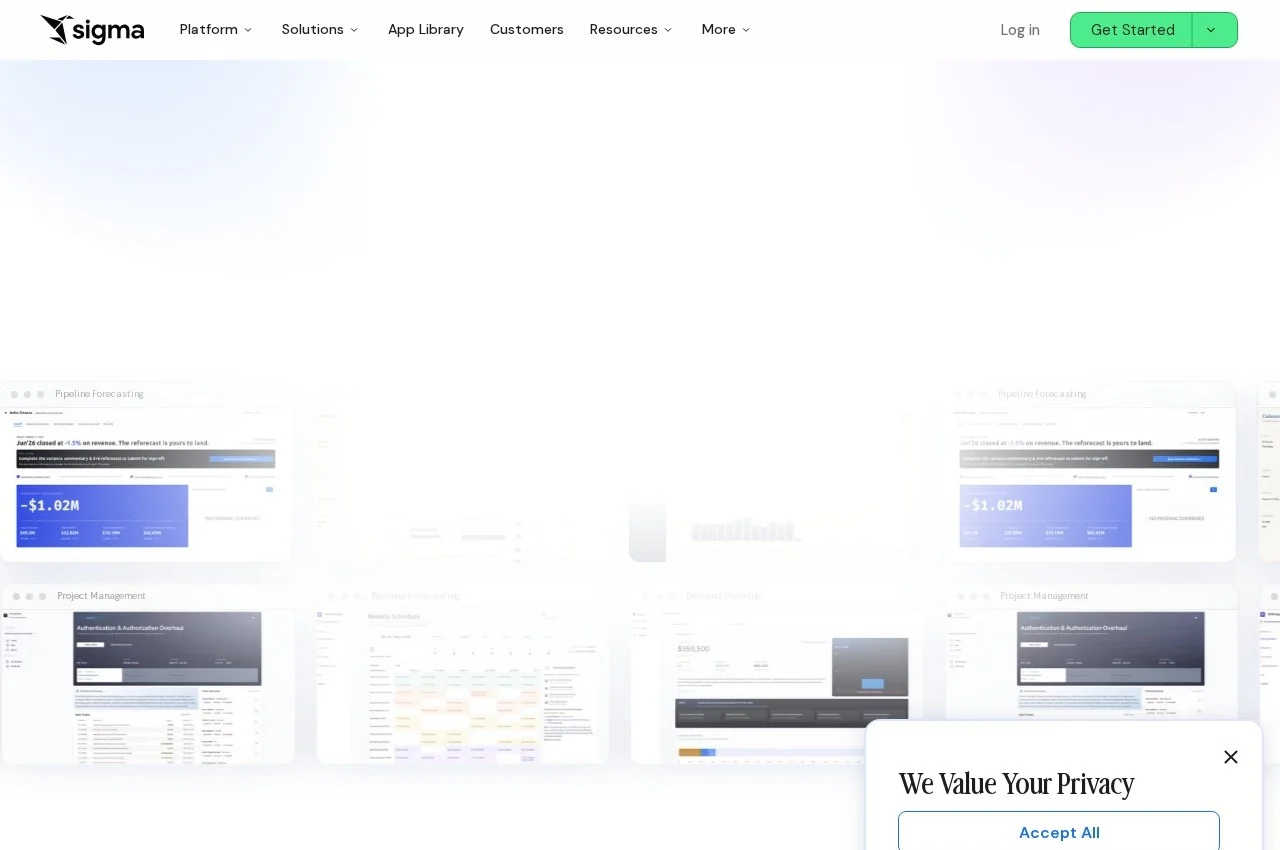 See all screenshots
- Deployment Cloud Based
- Starting price Quoted on request
- Free trial Available
- Best for Medium Business, Large Enterprise
What is Sigma Computing?
Sigma Computing is a business intelligence and analytics platform built on a warehouse-first architecture, covering data applications that act on live data, embedded and white-label analytics, pixel-perfect reporting, an AI toolkit, data models providing trusted metrics at scale, a spreadsheet user experience supporting editing, exploration and write-back, and agents that take action.
The spreadsheet interface with write-back is the defining choice and it addresses the most persistent failure in business intelligence adoption.
That failure is well documented and rarely solved. An organisation buys an analytics platform, builds dashboards, and within a year discovers that the people who actually make decisions have exported everything to Excel. This is usually treated as a training problem. It is not. It is because analysts need to model, to add a column, to test an assumption and to work with the data rather than only look at it, and dashboards are read-only by design.
Offering the spreadsheet interaction pattern directly on the warehouse means the analyst gets the flexibility they were leaving for, without the export that breaks governance, breaks the refresh and produces the seventeen conflicting versions of a number that every organisation eventually accumulates.
Write-back is the more consequential half. Analytics that can only read is a reporting tool. Analytics that can write back allows the decision to be recorded where the data lives, so a forecast adjustment, a category correction or an approval becomes part of the governed dataset rather than living in somebody's spreadsheet.
Warehouse-first architecture means computation happens in the data warehouse rather than in an extract, so there is no separate copy to refresh and no limit imposed by what fits in memory. That also means warehouse compute cost becomes the variable to watch, which is a different cost model from extract-based tools.
Embedded and white-label analytics extend the same engine into customer-facing applications.
Pricing is not published, with the vendor routing enquiries through a contact page.
Key Features of Sigma Computing
- Warehouse-first architecture
- Spreadsheet user interface on live data
- Write-back to the data warehouse
- Data models with trusted metrics
- Pixel-perfect reporting
- Embedded and white-label analytics
- Data applications that act on live data
- AI toolkit for machine learning
- Agents that take action
- No separate extract to refresh
Sigma Computing Pricing
Quoted
Quoted on request
No rate card is published. Normally quoted on user count, with data warehouse compute charged separately by your cloud provider.
Sigma Computing Specifications
- Deployment
- Cloud Based
- Desktop
- Web App
- Built for
- Medium Business
- Large Enterprise
- Support
- Phone
- Public API
- Yes
- Free trial
- Yes
- Free plan
- No
- Runs in browser
- No
- Customisable
- No
- Website
- sigmacomputing.com
Sigma Computing Videos
Sigma Computing Screenshots
Sigma Computing Comparisons



Your experience counts
Rate Sigma Computing
Used Sigma Computing? Your honest review helps the next buyer decide. It takes about three minutes.
Thanks, your review is in.
Our editors check every review before it goes live, usually within 2 business days.
Sigma Computing FAQs
Alternatives to Sigma Computing
Other Operational Analytics Software recorded on the same fields.