

AWS Cloud Map
VerifiedA managed registry for application resources, priced per resource and per query
Is this your product? Rent a top-5 spot in Service Discovery Software from $219 a month.
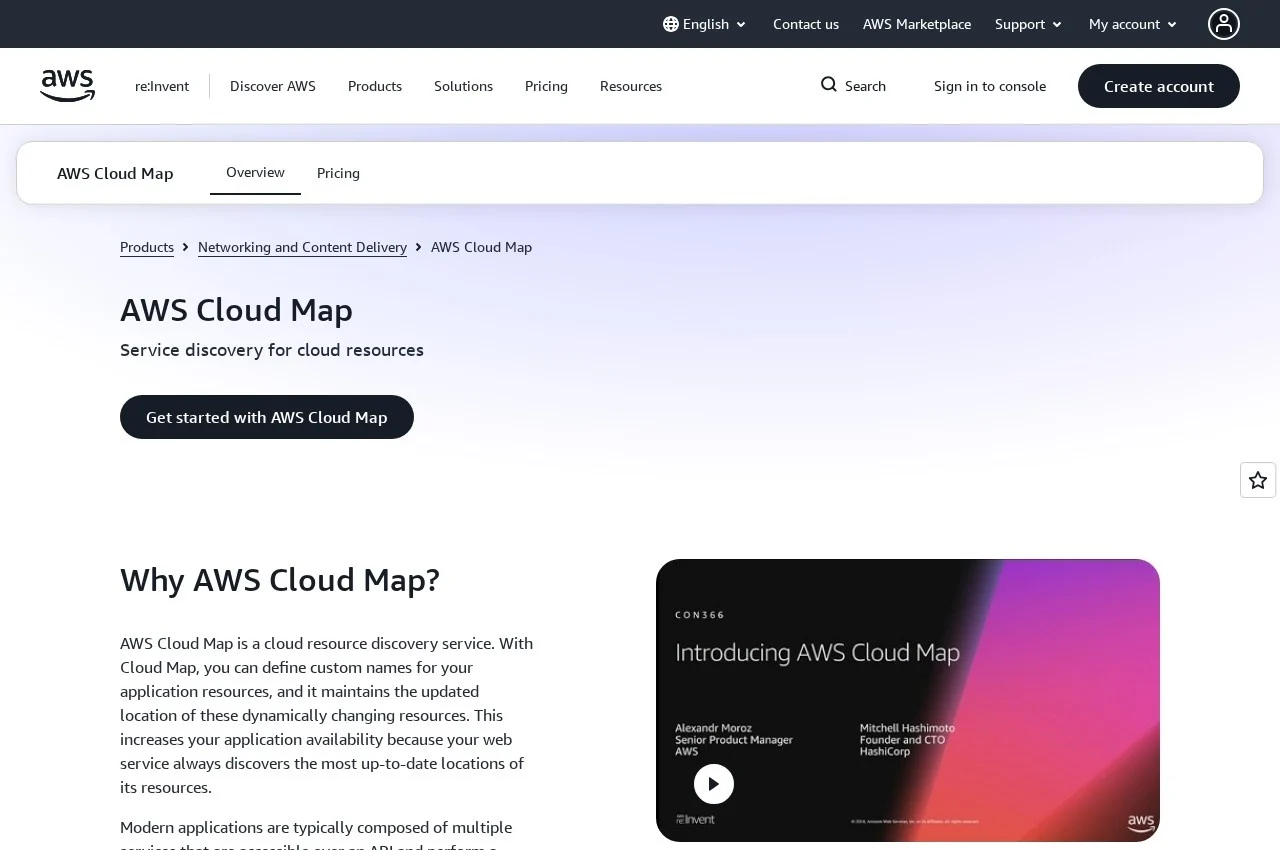 See all screenshots
- Deployment Cloud Based
- Starting price $0.10
- Free trial Not offered
- Best for Small Business, Medium Business, Large Enterprise
What is AWS Cloud Map?
AWS Cloud Map is a cloud resource discovery service. Applications register resources such as databases, queues, object stores and microservices under custom names, and the service maintains their current locations as those resources change, continually checking their health so the recorded location stays accurate. An application then queries the registry for what it needs, filtered by attributes such as version and deployment environment.
The problem it addresses is stated plainly by the vendor and will be familiar to anyone who has maintained a growing system. Resource names and locations are usually managed by hand inside application code, which becomes time consuming and error prone as dependencies multiply or as services scale up and down with traffic. The alternative has been to install and operate a third-party discovery product, which is infrastructure a team then owns.
Registering arbitrary resources rather than only services is the difference from a service registry. A queue or a table is a dependency in exactly the way another microservice is, and being able to look both up through one mechanism removes a category of configuration.
Pricing is metered rather than subscribed, at a rate per registered resource per month plus a rate per million discovery calls, so cost tracks the size of the estate and how often it is queried.
Key Features of AWS Cloud Map
- Custom names for application resources
- Registration of databases, queues and microservices
- Continuous health checking of registered resources
- Attribute-based queries by version and environment
- DNS-based and API-based discovery
- Automatic location updates as resources change
- Integration with Route 53 hosted zones
- Managed service with no infrastructure to operate
- Metered pricing per resource and per query
- Namespace organisation per environment
AWS Cloud Map Pricing
Service registry
$0.10
Charged per registered resource per month. A registry of 75 EC2 instances costs 7.50 dollars per month on the vendor’s own worked example.
Discovery API calls
$1
Charged per million HTTP discovery API calls. DNS-based discovery instead incurs Route 53 hosted zone and query charges.
AWS Cloud Map Specifications
- Deployment
- Cloud Based
- Desktop
- Web App
- Built for
- Small Business
- Medium Business
- Large Enterprise
- Support
- Knowledge Base
- Public API
- Yes
- Free trial
- No
- Free plan
- No
- Runs in browser
- No
- Customisable
- No
- Website
- aws.amazon.com
AWS Cloud Map Screenshots
AWS Cloud Map Comparisons



Your experience counts
Rate AWS Cloud Map
Used AWS Cloud Map? Your honest review helps the next buyer decide. It takes about three minutes.
Thanks, your review is in.
Our editors check every review before it goes live, usually within 2 business days.
AWS Cloud Map FAQs
Alternatives to AWS Cloud Map
Other Service Discovery Software recorded on the same fields.