
Amazon Aurora
VerifiedMySQL and PostgreSQL compatibility on storage AWS rebuilt underneath them
Is this your product? Rent a top-5 spot in RDBMS Software from $219 a month.
 See all screenshots
- Deployment Cloud Based, SaaS
- Starting price Not published
- Free trial Available
- Best for Small Business, Medium Business, Large Enterprise
What is Amazon Aurora?
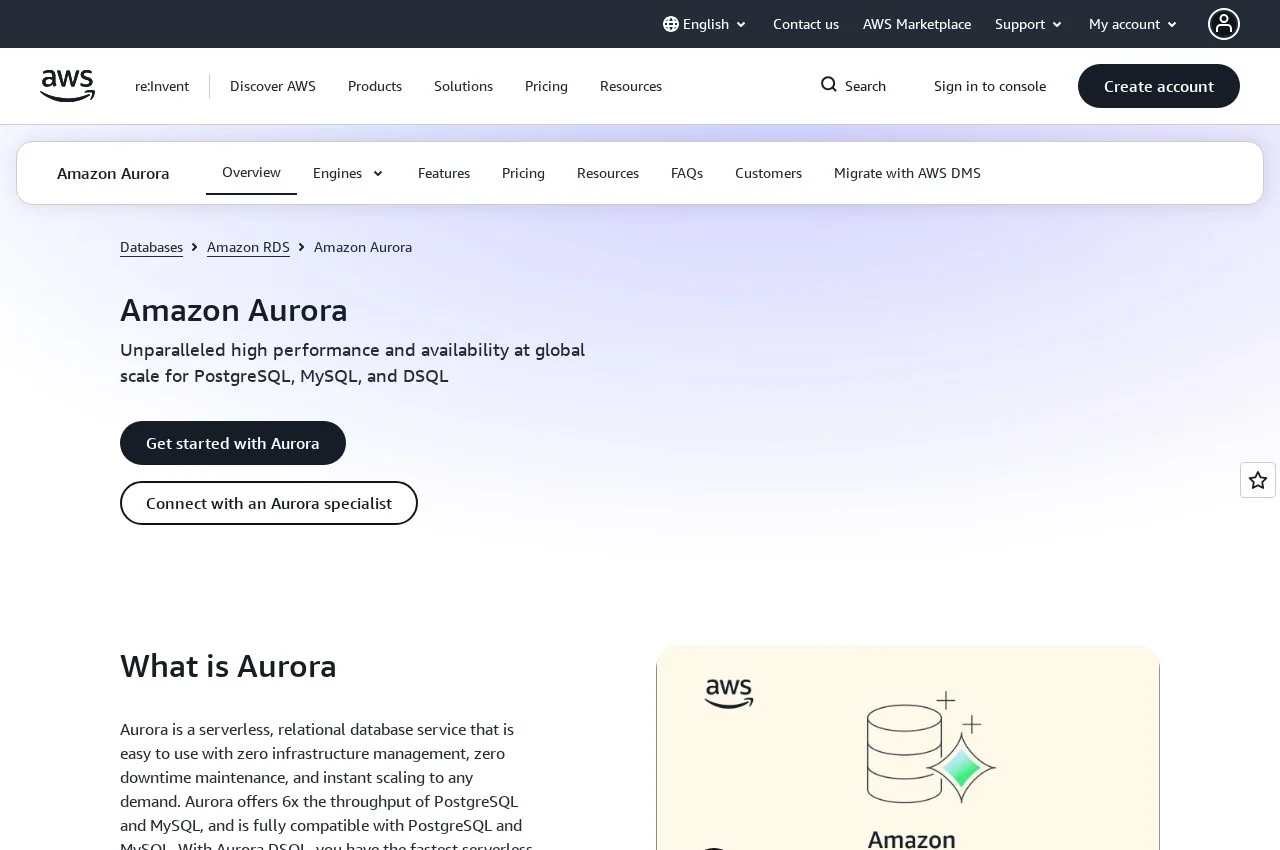
Amazon Aurora is AWS's managed relational database, compatible with MySQL and PostgreSQL, built on a distributed storage layer that replicates across availability zones, with Serverless capacity scaling and global database options.
Replacing the storage engine rather than the database is the engineering idea that makes Aurora interesting. The SQL layer is MySQL or PostgreSQL, so applications and tools work unchanged, while underneath it a purpose-built distributed storage system handles replication and durability, which is where the performance and availability claims come from.
Compatibility is what makes that a low-risk choice, since a team can move an existing MySQL or PostgreSQL application without rewriting it and can, in principle, move back, which is a materially different proposition from adopting a proprietary database with its own dialect.
Serverless capacity is the option worth understanding before committing, because it scales the database with demand and suits variable or unpredictable workloads, while a steady production workload is usually cheaper on provisioned capacity. The Amazon global database option extends the same storage layer across regions for read scale and disaster recovery, and Performance Insights gives the query-level visibility a self-managed database would need a separate tool for. Aurora is metered by consumption with no simple rate table published.
Key Features of Amazon Aurora
- MySQL and PostgreSQL compatibility
- Purpose-built distributed storage layer
- Replication across availability zones
- Automated backup and point-in-time recovery
- Aurora Serverless capacity scaling
- Global database across regions
- Read replicas with low replica lag
- Automated failover
- Integration with AWS services
- Managed patching and maintenance
- Performance Insights monitoring
- Consumption-based metering
Amazon Aurora Pricing
Consumption
Not published
No simple rate table is published. Aurora is metered by instance or capacity unit, storage consumed and request volume.
Amazon Aurora Specifications
- Deployment
- Cloud Based
- SaaS
- Desktop
- Web App
- Built for
- Small Business
- Medium Business
- Large Enterprise
- Support
- Knowledge Base
- Public API
- Yes
- Free trial
- Yes
- Free plan
- No
- Runs in browser
- No
- Customisable
- No
- Website
- aws.amazon.com
Amazon Aurora Screenshots
Amazon Aurora Comparisons

Your experience counts
Rate Amazon Aurora
Used Amazon Aurora? Your honest review helps the next buyer decide. It takes about three minutes.
Thanks, your review is in.
Our editors check every review before it goes live, usually within 2 business days.
Amazon Aurora FAQs
Alternatives to Amazon Aurora
Other RDBMS Software recorded on the same fields.