
Productboard
VerifiedFeedback, roadmaps and specs in one place, with an agent that knows the product
 See all screenshots
 - Deployment Cloud Based, SaaS
- Starting price Free
- Free trial Available
- Best for Small Business, Medium Business, Large Enterprise
What is Productboard?
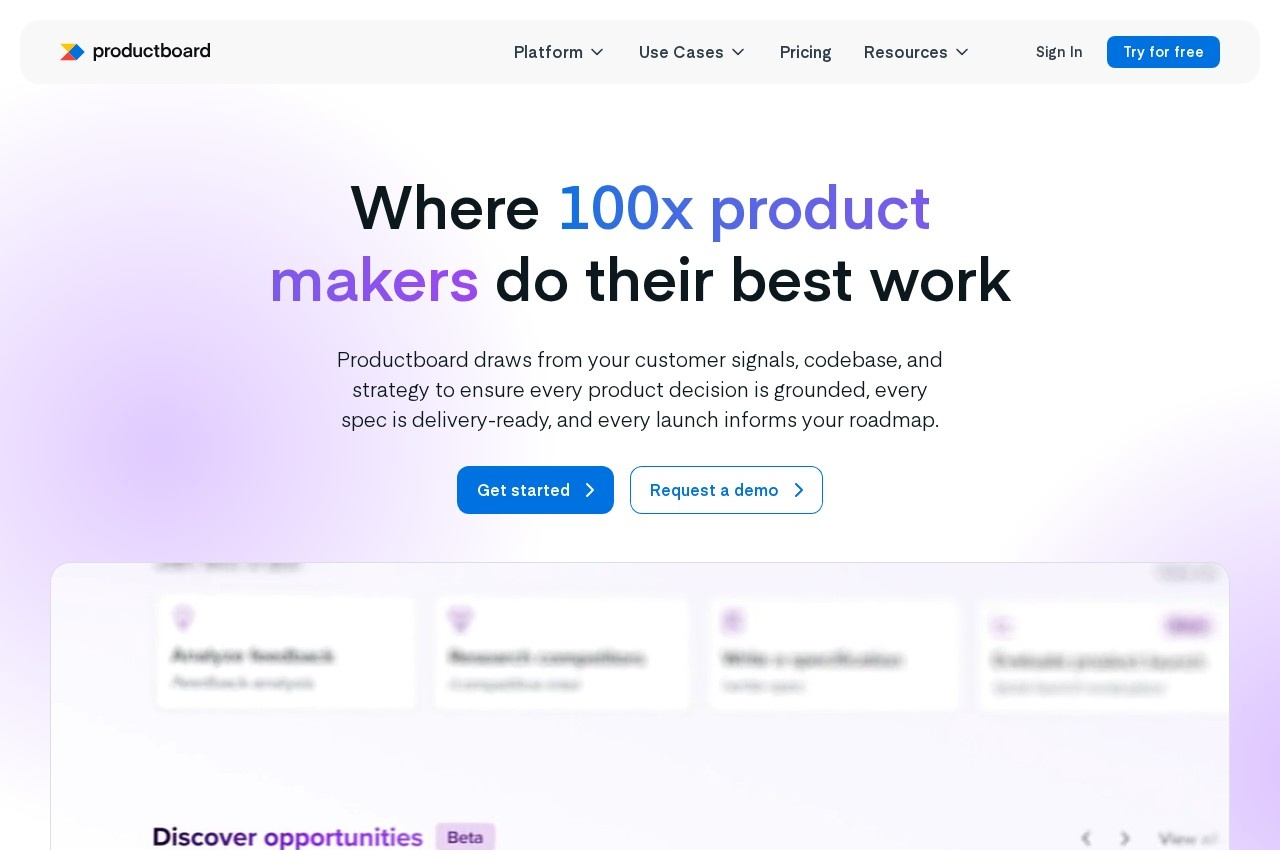
Productboard is a product management system covering customer feedback analysis, roadmapping, customer engagement, product specification and strategic planning, with an AI agent called Spark carrying context across the product and its customers.
Feedback analysis is where Productboard's argument starts and it is the right starting point. A product team at any scale receives more input than it can read: support tickets, sales calls, reviews, community threads and direct requests, arriving faster than anyone can categorise them. The instinct is to build for whoever asked loudest or most recently, which is how roadmaps end up serving a handful of vocal accounts. Centralising the input and surfacing themes from it changes what the prioritisation conversation is actually based on.
An agent specialised for product work rather than a general assistant is the newer positioning, and the distinction it draws is about context. A general model asked to draft a specification knows nothing about the product, its customers or what has already been decided, so it produces plausible generic text a product manager then rewrites. An agent holding the same feedback, roadmap and specification history has the material the job actually requires.
Interactive roadmaps handle stakeholder alignment, and a product portal lets customers see what is being built and what has shipped. More than 25 native integrations connect the surrounding stack, and the platform is SOC2-verified. The Free tier costs nothing with 50 AI credits a month, Plus is 19 dollars per maker per month billed annually or 25 monthly with 250 credits, and Business is 59 dollars per maker per month billed annually with a five maker minimum, or 75 monthly, with 500 credits. Credit top-ups are 5 dollars for 50 on monthly plans.
Key Features of Productboard
- Centralised customer feedback analysis
- AI theme and opportunity surfacing
- Interactive product roadmaps
- Public product portal
- AI-assisted product specifications
- Productboard Spark agent
- Strategic planning against objectives
- Over 25 native integrations
- SOC2-verified security
- Monthly AI credit allowances
- Customer idea validation
- Enterprise scale and compliance tooling
Productboard Pricing
Free
Free
Free forever, with 50 AI credits a month, one Product Portal and the core specification and preparation tools.
Plus
$19
Per maker billed annually, or 25 dollars per maker monthly. Adds 250 AI credits a month and prioritisation context.
Business
$59
Per maker billed annually with a five maker minimum, or 75 dollars monthly. Includes 500 AI credits a month.
Productboard Specifications
- Deployment
- Cloud Based
- SaaS
- Desktop
- Web App
- Built for
- Small Business
- Medium Business
- Large Enterprise
- Support
- Knowledge Base
- Public API
- Yes
- Free trial
- Yes
- Free plan
- No
- Runs in browser
- No
- Customisable
- No
- Website
- productboard.com
Productboard Screenshots
Productboard Comparisons


Productboard Reviews
No reviews yet
Used Productboard? Share your experience and help other buyers decide.
Productboard FAQs
Alternatives to Productboard
Other Product Management Software recorded on the same fields.