
Clearwave
VerifiedAI patient engagement with self-registration, kiosks, eligibility and Voice AI
- Deployment Cloud Based
- Starting price Quoted on request
- Free trial Not offered
- Best for Small Business, Medium Business, Large Enterprise
What is Clearwave?
Clearwave is an AI patient engagement platform built around registration, scheduling and payment, and it states its measure of success unusually precisely: low staff intervention, high patient adoption and real return on investment. Those three are the right tests. Patient self-service software fails when patients will not use it, in which case staff end up doing the work anyway and the practice has paid twice.
The components address the whole front-office sequence. Patient scheduling and self-scheduling handle booking. Patient registration covers intake. Insurance eligibility verification runs the check that determines whether a visit will actually be paid for, and doing it before the appointment rather than after is what prevents denied claims. Payment solutions collect money at the point of service. Kiosks provide in-practice self-registration for patients who arrive without completing anything in advance, which is the realistic fallback rather than an optimistic assumption.
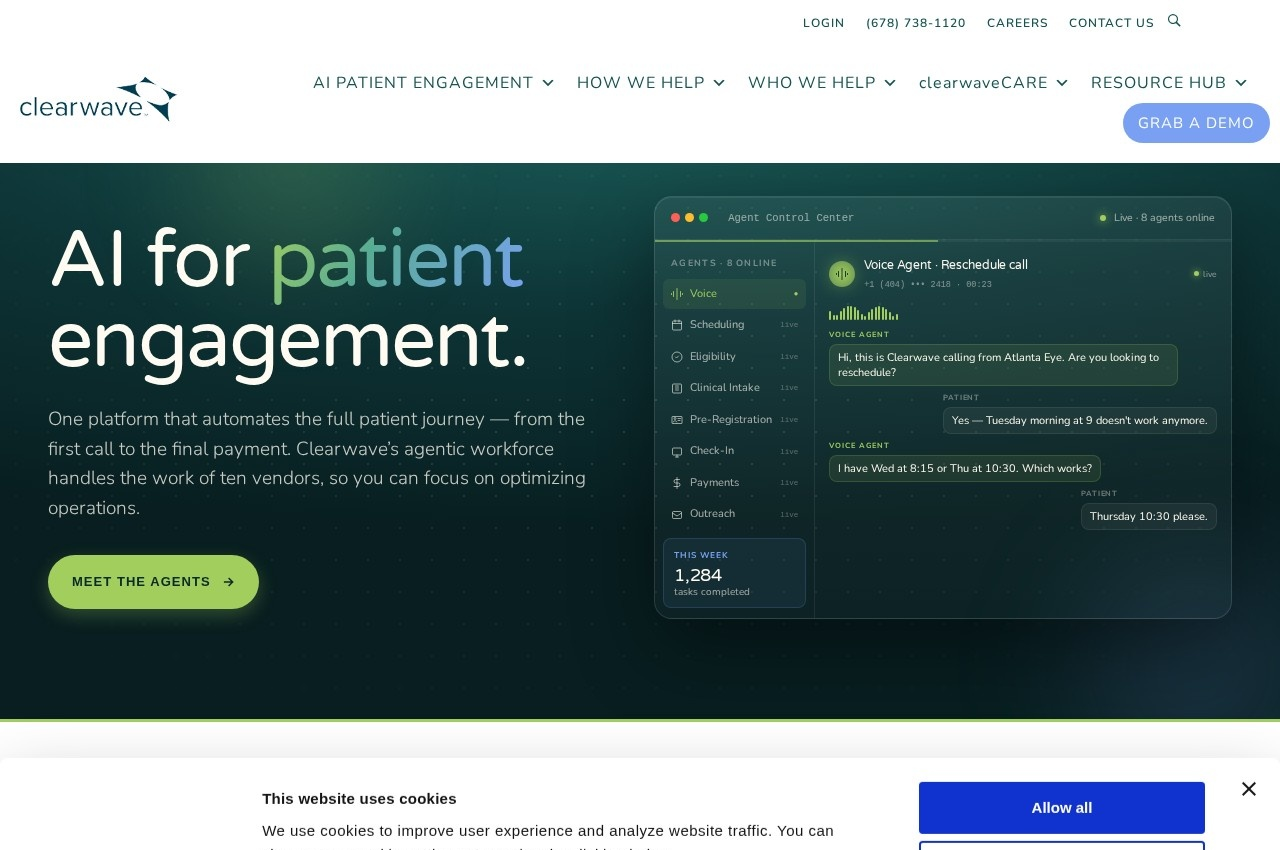
Clearwave Voice AI is the newer capability, aimed squarely at dropping hold times and booking more patients. Call abandonment is a direct revenue loss in specialty practices, since a patient who gives up waiting frequently books with another provider instead. PMS and EMR integrations connect it to existing systems, and a dashboard covers business insights and analytics. The specialty coverage is notably deep and specific, with named configurations for ophthalmology, orthopaedics, internal medicine, ENT, dermatology, FQHCs, oncology, cardiology, OBGYN, gastroenterology and neurology, plus hospitals and health systems. That specificity matters because registration questions and eligibility rules differ by specialty. Pricing is not published.
Key Features of Clearwave
- Patient self-registration
- In-practice self-service kiosks
- Patient scheduling and self-scheduling
- Clearwave Voice AI for call handling
- Insurance eligibility verification
- Patient payment collection
- Patient communications
- PMS and EMR integrations
- Business insights and analytics dashboard
- Specialty configurations across eleven named specialties
- Configurations for FQHCs, hospitals and health systems
- Revenue cycle acceleration tooling
Clearwave Pricing
Quoted
Quoted on request
No pricing is published. Cost typically depends on locations and providers. Clarify whether kiosk hardware is purchased, leased or included.
Clearwave Specifications
- Cloud Based
- Web App
- Android
- iOS
- Small Business
- Medium Business
- Large Enterprise
- Phone
Clearwave Screenshots
Overall Clearwave Reviews
No reviews yet
Used Clearwave? Share your experience and help other buyers decide.
Clearwave FAQs
Alternatives to Clearwave
Other Patient Registration Software products listed on SocialAtoZ.