

Apache Hadoop
VerifiedThe open source framework for reliable, scalable distributed computing, from the Apache Software Foundation
 See all screenshots
 - Deployment On Premise, Cloud Based
- Starting price Free
- Free trial Available
- Best for Medium Business, Large Enterprise
What is Apache Hadoop?
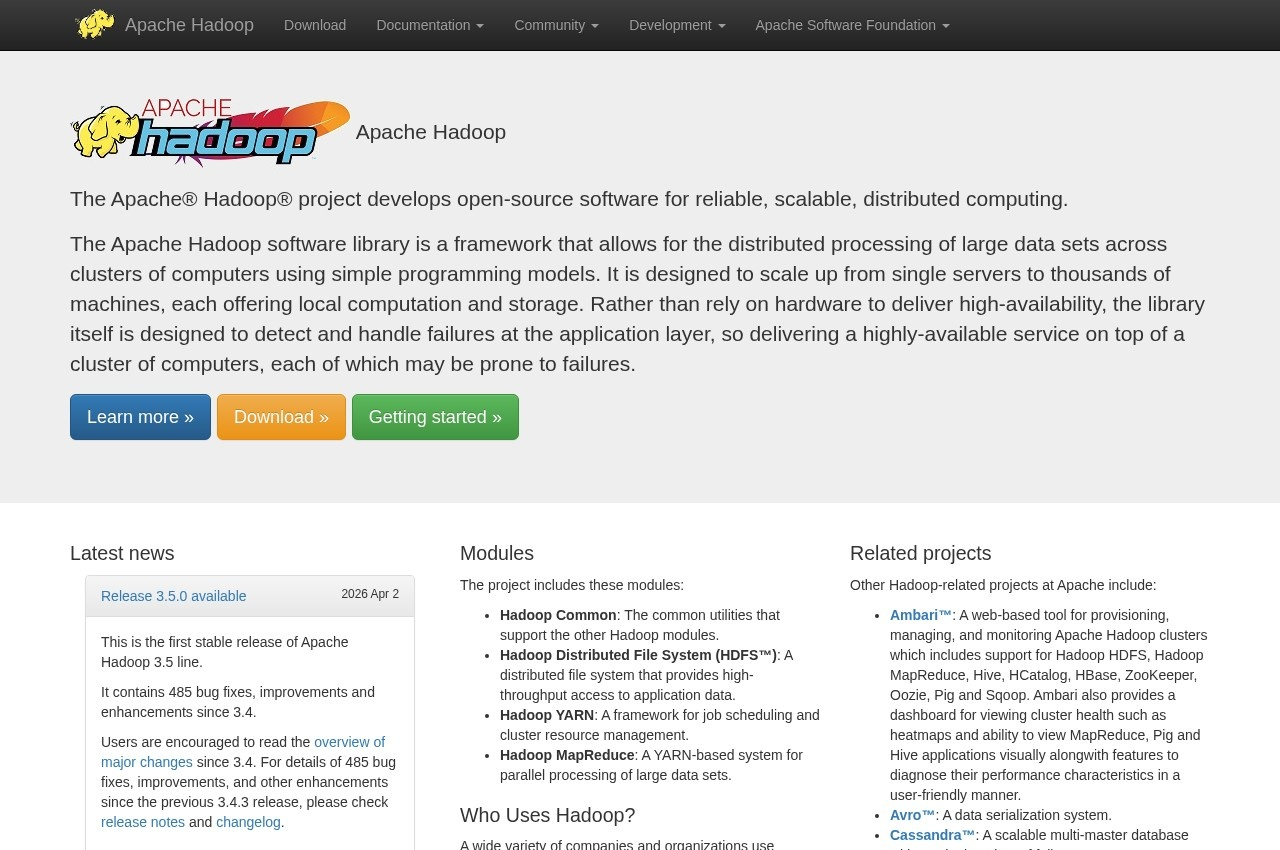
Apache Hadoop is an Apache Software Foundation project developing open source software for reliable, scalable, distributed computing, published across maintained release lines including 3.4.0, 3.3.6 and 2.10.2, with a wiki, community bylaws, criteria for committership, mailing lists and published security advisories.
Hadoop's historical significance is that it made distributed data processing accessible on commodity hardware, and the ideas it established remain the foundation of the field even as the specific implementation has been displaced for many workloads.
The core insight was to move computation to the data rather than data to the computation. When a dataset is too large for one machine, the conventional approach of loading it into a processing system fails on the transfer alone. Hadoop distributed the data across many machines and ran the processing on the machine holding each piece, which is why it scaled where previous approaches could not.
An honest assessment of where it now sits is more useful than a feature list. Cloud object storage and separated compute engines have replaced Hadoop for a great many workloads that would once have required it, because storing data in object storage and running a query engine against it is simpler and cheaper than operating a cluster where storage and compute are bound together.
Where Hadoop remains relevant is substantial nonetheless. Large existing deployments represent significant investment and continue to run. Organisations that cannot use public cloud for regulatory or sovereignty reasons still need on-premise distributed processing. And the ecosystem that grew around Hadoop, including formats and schedulers, remains in wide use well beyond Hadoop clusters themselves.
Published CVEs and a formal security process are worth noting for anyone running it, since a distributed system holding an organisation's data warrants the same patching discipline as any other infrastructure, and older release lines eventually stop receiving fixes.
The software is free and open source under the Apache licence, with commercial distributions and support available from third parties.
Key Features of Apache Hadoop
- Distributed storage across commodity hardware
- Distributed processing framework
- Computation moved to the data
- Fault tolerance across node failures
- Horizontal scaling
- Multiple maintained release lines
- Open Apache licence
- Published security advisories
- Community governance and bylaws
- On-premise deployment without cloud dependency
Apache Hadoop Pricing
Open source
Free
Free and open source under the Apache licence, available for download across maintained release lines.
Commercial support
Quoted on request
Commercial distributions, management tooling and support are offered by third parties rather than by the project.
Apache Hadoop Specifications
- Deployment
- On Premise
- Cloud Based
- Desktop
- Linux
- Web App
- Built for
- Medium Business
- Large Enterprise
- Support
- Public API
- Yes
- Free trial
- Yes
- Free plan
- No
- Runs in browser
- No
- Customisable
- No
- Website
- hadoop.apache.org
Apache Hadoop Screenshots
Apache Hadoop Comparisons



Apache Hadoop Reviews
No reviews yet
Used Apache Hadoop? Share your experience and help other buyers decide.
Apache Hadoop FAQs
Alternatives to Apache Hadoop
Other Hadoop-Related Software recorded on the same fields.