

Anaplan Supply Chain
VerifiedConnected planning where the supply chain model shares maths with the finance one
 See all screenshots
 - Deployment Cloud Based, SaaS
- Starting price Not published
- Free trial Not offered
- Best for Medium Business, Large Enterprise
What is Anaplan Supply Chain?
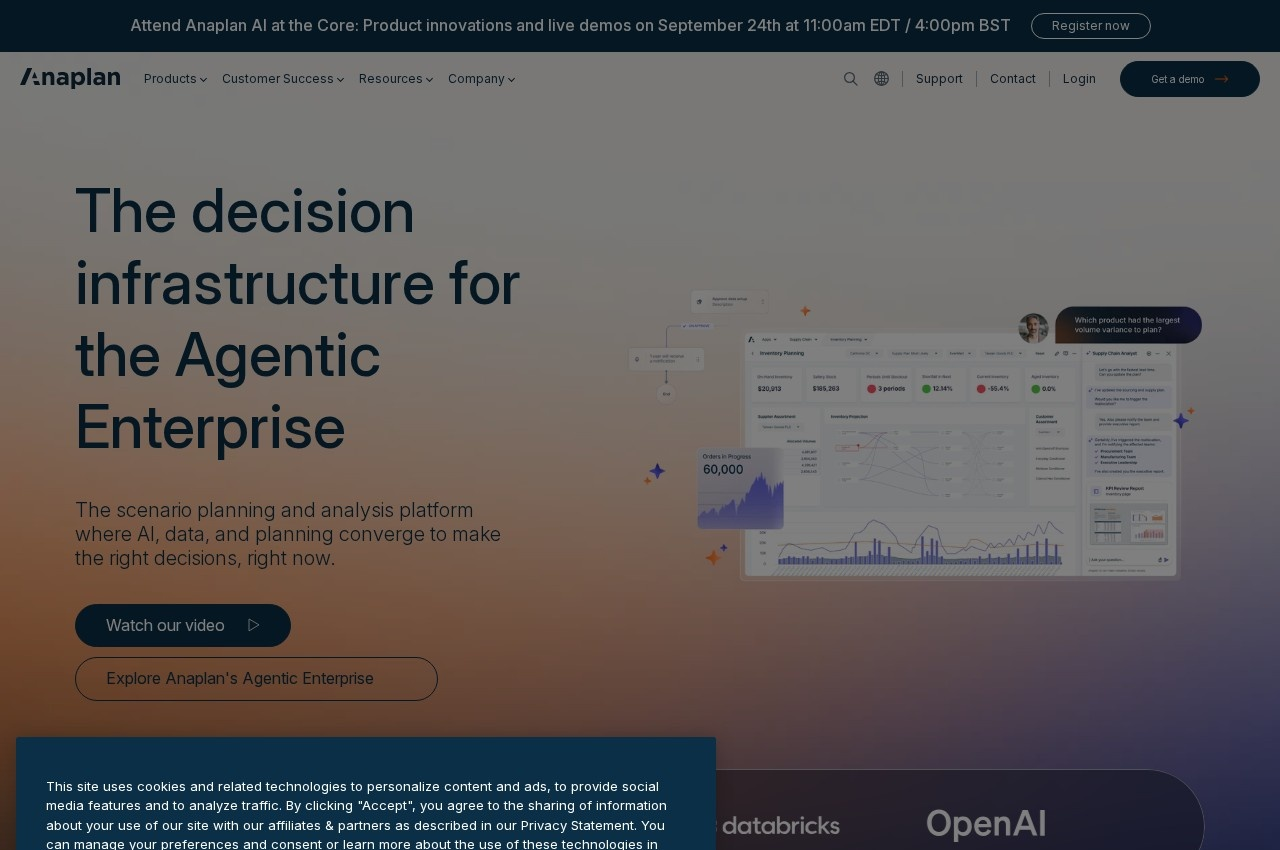
Anaplan Supply Chain is the supply chain application of Anaplan's connected planning platform, which the company now describes as decision infrastructure for agentic enterprises, sitting alongside purpose-built applications for finance, sales, human resources and retail planning.
Sharing a platform with financial planning is the distinguishing property and it solves a specific organisational failure. A supply chain plan and a financial plan describe the same business and are almost always built in different tools by different teams, so the volumes operations is preparing to produce and the revenue finance has committed to the board diverge quietly until a quarter ends badly. Modelling both on one engine makes the operational plan and the financial plan reconcile by construction.
The platform being a modelling engine rather than a fixed application is the other half. Anaplan is effectively a calculation environment in which planning models are built, which means an unusual supply chain can be represented properly rather than forced into someone else's process. The cost is real and should be stated: models have to be built and maintained by people who understand them, and a large Anaplan estate is a capability an organisation has to keep staffing.
The application library spans supply chain alongside consensus margin planning, integrated financial planning, profitability analysis, sales forecasting, territory and quota planning, and workforce planning, so the same model can carry a demand signal through to a margin outcome. The interface is published in English, Japanese, French, German, Italian and Spanish. Rates are not published, with a contact route given instead.
Key Features of Anaplan Supply Chain
- Connected planning across functions
- Shared modelling engine with finance
- Custom supply chain model building
- Demand and supply planning applications
- Scenario planning and simulation
- Consensus margin planning
- Integrated financial planning
- Sales forecasting and quota planning
- Workforce planning
- Out-of-the-box application library
- Agentic decision infrastructure
- Six interface languages
Anaplan Supply Chain Pricing
Not published
Not published
No figures are published. The platform is quoted per customer on scope, volume and the modules licensed.
Anaplan Supply Chain Specifications
- Deployment
- Cloud Based
- SaaS
- Desktop
- Web App
- Mobile
- iOS
- Android
- Built for
- Medium Business
- Large Enterprise
- Support
- Knowledge Base
- Public API
- Yes
- Free trial
- No
- Free plan
- No
- Runs in browser
- No
- Customisable
- No
- Website
- anaplan.com
Anaplan Supply Chain Screenshots
Anaplan Supply Chain Comparisons

Anaplan Supply Chain Reviews
No reviews yet
Used Anaplan Supply Chain? Share your experience and help other buyers decide.
Anaplan Supply Chain FAQs
Alternatives to Anaplan Supply Chain
Other Supply Chain Suites recorded on the same fields.