
Most complete listing
SuperOps
Answers the most buyer questions in this category.
6 tools compared
Remote Monitoring And Management Software is software that helps you monitor, manage, and maintain IT systems, infrastructure, and applications so they stay reliable. Use the list below to compare the top Remote Monitoring And Management Software options by features, pricing, and reviews, and shortlist the ones that match your workflow and budget.
Picked from the Remote Monitoring And Management Software records below, by what each one is strongest at.
Most complete listing
Answers the most buyer questions in this category.
Free trial
Try it before you buy.
Compare the 6 most relevant Remote Monitoring And Management Software options on price, free trial and deployment.
| Product | Starting price | Free trial | Free plan | API | Deployment |
|---|---|---|---|---|---|
| SuperOps AI-native unified endpoint management with PSA and RMM | Custom | – | – | ✓ | Cloud Based |
| N-able N-central Unified endpoint management RMM for larger managed estates | Custom | ✓ | – | ✓ | Cloud Based, On Premises |
 Kaseya VSA Kaseya's long-running RMM, now at VSA 10 | Custom | – | – | ✓ | Cloud Based, On Premises |
 Atera Full-stack IT management priced per technician, not per device | Custom | ✓ | – | ✓ | Cloud Based |
 Datto RMM Cloud RMM for MSPs, now one of two Kaseya RMM… | Custom | – | – | ✓ | Cloud Based |
 NinjaOne Unified IT operations platform for endpoint management and support | Custom | ✓ | – | ✓ | Cloud Based |
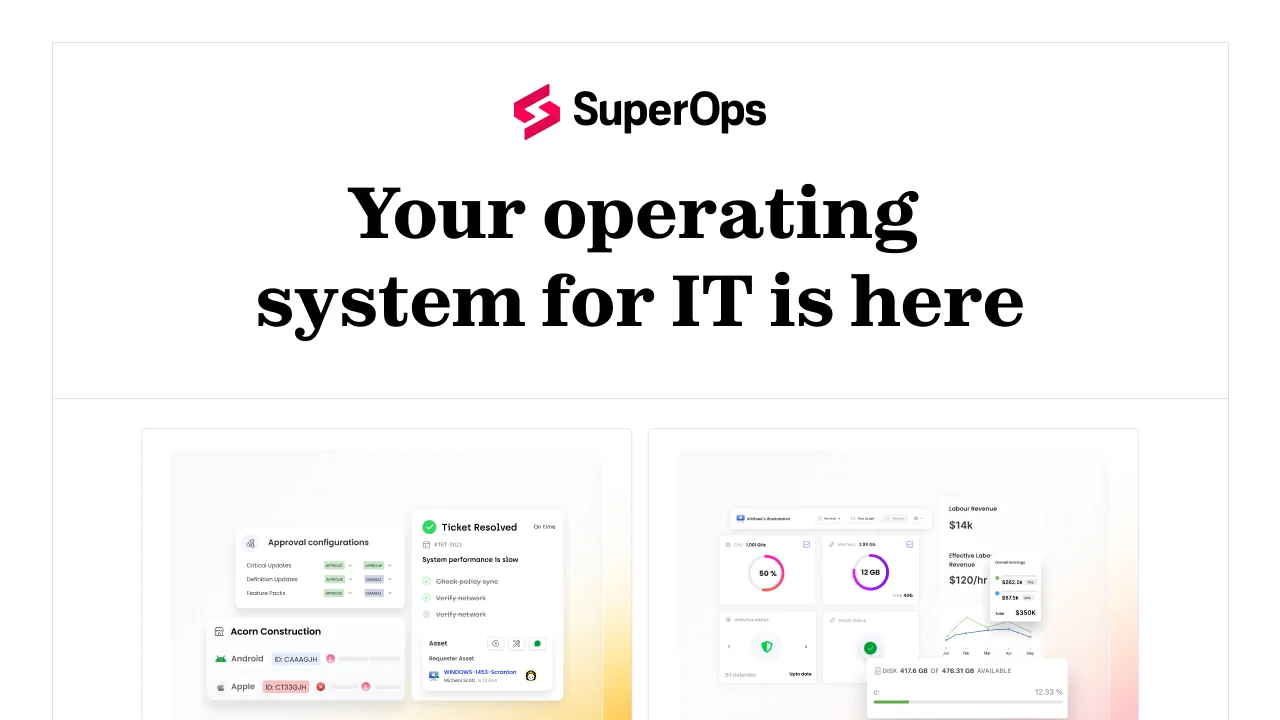
AI-native unified endpoint management with PSA and RMM
SuperOps positions itself as AI-native rather than AI-added, combining unified endpoint management with PSA and RMM in one platform. The distinction it draws is that the AI is built into the workflow rather than bolted onto an older codebase, which is a fair claim for a newer entrant competing against platforms with long histories.
Its stated argument is that data silos, not a lack of AI, are the real problem in IT operations, which shapes a product built around one dataset spanning monitoring, tickets and assets rather than integrated modules. It serves both MSPs and internal IT teams. Pricing is not published on the homepage and evaluation runs through the vendor.
Explore various Keka features, compare the pricing plans, and unlock the potential of seamless operations by selecting the right software for your business.
Features
View all SuperOps FeaturesPricing
SuperOps Caters to
Unified endpoint management RMM for larger managed estates
N-central is N-able's RMM platform, aimed at the heavier end of managed services where estates are large and automation depth matters more than simplicity. It covers monitoring, patching, automation and remote access, positioned as unified endpoint management rather than device monitoring alone.
N-able sells a second RMM alongside it, so buyers should establish which fits: N-central targets complex, larger deployments, while the lighter product suits simpler estates. Security features run through the platform, reflecting how much of an MSP's obligation is now protective rather than purely operational. A free trial is available and pricing is not published.
Explore various Keka features, compare the pricing plans, and unlock the potential of seamless operations by selecting the right software for your business.
Features
View all N-able N-central FeaturesPricing
N-able N-central Caters to
Kaseya's long-running RMM, now at VSA 10
VSA is Kaseya's remote monitoring and management product and one of the longest-established in the category, currently at version 10. Kaseya reports 40,000 customers across more than 150 countries and 17 million managed endpoints, which makes it one of the largest installed bases here.
Buyers should understand the family structure before shortlisting. Kaseya's own site describes VSA and Datto RMM as its two RMM tools, and Autotask PSA sits alongside them for service management, all under the same ownership. So several products that look like independent alternatives are in fact siblings. VSA covers endpoint monitoring, patching, automation and remote control, and integrates across the wider Kaseya portfolio. Pricing is not published; the $1B figure on the site refers to savings reported by customers, not cost.
Explore various Keka features, compare the pricing plans, and unlock the potential of seamless operations by selecting the right software for your business.
Features
View all Kaseya VSA FeaturesPricing
Kaseya VSA Caters to
Full-stack IT management priced per technician, not per device
Atera's defining characteristic is its billing unit. Almost every platform in this category charges per managed endpoint or device, so costs rise as a client estate grows. Atera charges per technician, which means an MSP can add devices without the bill moving. For a provider growing endpoint counts faster than headcount, that inverts the economics of the category.
The platform is full-stack, combining RMM, PSA, remote access, patching and ticketing rather than requiring separate products, and recent development has gone into autonomous AI agents that action routine work rather than only flagging it. It serves MSPs and internal IT teams. A free trial is available. Atera does not publish a figure per technician on its homepage, so the exact rate comes from its pricing page or sales.
Explore various Keka features, compare the pricing plans, and unlock the potential of seamless operations by selecting the right software for your business.
Features
View all Atera FeaturesPricing
Atera Caters to
Cloud RMM for MSPs, now one of two Kaseya RMM products
Datto RMM is remote monitoring and management built for managed service providers, covering endpoint monitoring, patching, automation and remote support across client estates. Its ownership is the context buyers most often miss: Datto is part of Kaseya, and Kaseya's own site describes VSA and Datto RMM together as its two RMM tools.
That matters when shortlisting, because Datto RMM, Kaseya VSA and Autotask PSA are sibling products under one parent rather than independent alternatives. Datto RMM pairs naturally with Autotask PSA for service management, and Datto's backup and continuity heritage sits alongside it. Pricing is not published and there is no self-serve trial; the route in is a demo with the sales team.
Explore various Keka features, compare the pricing plans, and unlock the potential of seamless operations by selecting the right software for your business.
Features
View all Datto RMM FeaturesPricing
Datto RMM Caters to
Unified IT operations platform for endpoint management and support
NinjaOne is a unified IT operations platform rather than a point RMM tool, bringing endpoint monitoring, patching, remote access, backup, documentation and ticketing under one console. The pitch is closing the visibility gaps that appear when those functions live in separate products with separate agents.
It serves both managed service providers looking after client estates and internal IT teams running their own, which is worth noting because much of this category is MSP-only. Documentation and ticketing sit alongside the monitoring layer, so the context an engineer needs is in the same place as the device they are fixing. A free trial is available. Pricing is not published; quotes come through the sales team, and the $100,000 figure on the site is a customer's estimated ROI rather than a cost.
Explore various Keka features, compare the pricing plans, and unlock the potential of seamless operations by selecting the right software for your business.
Features
View all NinjaOne FeaturesPricing
NinjaOne Caters to
The Remote Monitoring And Management Software market has widened quickly, which makes knowing where to start harder than the decision itself. This guide covers what it does, the capabilities worth checking, and how to compare a shortlist.
Remote Monitoring And Management Software helps teams handle the scheduling, records and invoicing that remote monitoring and work generates without stitching together general purpose tools. In practice the gain is consistency, because everyone works from the same record instead of a personal copy of it. A tool worth keeping is one that does not need replacing the moment your requirements grow.
Requirements vary, though most credible Remote Monitoring And Management Software products offer the capabilities below.
When the match is good, the outcomes people describe are:
Remote Monitoring And Management Software is used by owners and managers in remote monitoring and work, administrative staff, and the frontline teams delivering it. Company size is a weaker signal than workflow match when judging whether an option suits you.
These are the practical considerations when comparing Remote Monitoring And Management Software:
Shortlist two or three and trial each against real work rather than a prepared demo. Involve whoever will use it daily, since day to day usability decides adoption more often than the feature comparison does.
Pricing is typically monthly per user or per site, with bands tied to scale. Specialist products often cost more than general purpose alternatives, which reflects a narrower market rather than a worse deal. Work out cost at your projected volume, not your current one, and confirm the quoted tier includes what you require.
Remote Monitoring And Management Software exists to run the admin behind remote monitoring and work, from records and bookings through to billing and compliance evidence.
You can use a general tool, but you will rebuild the remote monitoring and parts by hand that Remote Monitoring And Management Software covers out of the box.
Remote Monitoring And Management Software products are often designed around a particular scale, so ask directly what size of remote monitoring and operation the typical customer runs.
Before committing to Remote Monitoring And Management Software, get specifics on what it imports from your existing remote monitoring and data and what you will re enter by hand.
Expect monthly per user or per location pricing for Remote Monitoring And Management Software, with a premium over generic tools that reflects the smaller remote monitoring and market.
Evaluate Remote Monitoring And Management Software against actual remote monitoring and work and let the eventual daily users lead that trial.