
You asked for a number and got a top-20 list. Those rankings have their place, and the most popular platforms by user count are ranked separately here.
That’s what every page answering this question does. It counts to twenty, ranks them by users, and never returns to the thing you asked.
There’s no fixed answer, and the reason is more useful than a number would be. Working out how many social media platforms are there means first deciding what you’re willing to count.
Key Takeaways
- The category has no agreed edge, so every published count picks its own.
- Platform categories stay stable even while the list churns.
- The number that changes your results is the count you’re on, not the count that exists.
Why the Count Has No Answer
It has no answer because nobody agrees where the category stops.
A social platform used to mean a profile, a friend list and a feed. Every part of that definition has since leaked into software nobody would have called social.
The Line Is Blurrier Than It Looks
Five cases decide most of the difference between one published count and another.
- Chat apps, which now carry profiles, groups, status posts and broadcast channels.
- Video platforms, where the comments and subscriptions do the social work.
- Forums and community platforms, which predate the term and match its definition.
- Games with persistent chat, voice and friend lists.
- Retail and review apps that added feeds, follows and creator posts.
Include all five and the count runs into the hundreds. Include none and you’re left with about a dozen. Both answers are defensible, which is why you keep finding both.
The Numbers That Do Hold Up
Three figures are stable enough to plan around, and one caveat applies to all of them.
More than five billion people use social media of some kind. The average user is active on six or seven platforms in a given month. Platforms with genuine global scale number in the low tens rather than the hundreds.
The caveat is that these move every year, so treat any precise figure you read as dated the moment it was published. The shape holds even when the digits change.
Your Audience Is Already on Six
The average person uses six or seven platforms in a month, and that changes the arithmetic.
It means the people you want are reachable from more than one place, so the question isn’t which single platform holds them. It’s which two of the six they use will reach them without asking you to produce three formats.
It also means the overlap is doing work you don’t have to. Somebody who follows you on one platform and sees you mentioned on another forms an impression from both, and you only paid for one.
Being present everywhere is a way of buying reach you were going to get anyway.
Categories Outlast the Count
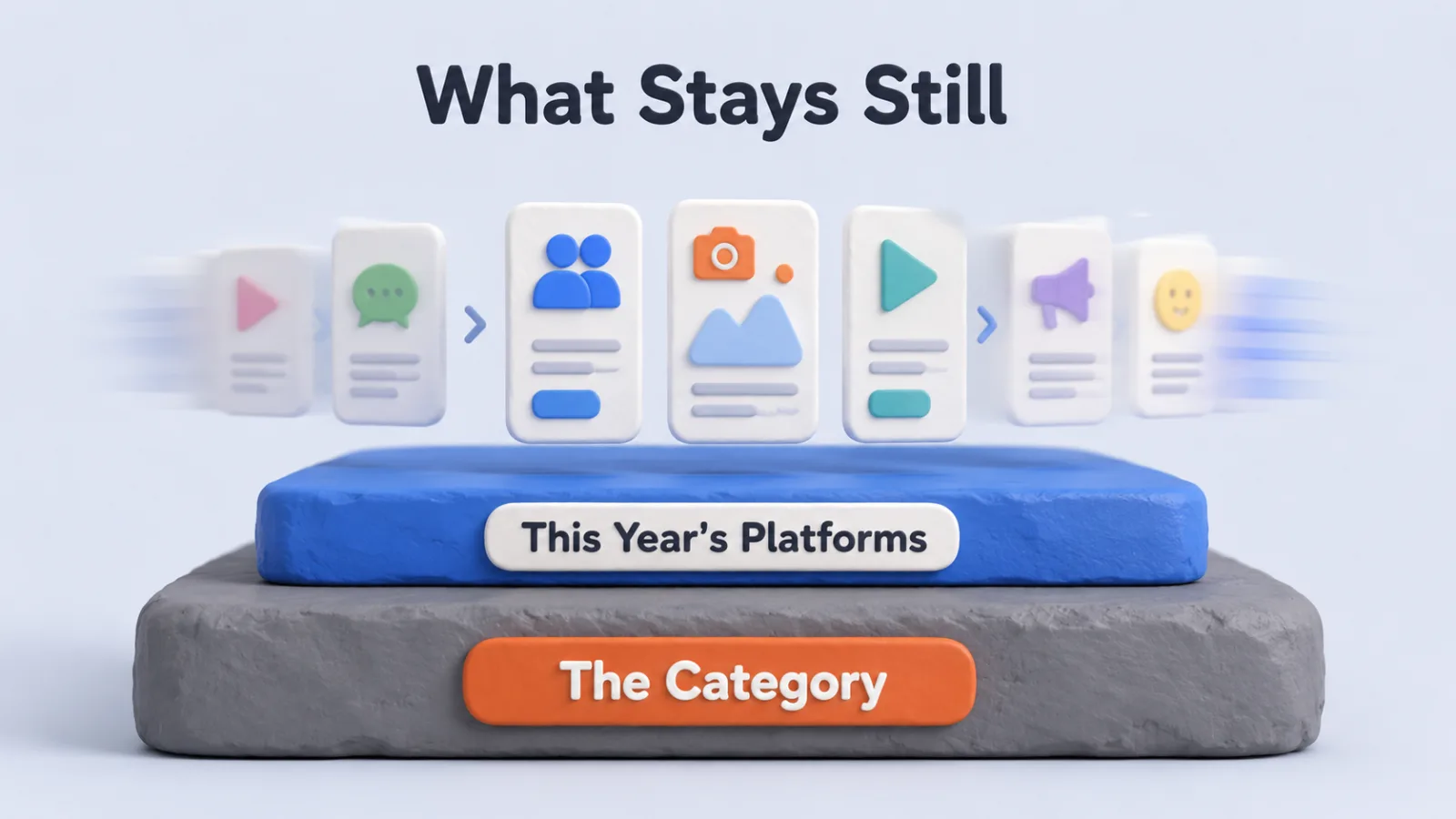
Individual platforms come and go. The categories they fall into have barely changed in fifteen years.
| Category | What it’s built around |
|---|---|
| Networks | Profiles and a feed of people you know |
| Messaging | Private and group conversation |
| Media sharing | Photos and short video as the unit |
| Long video | Watching, subscribing and commenting |
| Community | Topics rather than people |
| Professional | Work identity and industry conversation |
| Discovery | Saving and finding things rather than people |
| Live and audio | Real-time presence |
A new platform almost always occupies an existing category rather than inventing one. Knowing the eight tells you more than memorizing this year’s top twenty.
How to Read That Table
To read it, collapse the eight into three questions about what a platform organizes.
Networks, messaging and media sharing organize around people you already know or choose to follow. Reach there compounds slowly and holds, because the audience is a list you built.
Community and discovery organize around subjects instead. Nobody needs to know you for a post to travel, which makes them the fastest place to start and the hardest place to keep attention.
Professional, long video and live organize around a demonstrated capability. They reward depth over frequency, and they suit anyone whose offer takes more than a caption to explain.
The grouping survives the churn because it describes what a platform is for. Facebook, Instagram and the messaging apps have sat in the first group for over a decade. Reddit and Pinterest have held the second, LinkedIn and YouTube the third, through every ranking reshuffle in between.
The Method Behind Published Counts
The disagreement between sources is a method problem rather than a research one.
Some counts come from app store categories, which means a platform is social if its publisher filed it that way. Some come from traffic panels that only see the web, missing anything used almost entirely in an app.
Most user numbers are self-reported by the platform, using a definition of an active user the platform chose and can revise. Two companies reporting the same figure are frequently measuring different things.
None of that is dishonest. It does mean a count carries the assumptions of whoever produced it, and those assumptions are rarely printed beside the number.
Regional Platforms Change the Answer
Published lists lean heavily toward what the English-speaking web uses.
WeChat dominates in China and carries payments, government services and commerce alongside messaging. KakaoTalk holds a comparable position in South Korea, LINE in Japan, and VK across parts of eastern Europe.
Each would restructure a global ranking if counted consistently, and some exceed platforms that appear on every Western top-twenty list. If your audience sits outside your own market, the question stops being a global count and becomes which ones exist where they are.
The Number That Decides Your Results
Here’s the count worth having: the number you can sustain.
For most businesses that’s two or three. Each one is a separate format, a separate posting rhythm and a separate audience expectation, and the effort doesn’t divide neatly across them.
An abandoned account is worse than no account. Somebody who finds a profile whose last post is eleven months old learns something about you that no amount of posting elsewhere corrects.
Running more than a couple properly is where scheduling and inbox tooling stops being optional, and social media management tools exist for precisely that gap.
What Each Extra One Costs
The cost is not the posting, which is the part people budget for.
It’s adapting the work to a format that platform rewards. Then answering the replies and messages that follow, and learning a separate set of numbers well enough to know whether any of it worked.
Those three compound rather than add. Two platforms run properly take less effort than three run badly, and produce more.
How to Choose Yours
Start with where your audience already spends time, not where you’d enjoy posting.
Finding that out is a research task rather than a guess, and monitoring what’s already being said about your category is the fastest route to it. That’s the practical use of social media listening before you commit to a platform.
Then check the format against what you can sustain. A platform that rewards daily short video is a different commitment from one that rewards a weekly written post.
Picking the one you can keep up with beats picking the one with the bigger audience. Consistency is the variable you control.
Last, consider where the decision happens. Some categories are researched on one platform and bought after a conversation on another. That second one is where support and sales now live, through social media customer support tools.
Signals a Platform Deserves Your Time
Four checks separate a platform worth committing to from one that merely has users.
The first is whether your audience is already there, which you confirm by finding them rather than by reading a chart. The second is whether new accounts still get discovered.
A platform that has closed off reach to newcomers is a different product from the one written about three years ago, whatever its user count still says.
The third is whether the format matches something you can produce without dreading it. The fourth is whether the company behind it looks stable, since a platform in financial trouble changes its rules in ways that break whatever you built.
A platform failing two of the four is somewhere to claim a name and leave.
Why the List Keeps Changing
They launch constantly and most of them close.
The survivors then converge. Short video, stories, live streams and direct messages started on different platforms and now appear on nearly all of them. That makes the platforms harder to tell apart, and the count harder to justify.
That convergence is why a ranked list goes stale so fast. The ordering shifts, the names change, and the categories underneath sit still.
The Day a Platform Shuts Down
Closures are ordinary, and the damage depends entirely on what you kept.
An audience that exists only as follower counts on somebody else’s platform disappears with it. The same audience, with even a fraction converted to an email list or a community you host, survives intact and moves with you.
That’s the argument for treating every platform as rented rather than owned. Post there, build there, and route the people who respond toward something you control.
Export what you can while the platform is healthy. Data export tools tend to degrade in the months before a shutdown, which is exactly when everybody tries to use them at once.
What Counts as Social Is Still Moving
The edge keeps moving outward rather than settling.
Commerce apps added creator feeds. Fitness and language apps added friends and streaks. AI chat apps added personas people talk to daily, and whether those count is a question nobody has answered yet.
Expect published counts to keep rising for that reason alone, without a single new network being built.
Questions People Ask About Social Media Platforms
How many social media platforms are there in total?
No exact figure exists, and any page giving you one has quietly chosen a definition. Counts above a hundred are common once regional networks and messaging apps are included, while the platforms with real scale number closer to fifteen.
Should a small business be on every platform?
No. Two or three, chosen deliberately and posted to consistently, beat a presence everywhere. A dormant account on a fourth platform costs more credibility than the reach it never delivered.
Does a messaging app count as social media?
It depends who is counting, and that is the whole problem. Messaging apps carry profiles, groups, status posts and channels, which is most of what defined a social network before anyone drew the line.
Which platform has the most users?
Facebook still reports the largest global user base. The more useful question is which one holds the people you want, because a smaller platform where your audience is beats a larger one where it is not.
Should you join new platforms as they launch?
Rarely, because most close within a few years. Claiming your name costs minutes and is worth doing, while building an audience there is a bet you place at most once or twice.
Count What You Can Keep Up With
The number you were looking for doesn’t exist, and the one that matters is small.
Pick the categories your audience lives in, choose one platform from two of them, and post there until it’s a habit rather than a project.
Whether the total is forty or four hundred changes nothing about that decision. It was never the number you needed.
Add SocialAtoZ as a preferred source
See us more often in your Google results.