
Most complete listing

o9 Solutions
Answers the most buyer questions in this category.
8 tools compared
Supply Chain Management software is software that helps you plan and manage transportation, shipments, and the movement of goods across the supply chain. Use the list below to compare the top Supply Chain Management software options by features, pricing, and reviews, and shortlist the ones that match your workflow and budget.
Picked from the Supply Chain Management software records below, by what each one is strongest at.
Most complete listing
Answers the most buyer questions in this category.
Free trial

Try it before you buy.
Compare the 8 most relevant Supply Chain Management software options on price, free trial and deployment.
| Product | Starting price | Free trial | Free plan | API | Deployment |
|---|---|---|---|---|---|
| o9 Solutions A single planning model spanning demand, supply, revenue and merchandising | Not published | – | – | ✓ | Cloud Based, SaaS |
 SAP Integrated Business Planning Supply chain planning on SAP HANA, native to the system… | Not published | – | – | ✓ | Cloud Based, SaaS |
| Oracle SCM Cloud A complete supply chain and manufacturing suite inside the Fusion… | Not published | ✓ | – | ✓ | Cloud Based, SaaS |
 Manhattan Associates Warehouse, transport and store systems built on one platform rather… | Not published | – | – | ✓ | Cloud Based, On Premise, SaaS |
 E2open A connected network reaching past your own suppliers to theirs | Not published | – | – | ✓ | Cloud Based, SaaS |
 SAP Extended Warehouse Management: What It Does and Who It Fits Warehouse management software from SAP for complex, high-volume warehouse and… | Not published | – | – | ✓ | Cloud Based, On Premises, Hybrid |
| Portcast: What the Freight Visibility Platform Does and Who It Fits Supply chain visibility software that predicts shipment delays and controls… | Not published | – | – | – | Cloud Based |
| Portcast: What the Freight Visibility Platform Does and Who It Fits Supply chain visibility software that predicts shipment delays and controls… | Not published | – | – | – | Cloud Based |
A single planning model spanning demand, supply, revenue and merchandising
o9 Solutions builds the o9 Digital Brain, an AI-powered enterprise planning and execution platform covering demand planning, integrated business planning, supply chain planning and analytics, revenue growth management, supplier relationship management, merchandise planning and sustainability reporting across more than 30 industries.
Extending planning into revenue growth management and merchandising is the scope decision that distinguishes o9, and it follows a real logic. The commercial team's promotion calendar and the supply team's production plan are the same problem viewed from two ends, and when they live in separate systems a promotion gets approved that the factory cannot supply. Holding both in one model makes that contradiction visible before it is agreed rather than after.
The value claims are stated in an unusually commercial form, with multiple annual value cases above 100 million dollars and an increasing number of transformations above a billion. Those are customer outcome figures rather than prices, and they signal the size of organisation o9 sells to more clearly than a feature list does.
Post-Game Analysis is a newer capability and a sensible one: reviewing what a plan predicted against what actually happened is how forecasting improves, and it is almost always the step a busy planning team drops. Multi-echelon inventory optimisation, machine learning forecasting, a control tower, supplier collaboration and assortment planning complete the o9 Solutions platform, with virtual guided tours published in place of screenshots. Rates are not published.
Explore various Keka features, compare the pricing plans, and unlock the potential of seamless operations by selecting the right software for your business.
Features
View all o9 Solutions FeaturesPricing
o9 Solutions Caters to
Supply chain planning on SAP HANA, native to the system of record
SAP Integrated Business Planning is a cloud supply chain planning solution powered by SAP HANA, combining sales and operations planning, forecasting and demand, response and supply, demand-driven replenishment and inventory planning with analytics, what-if simulation and alerting.
Native integration with the SAP Supply Chain Control Tower is the practical argument, and for an SAP shop it is often decisive. Planning depends entirely on the accuracy of master data, open orders and inventory positions, all of which live in the enterprise resource planning system. Every third-party planning tool has to build and maintain that integration, and the reconciliation problems it creates are a permanent tax. A planning solution from the same vendor removes that particular argument, whatever else it costs.
Being built on SAP HANA has a specific consequence beyond branding. In-memory processing is what allows SAP Integrated Business Planning to run what-if simulation interactively rather than as a batch request, and a planner who can test a scenario in the meeting where the question is asked uses simulation far more often than one who has to schedule a run.
Demand-driven replenishment is worth calling out as a distinct methodology rather than a feature. It positions buffers at decoupling points and replenishes against actual consumption instead of forecast, which is a genuinely different operating model for supply chains where forecast accuracy is poor and volatility is high. Machine learning algorithms support the forecasting side, and the solution is positioned around building a risk-resilient supply chain. Rates are not published.
Explore various Keka features, compare the pricing plans, and unlock the potential of seamless operations by selecting the right software for your business.
Pricing
SAP Integrated Business Planning Caters to
A complete supply chain and manufacturing suite inside the Fusion applications family
Oracle SCM Cloud, sold as Oracle Fusion Cloud Supply Chain and Manufacturing, is a complete suite of supply chain applications spanning planning, production and delivery, with built-in artificial intelligence and agentic applications throughout.
Being part of the Fusion applications family is the structural fact that matters most in an evaluation. Supply chain, enterprise resource planning, human capital and customer experience share a single data model rather than being integrated products, which means a change to an item master or a cost centre propagates without a reconciliation job. Organisations that have lived through integrating best-of-breed applications know exactly what that is worth, and those that prefer specialist depth in each area know what it costs.
Suite completeness is the second argument and it is a real one for large manufacturers. A supply chain involves planning, procurement, manufacturing execution, maintenance, logistics, order management and product lifecycle management, and every boundary between two vendors is a place where data has to be mapped and kept current. Covering all of it from one supplier removes those boundaries in exchange for the concentration risk of a single vendor.
The agentic positioning is current rather than aspirational, with Oracle describing applications that plan, produce and deliver rather than only report, and connecting teams so work is executed across the chain as conditions change. Grupo Bimbo is published as a customer improving logistics visibility, emissions and product freshness. Rates are not published on the product page, with a corporate pricing route linked separately.
Explore various Keka features, compare the pricing plans, and unlock the potential of seamless operations by selecting the right software for your business.
Features
View all Oracle SCM Cloud FeaturesPricing
Oracle SCM Cloud Caters to
Warehouse, transport and store systems built on one platform rather than acquired
Manhattan Associates builds retail and supply chain software across three areas: unified commerce covering point of sale and order management, supply chain execution covering warehouse, labour, yard and transportation management, and supply chain planning covering forecasting, allocation and replenishment.
Unified commerce and supply chain execution sitting on one platform is what the product is actually about. The commitment a retailer makes at checkout, promising an item by a date, is only credible if the system making it knows what the warehouse holds, what is in transit and what the store has on its shelves. Order management and warehouse management supplied by different vendors communicate through an integration that is periodically out of date, which is exactly how a customer gets promised something that is not there.
Labour management appearing beside warehouse management is a detail worth noticing. Warehouse cost is overwhelmingly people rather than technology, and the engineered standards, task interleaving and performance measurement Manhattan Associates builds in are where the return on a warehouse system usually comes from, however much attention the automation gets.
ActiveAgents and Agent Foundry are the current AI layer, letting agents act inside the operational systems rather than alongside them, with ProActive and ActivePlatform underneath. The named products run consistently as ActiveStore, ActiveOrder, ActiveWarehouse, ActiveTransportation and ActivePlanning, which reflects a platform built as one rather than assembled by acquisition. Manhattan operates across the Americas, Europe and Asia with localised sites in a dozen countries. Rates are not published.
Explore various Keka features, compare the pricing plans, and unlock the potential of seamless operations by selecting the right software for your business.
Pricing
Manhattan Associates Caters to
A connected network reaching past your own suppliers to theirs
E2open is a connected supply chain platform organised into five suites, covering channel, planning, global trade, logistics and supply, with control tower, risk and resilience, artificial intelligence and managed services layered across them.
The channel suite is the unusual one and it addresses a blind spot most supply chain software ignores entirely. A manufacturer selling through distributors and resellers cannot see what actually sold to the end customer, only what shipped into the channel, so it is planning production against its own inventory movements rather than against demand. Collaboration across the channel makes sell-through visible, which is the difference between forecasting and guessing for anyone with an indirect route to market.
Global trade being a first-class suite reflects how much administrative weight cross-border commerce now carries. Filing, classification, restricted party screening and duty determination are unforgiving work where the cost of non-compliance is penalties and seized shipments rather than inefficiency, and the volume of it scales with every additional market entered, which is why E2open treats it as a suite rather than a module.
Logistics covers planning, executing and tracking multimode shipments on one platform, with transportation procurement and Logistics as a Service offered alongside, and direct procurement and channel managed services available where a customer would rather buy the outcome than the software. Industry coverage runs across aerospace and defence, apparel and footwear, automotive, consumer packaged goods, food and beverage, freight carriers, high tech, industrial manufacturing, oil, gas and chemicals, pharmaceutical, retail and semiconductor. Rates are not published.
Explore various Keka features, compare the pricing plans, and unlock the potential of seamless operations by selecting the right software for your business.
Features
View all E2open FeaturesPricing
E2open Caters to
Warehouse management software from SAP for complex, high-volume warehouse and distribution operations
SAP Extended Warehouse Management (SAP EWM) is a warehouse management system that controls stock and tasks at the storage bin level, from receiving through putaway, picking and shipping. It connects to SAP ERP or SAP S/4HANA for orders and inventory. It suits large, complex operations more than simple stockrooms.
SAP EWM runs a warehouse by turning each delivery and order into warehouse tasks that staff or equipment carry out, with every move recorded against a specific bin. The ERP owns the order. EWM owns what happens on the floor.
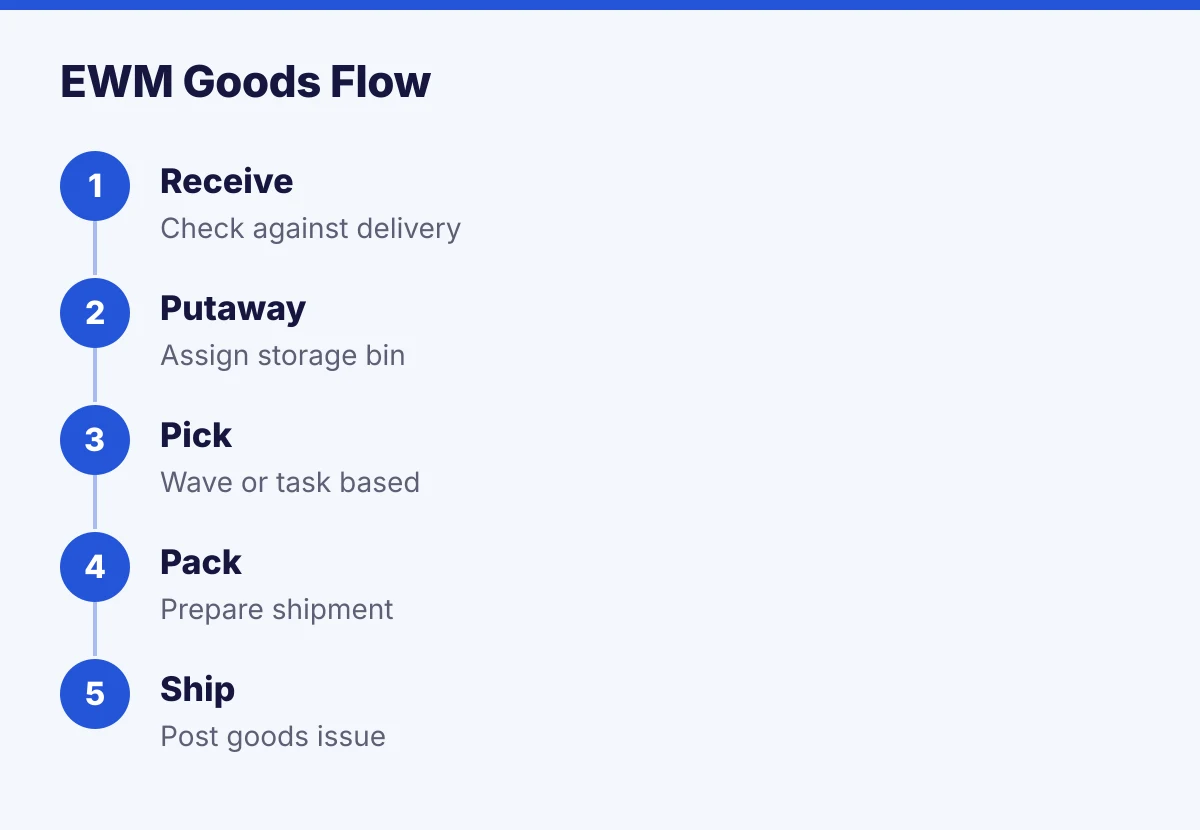
Inbound work starts with an expected delivery from the ERP. Goods are received, checked and sent to a bin chosen by putaway rules.
Outbound work reverses it. EWM groups orders into waves or task queues, directs pickers by RF device, supports packing, and posts the goods issue back to the ERP.
Two layers sit on top. A warehouse monitor shows open tasks and stock status. Resource management assigns work to people and equipment. EWM also offers interfaces for material flow systems such as conveyors and automated storage.
SAP EWM fits enterprises that already run SAP and have warehouses where bin-level control, high volumes or automation justify a heavy system. The closer your ERP is to SAP, the stronger the case.
Shortlist it when:
If you're also planning demand and supply, look at SAP Integrated Business Planning. For the data layer behind warehouse reporting, SAP HANA is the database SAP's newer products run on.
SAP EWM is the wrong tool for small warehouses, teams without SAP skills, and companies not on SAP. Implementation takes configuration, testing and trained staff, and that cost only pays back with real complexity.
Skip it when:
Companies still using the older warehouse module inside SAP ERP should confirm SAP's current support timeline with SAP before deciding to stay or move.
SAP offers EWM in more than one deployment form, including embedded in SAP S/4HANA and as a separate system. Check SAP's official documentation for the current editions and cloud options. The choice affects upgrades, hardware and how tightly it ties to the ERP.
Pricing isn't published on SAP's product page. Expect a quote driven by edition, deployment and scope, not a listed per-user rate. Ask whether licenses are by user, volume or bundle, and what implementation partners typically add.
Before you commit, put these questions to SAP or a partner:
Request a demo using your own process, not a generic script. A pick wave with your real order profile will show more than any slide deck.
Read SAP Extended Warehouse Management: What It Does and Who It Fits Reviews
Explore various Keka features, compare the pricing plans, and unlock the potential of seamless operations by selecting the right software for your business.
Pricing
SAP Extended Warehouse Management: What It Does and Who It Fits Caters to
Supply chain visibility software that predicts shipment delays and controls freight costs
Portcast is a supply chain visibility platform that pairs shipment tracking with freight spend control. It connects shipment milestones to orders, contracts and invoices, then uses AI to flag delays and cost risks. It suits enterprise operations and finance teams moving large global freight volumes.
Portcast links tracking data to money. Most visibility tools stop at "where is the container." Portcast, according to its website, also ties that data to contracts and invoices, so a late vessel shows up as a cost and service-level problem, not only a new date.
The platform presents three views: an operations command center, freight audit and spend control, and planning and performance optimization. Each team sees the same shipment data through its own workflow.
Portcast moves from data to insight to decision to action. Shipment milestones, orders, contracts and invoices feed one place. AI then surfaces ETA changes, exceptions and cost risks, and recommends what to do.
Actions run with human approval, and outcomes feed back into future recommendations. That's a sensible design: you keep control, and the system learns from your calls.
The vendor says its network covers 12,000+ ports, 5,000+ vessels and 220+ carriers and NVOCCs (non-vessel-operating common carriers). Those are Portcast's own figures, so ask for coverage on your specific lanes.
Portcast fits enterprise shippers and logistics teams where delays and invoice errors cost real money. Three situations stand out:
Look elsewhere if you ship a few containers a month. A platform built around contract and invoice matching assumes volume and data worth connecting. Also check mode coverage: the site's strongest evidence is for ocean freight.
Pricing isn't published, and the call to action is "Book a demo." Use that call to test the claims that matter to you.
Treat the vendor's outcome figures as claims until a reference customer confirms them. For other options, compare against the alternatives listed on this page, or browse our supply chain software categories.
Read Portcast: What the Freight Visibility Platform Does and Who It Fits Reviews
Explore various Keka features, compare the pricing plans, and unlock the potential of seamless operations by selecting the right software for your business.
Pricing
Portcast: What the Freight Visibility Platform Does and Who It Fits Caters to
Most Supply Chain Management software options look alike on a feature grid, so the useful comparison is how each handles your actual process. Below are the core capabilities, who benefits most, typical pricing, and what to test before committing.
Supply Chain Management software helps teams plan and manage the movement, storage, and delivery of goods. The real return is usually less rekeying and fewer version disputes rather than any single headline feature. The practical difference shows up in the awkward cases rather than the standard ones.
Which of these matter depends on your process, but they are worth checking against any Supply Chain Management software shortlist.
Organisations running Supply Chain Management software that genuinely fits their workflow tend to see:
Supply Chain Management software is used by dispatchers, fleet and transport managers, warehouse teams, and delivery drivers. What matters more than headcount is whether the product’s assumptions about your process are correct.
When comparing Supply Chain Management software, weigh these factors:
Narrow to a few options and test on your own data. The eventual daily users should run the trial, because their friction determines whether a rollout sticks.
Usually per vehicle, per driver, or per delivery each month. High volume operations often negotiate per delivery rates. Budget against where you expect to be, and read carefully which capabilities are gated above the tier you are quoted.
Supply Chain Management software handles the day to day paperwork of logistics and delivery work, keeping customer records, scheduling and payment in one place.
General tools need adapting to logistics and delivery workflows and rarely cover the terminology or compliance involved, which is what Supply Chain Management software is built around.
Scale assumptions vary widely across Supply Chain Management software, so ask any vendor what a typical logistics and delivery customer of theirs actually looks like.
Supply Chain Management software vendors differ on migration, so confirm the import path for your current logistics and delivery records rather than assuming it is included.
Supply Chain Management software pricing is commonly per seat or per site and tiered by scale, so budget above what a general purpose logistics and delivery tool would cost.
Trial Supply Chain Management software against real logistics and delivery work rather than a vendor demo, and involve the staff who will use it daily.