

OpenTelemetry
VerifiedThe vendor-neutral instrumentation standard the whole category now builds on
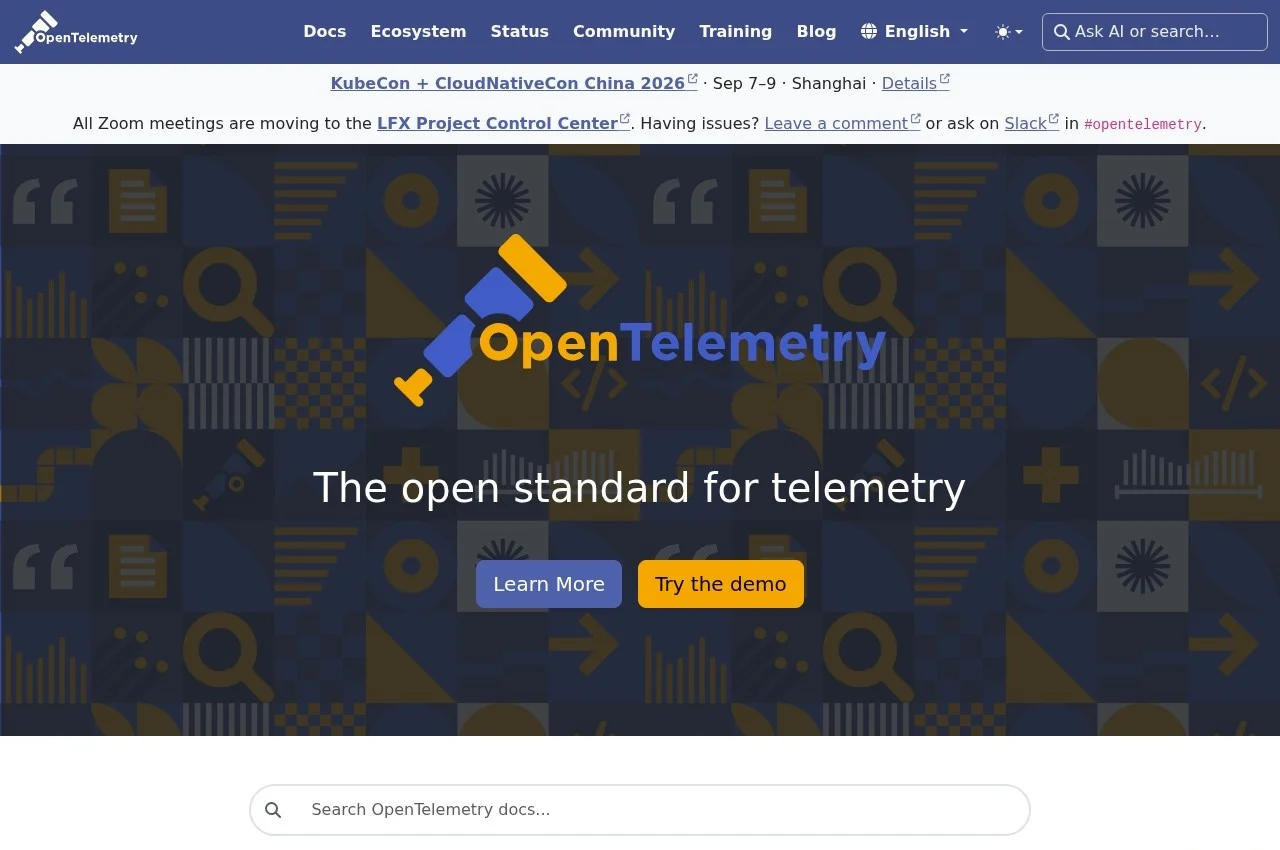 See all screenshots
- Deployment On Premise, Cloud Based
- Starting price Free
- Free trial Available
- Best for Freelancers, Small Business, Medium Business
What is OpenTelemetry?
OpenTelemetry is an open source observability framework providing a vendor-neutral way to instrument, generate, collect and export telemetry, covering traces, metrics, logs, baggage and profiles as distinct signals.
Being a standard rather than a product is the whole point, and it changed the economics of this market. Before it, instrumenting an application meant embedding a specific vendor's agent throughout the codebase, which made changing observability supplier a rewriting project rather than a procurement decision. Instrumenting once against OpenTelemetry and pointing the output wherever you like turns that back into a commercial choice, which is why nearly every vendor in the category now advertises support for it.
Zero-code instrumentation is the practical on-ramp and it deserves emphasis. Adding observability to an existing service without modifying it, by attaching an agent that instruments common libraries automatically, means a team can get traces out of software nobody wants to touch. Code-based instrumentation then adds the application-specific detail where it matters.
Semantic conventions are the quietly important part: agreeing what an attribute for an HTTP method or a database system is called means telemetry from different languages and libraries can be queried together, which is the difference between a standard and a wire format. The Collector receives, processes and exports data with sampling including tail-based sampling, and the project publishes a full demo architecture of instrumented microservices. Documentation is available in a dozen languages. OpenTelemetry is free and open source under the Cloud Native Computing Foundation.
Key Features of OpenTelemetry
- Vendor-neutral telemetry standard
- Traces, metrics and logs signals
- Baggage and profiles support
- Zero-code automatic instrumentation
- Code-based instrumentation APIs
- Semantic conventions for attributes
- OpenTelemetry Collector
- Tail-based sampling
- Context propagation across services
- Multiple language distributions
- Reference demo architecture
- Documentation in a dozen languages
OpenTelemetry Pricing
Free and open source
Free
Free under the Cloud Native Computing Foundation with no licence cost. Expenditure arises only from the observability backend the telemetry is exported to.
OpenTelemetry Specifications
- Deployment
- On Premise
- Cloud Based
- Desktop
- Linux
- Windows
- Mac
- Web App
- Mobile
- iOS
- Android
- Built for
- Freelancers
- Small Business
- Medium Business
- Large Enterprise
- Support
- Knowledge Base
- Public API
- Yes
- Free trial
- Yes
- Free plan
- No
- Runs in browser
- No
- Customisable
- No
- Website
- opentelemetry.io
OpenTelemetry Screenshots
OpenTelemetry Comparisons



Used OpenTelemetry? Write the first review.
OpenTelemetry FAQs
Alternatives to OpenTelemetry
Other Observability Software recorded on the same fields.