
Honeycomb
VerifiedHigh-cardinality tracing plus purpose-built observability for AI agents
 See all screenshots
- Deployment Cloud Based, SaaS
- Starting price $0.10
- Free trial Available
- Best for Small Business, Medium Business, Large Enterprise
What is Honeycomb?
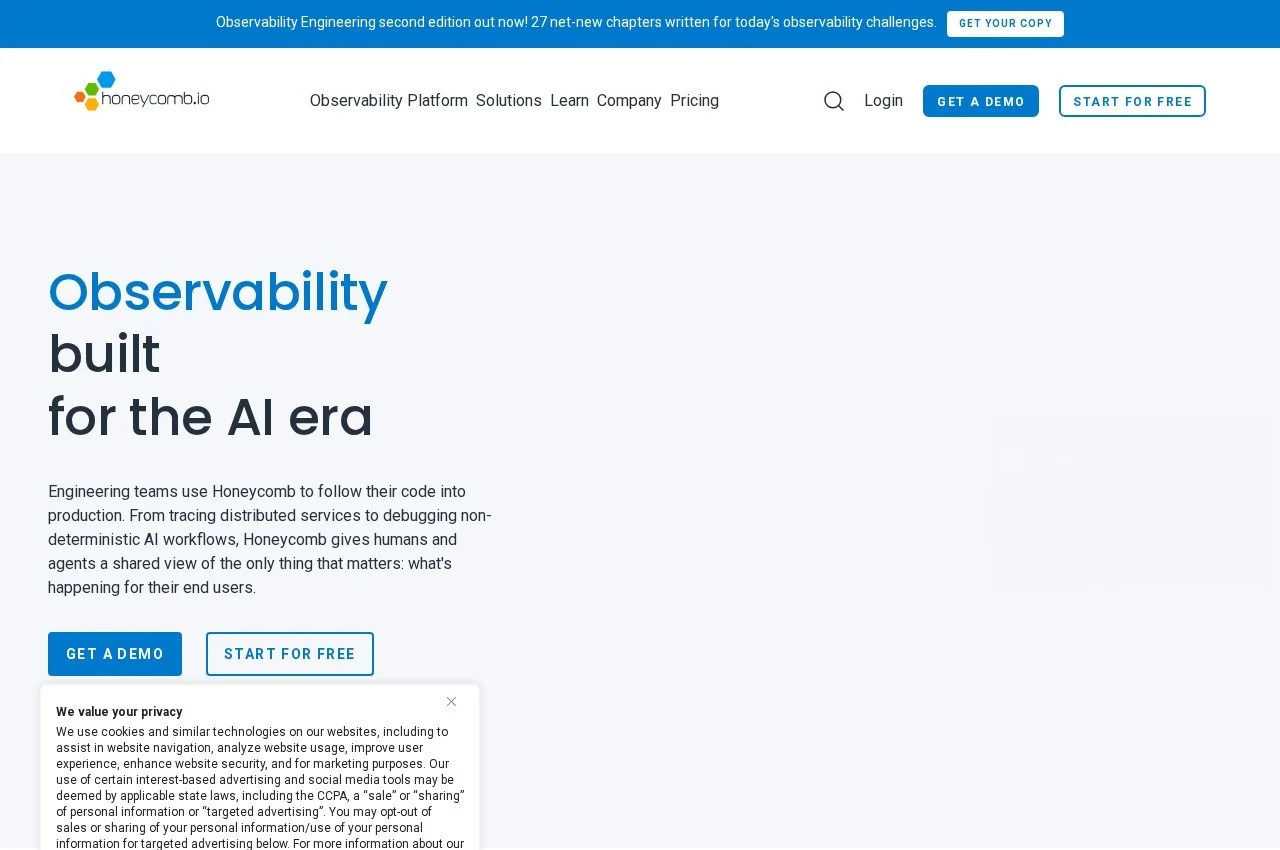
Honeycomb is an observability platform built on distributed tracing, combining log analytics, time series metrics, frontend observability and a telemetry pipeline, with a distinct product line for observing AI agents and large language model applications.
BubbleUp is the capability Honeycomb is best known for and it inverts how debugging usually works. The normal process is to form a hypothesis about what the slow or failing requests have in common and then write a query to test it, which only finds causes someone already suspected. BubbleUp takes a selected set of anomalous events and automatically compares every dimension against the baseline, surfacing what actually distinguishes them. That finds the causes nobody thought to look for, which are the ones that take days.
The AI agent observability line is genuinely purpose-built rather than relabelled tracing. Agent Timeline, LLM Observability, an Agentic Intelligence Canvas, Model Context Protocol support and MCP Skills address a workload where a single user request fans out into many model calls and tool invocations, and where the failure is often a wrong answer rather than an error code. Conventional monitoring has nothing to say about that.
Service level objectives, a service map, anomaly detection and OpenTelemetry support round out the platform, with private cloud deployment available. Honeycomb's team also wrote Observability Engineering, now in a second edition with 27 new chapters. The free tier covers up to 20 million events and 100 million time series data points, Pro starts at 150 dollars a month for 50 million events scaling to 750 million, and the telemetry pipeline starts at 0.10 dollars per gigabyte.
Key Features of Honeycomb
- Distributed tracing foundation
- BubbleUp automatic anomaly comparison
- High-cardinality query support
- Log analytics
- Time series metrics
- Frontend observability
- Telemetry pipeline with per-GB pricing
- AI agent observability
- LLM observability and agent timeline
- Model Context Protocol support
- Service level objectives and service map
- Private cloud deployment
Honeycomb Pricing
Free
$0.10
The free tier covers up to 20 million events and 100 million time series data points. The separate telemetry pipeline starts at 0.10 dollars per gigabyte.
Pro
$150
Starting rate for 50 million events, scaling to 750 million events a month and 3.75 billion metrics data points, including all features and custom fields.
Honeycomb Specifications
- Deployment
- Cloud Based
- SaaS
- Desktop
- Web App
- Built for
- Small Business
- Medium Business
- Large Enterprise
- Support
- Knowledge Base
- Public API
- Yes
- Free trial
- Yes
- Free plan
- No
- Runs in browser
- No
- Customisable
- No
- Website
- honeycomb.io
Honeycomb Videos
Honeycomb Screenshots
Honeycomb Comparisons



Used Honeycomb? Write the first review.
Honeycomb FAQs
Alternatives to Honeycomb
Other Observability Software recorded on the same fields.