

Refiner
VerifiedIn-app and mobile survey platform for product teams, with segmentation and AI insights
 See all screenshots
 - Deployment Cloud Based
- Starting price Quoted on request
- Free trial Available
- Best for Small Business, Medium Business, Large Enterprise
What is Refiner?
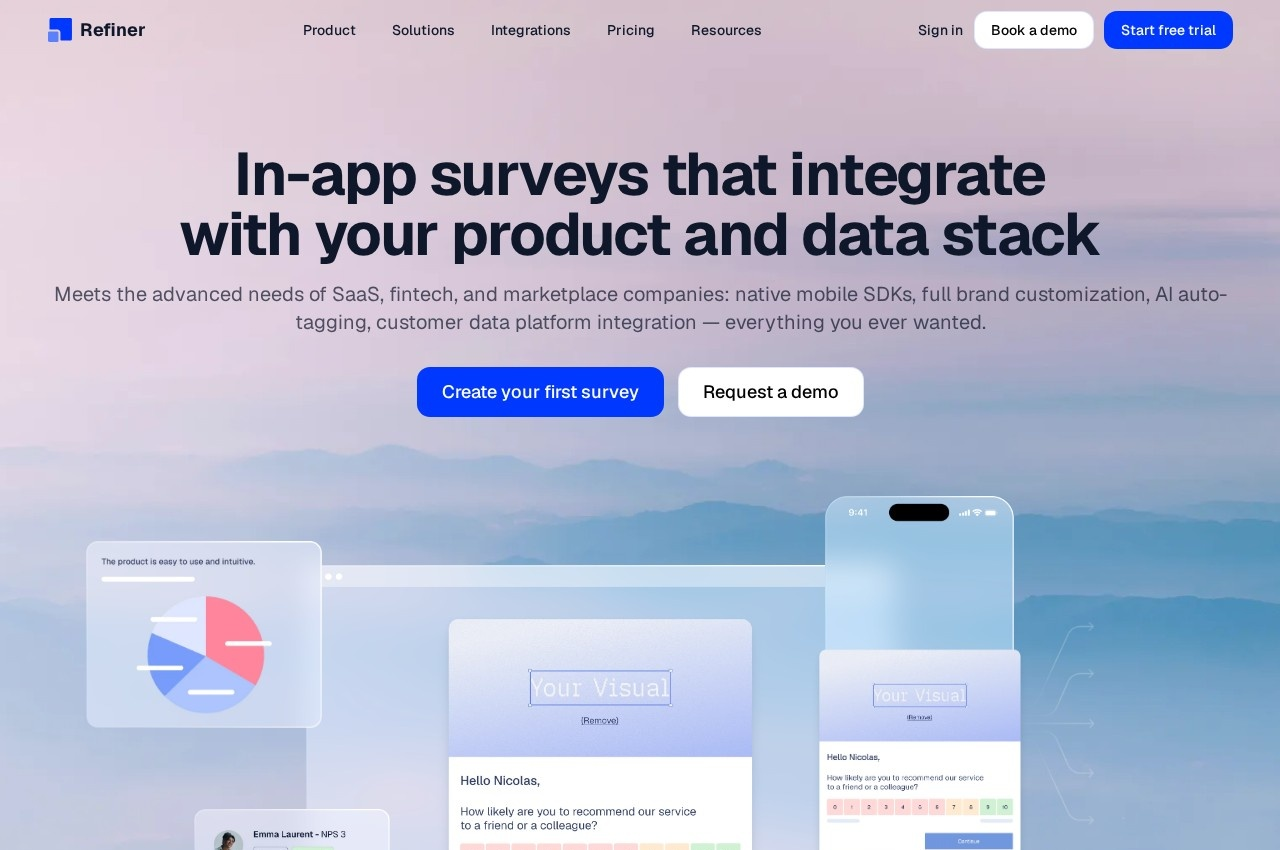
Refiner is a survey platform aimed at software product teams, covering in-app, mobile, website, email and link surveys plus in-app messages, with a survey builder, on-brand design, a reporting dashboard, AI insights, user segmentation, team alerts and integrations.
The emphasis on in-app surveys is the defining characteristic and it produces a materially different result from email surveying.
An emailed survey reaches people who open marketing email, which is a self-selecting group weighted toward the engaged and the unusually annoyed. An in-app survey reaches people while they are using the product, which is both a more representative sample and a more accurate moment. Somebody asked about a feature while they are using it gives a better answer than the same person asked a week later by email, when they are recalling an impression rather than reporting an experience.
User segmentation is what makes that targeting precise. The value of an in-app survey comes from asking the right users at the right point, such as those who tried a feature twice and stopped, or those who reached a limit. Surveying everyone equally wastes the main advantage of being inside the product.
Published use cases cover Net Promoter Score, Customer Effort Score, customer satisfaction, product market fit and user research, and product market fit surveying is worth noting because it is a specific methodology asking how disappointed users would be if the product disappeared, which is a genuinely different question from satisfaction.
Team alerts through Slack and email address the failure mode where responses accumulate in a dashboard nobody opens. Feedback that reaches the team where they already work gets acted on.
The product is positioned for software as a service, fintech and marketplace businesses, and for product, customer success, marketing and growth teams.
Pricing is not published on the captured page, though a pricing page and a free trial are offered.
Key Features of Refiner
- In-app surveys
- Mobile surveys
- Website and email surveys
- Survey links and in-app messages
- Survey templates and on-brand design
- User segmentation and targeting
- Reporting dashboard
- AI insights across responses
- Team alerts via Slack and email
- Product market fit surveying
- Integrations with the product stack
- Free trial
Refiner Pricing
Quoted
Quoted on request
A pricing page and free trial are published. Normally priced on tracked users or responses per month.
Refiner Specifications
- Deployment
- Cloud Based
- Desktop
- Web App
- Built for
- Small Business
- Medium Business
- Large Enterprise
- Support
- Public API
- Yes
- Free trial
- Yes
- Free plan
- No
- Runs in browser
- No
- Customisable
- No
- Website
- refiner.io
Refiner Screenshots
Refiner Comparisons



Refiner Reviews
No reviews yet
Used Refiner? Share your experience and help other buyers decide.
Refiner FAQs
Alternatives to Refiner
Other NPS Software recorded on the same fields.