
Survicate
VerifiedFeedback platform unifying surveys across every channel, from $114 a month
 See all screenshots
 - Deployment Cloud Based
- Starting price $114
- Free trial Available
- Best for Small Business, Medium Business, Large Enterprise
What is Survicate?
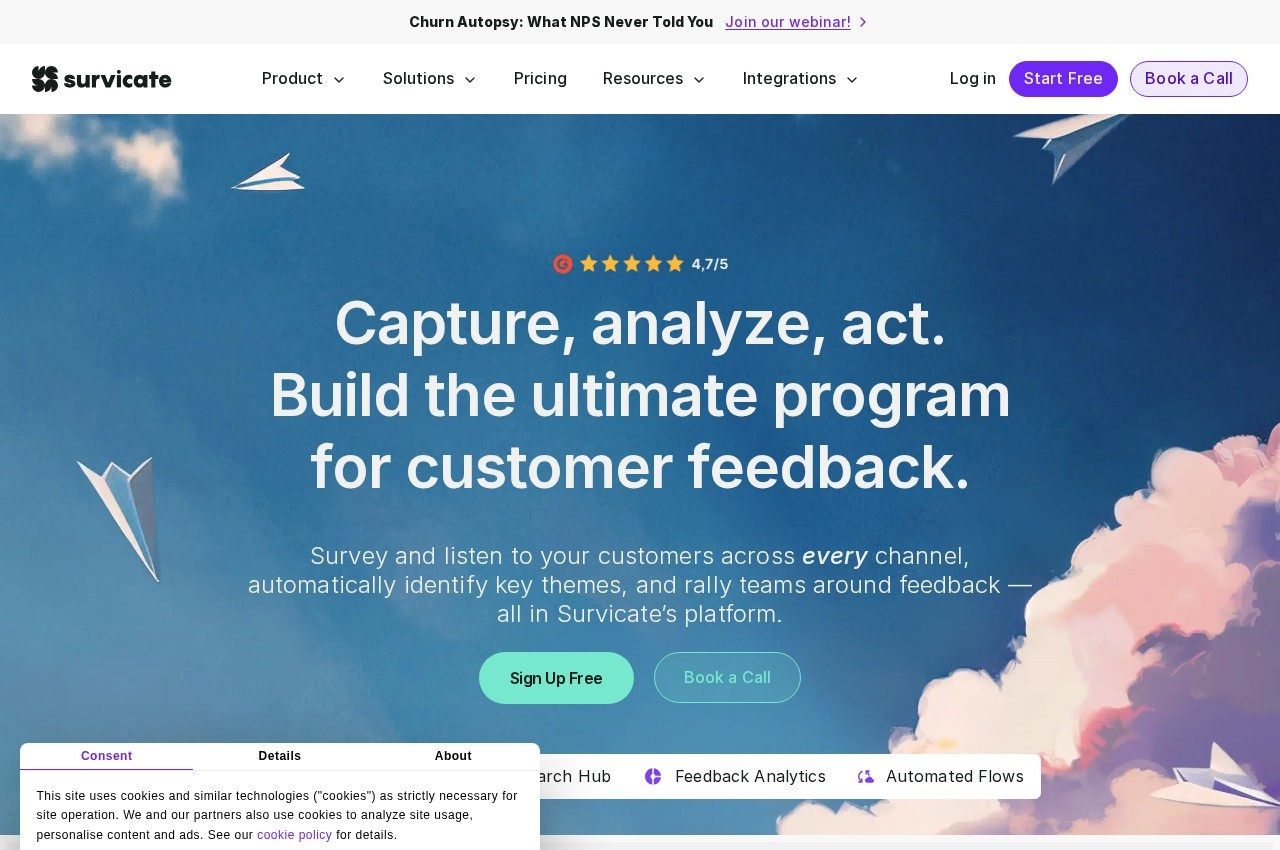
Survicate is a customer feedback platform covering customer surveys, a research hub, feedback analytics and automated flows, with the vendor stating more than 2,000 digital businesses and 4,000 customer experience, product, research and marketing teams as users.
The problem the vendor sets out is unification, and it is the correct diagnosis for most organisations that already run feedback programmes. Companies are not short of customer feedback. They are drowning in it across separate sources, none of which combine, so nobody can see the scale of any individual issue.
The consequence is specific and expensive. Support tickets sit in one system, in-app survey responses in another, review sites elsewhere, and sales call notes in a customer relationship system. Each shows a fragment. A problem generating twenty complaints across four systems looks minor in each and serious in aggregate, but nobody ever sees the aggregate, so it does not get fixed until it becomes large enough to appear in one channel alone.
Automated flows are what turn collection into a process rather than an exercise. A survey that fires when a defined event occurs produces feedback tied to a moment, which is far more useful than a periodic survey asking people to remember how they felt.
The research hub positions the platform for structured research alongside continuous measurement, which suits organisations where product teams run studies and customer experience teams run ongoing programmes from the same tooling.
One published customer account reports more than 1,000 responses in a single day using the NPS surveys, which speaks to distribution reach rather than to analysis.
Pricing is published with monthly and yearly billing. Growth starts at $114, Pro at $349 and Enterprise at $569, with the higher tiers adding SAML single sign-on, access logs, on-demand security review and a non-disclosure agreement. A free sign-up is offered.
Key Features of Survicate
- Multi-channel customer surveys
- Net Promoter Score surveys
- Feedback analytics across sources
- Unified view of fragmented feedback
- Automated event-triggered flows
- Research hub for structured studies
- Theme identification across responses
- SAML single sign-on on higher tiers
- Access logs and security review
- Integrations across the stack
- Free sign-up
- Monthly and yearly billing
Survicate Pricing
Enterprise
$569
Adds SAML single sign-on, access logs, on-demand security review and a non-disclosure agreement.
Survicate Specifications
- Deployment
- Cloud Based
- Desktop
- Web App
- Built for
- Small Business
- Medium Business
- Large Enterprise
- Support
- Public API
- Yes
- Free trial
- Yes
- Free plan
- No
- Runs in browser
- No
- Customisable
- No
- Website
- survicate.com
Survicate Screenshots
Survicate Reviews
No reviews yet
Used Survicate? Share your experience and help other buyers decide.
Survicate FAQs
Alternatives to Survicate
Other NPS Software recorded on the same fields.