

Do you know what a Social Media Manager is and what its main functions are? Social networks play a very important role for any type of business, which is why the work of the Social Media Manager has become a highly demanded and well-paid profession today.
Brands need to develop a Digital Marketing strategy when selling their products or services online, and although we believe it is simple, it requires careful planning to achieve excellent results.
If you want to learn more about the tasks this professional performs, you’re in the right place. Let’s start!
The Social Media Manager is the person in charge of carrying out and supervising the Marketing strategy on a company’s social networks, using the digital tools at their disposal, such as blogs, podcasts, or webinars; hence, the SMM must know them all and understand what contributes to a corporate campaign.
This professional is also involved in supervising the Community Manager on issues related to generating, curating, editing, publishing, and managing content on platforms such as Facebook, Instagram, Twitter, YouTube, and, more generally, any of the main social networks where you have a presence.
In addition to contributing to the Brand’s voice, this person will analyze campaign results by tracking participation metrics such as likes, clicks, interactions, and overall engagement.
Above all, the Social Media Manager must be an individual:
- Analytical
- Creative
- motivated
- With experience
- Passion for your work
The main tasks that are entrusted to a specialist in managing the main Social Media trends in favor of the company for which they work (either employed or collaborating as a Freelance) are:
She is in charge of developing a publication strategy for a company’s social networks to boost audience engagement.
The idea is to turn the company’s fans into customers and retain them over time.
Campaign Performance Analysis
Another challenge social media managers face is understanding how to use metrics effectively and optimize campaigns based on them.
The term “Analytics” is used quite broadly here, referring to both social media metrics (e.g., likes, comments, shares) and business metrics (e.g., traffic, leads, conversions, revenue).
An excellent Social Media Manager can understand both types of metrics.
Not only that, it will relate them to each other to provide an overview of the performance of the company’s social networks in relation to business objectives.
Communication with People
Day-to-day responsibilities include ensuring the company voice is consistent and working with the CM to create and nurture a community across all social platforms.
You Must Keep Abreast of Major Trends
It can be a daily challenge because it requires you to stay attuned to trends across your channels (and in your industry) at all times.
This implies that a Social Media Manager is proactive, since, as you well know, new techniques and strategies are emerging almost every day to implement across them.
A clear example is that last year, around this time, no one was still talking about TikTok. And now he is on everyone’s lips!
Content writing (Copywriting)
Copywriting is a fundamental skill for marketing on social networks (and probably across the sector).
In networks, you must know how to write very well to transmit and reach a larger audience. And all of this, without great persuasive writing skills, can be quite difficult.
Ease of Speaking in Public
With features and apps like Facebook Live, Instagram Live, and Periscope, streaming video is becoming increasingly important on social platforms.
Marketers have noticed an increase in its usability because it generates greater reach and engagement.
From an engagement perspective, live content also offers opportunities for high audience engagement and interaction.
Therefore, Social Media Managers must be confident enough to speak in public, respond to unexpected messages or questions about the product or service, and possess strong conversational skills and empathy.
Behavioral Psychology
With data and analytics, this professional will know which social media post types work well for a given business.
Behavioral psychology tells you why, for example, people are attracted to certain posts, or why people share some and not others.
You will also be able to spot trends, replicate past successes, and understand the underlying causes of those trends to create future successes.
You certainly don’t need a degree or extensive experience in psychology to be a good Social Media Manager.
But interest in learning and understanding it, on some level, is an important skill.
Budget Control
As a social media manager, you may be assigned a budget to work on the brand’s Facebook Ads campaigns and advertising in order to optimize them as much as possible.
In addition to paid advertising, you may also need to invest in social media management tools, layouts, images, or paid enhancement courses.
To find out how much money this professional earns, you have to take into account the functions he performs and the size and budget of the company that hires him.
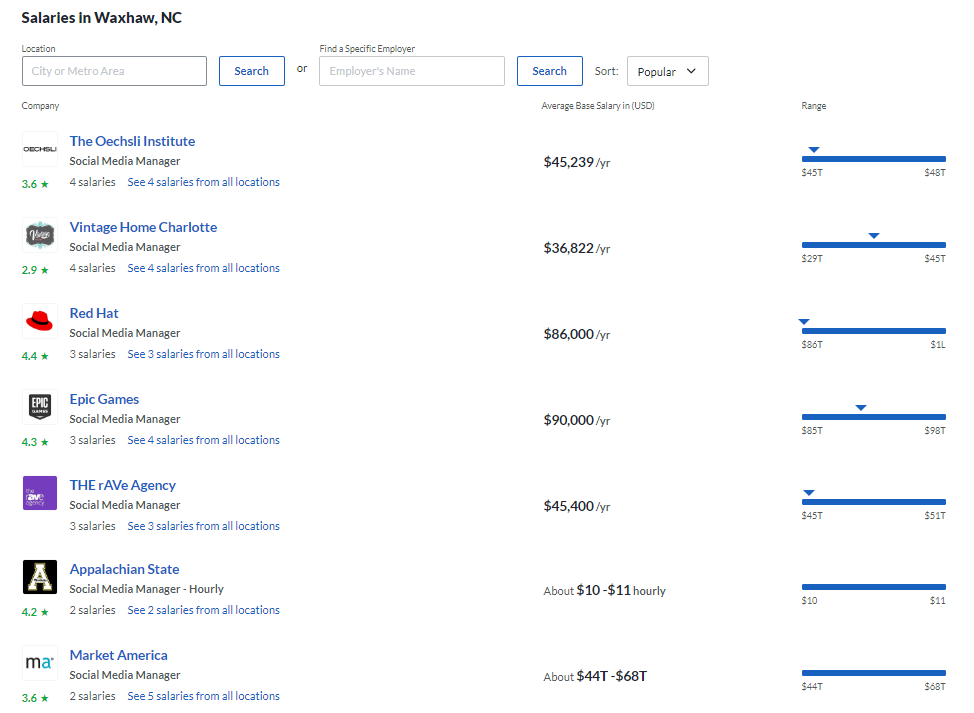
A Social Media Manager in the United States earns between $40,000 and $120,000 per year. But according to various studies, here in Spain that salary can be between 25,000 and 50,000 euros gross per year.
For example, this is indicated by the postcard: www.glassdoor.es, as you can see in the image:
A Social Media Manager is often confused with the Community Manager. I even bet you thought they were both doing the same thing, right?
The Social Media Manager focuses on promoting the Brand’s products from a strategic perspective, while the Community Manager executes these actions in practice.
All this is to encourage audience participation and provide mutual support for the Brand itself.
In small or medium-sized companies, both roles are usually combined in a single person, who is in charge of the company’s entire social media marketing strategy.
Surveys are an important part of a CM’s role because they help convey what the brand is looking for and identify ways to improve the user experience.
Plus, catching problems early helps reduce customer frustration later.
The duties of a Community Manager are broader than those of a Social Media Manager and include raising awareness and engagement.
To summarize, the responsibilities of a CM include:
- Develop a community for users of the product or service.
- Increase public participation through debates
- Connect new users with resources to help them get involved in the community
- Respond to questions that arise and help troubleshoot
- Find ways to improve the user experience by collecting feedback from the brand’s community of followers.
The workflow of a CM
An example of the day-to-day of a CM:
- 40% Of the time, having conversations with the defenders of the Brand and the people of the communities of followers of his brand.
- 25% create content and design strategies to increase the community of followers and connect with new people.
- 20% creating visibility and credibility, attending Twitter chats or Online events.
- 10% analyzing the efforts that generate more traffic and engagement, together with the SMM.
- 5% creating relationships with people from different teams in the company.
Conclusion
In short, knowing what a Social Media Manager is and the functions it performs for a brand will allow you to assess whether it is indeed the profession you really want to dedicate yourself to.
He is in charge of defining the objectives that the brand intends to achieve and creating the marketing strategy in social networks.
Measure all marketing actions and work towards the objectives that we mentioned before.

June 9, 2026

June 9, 2026

June 9, 2026

June 9, 2026

June 9, 2026