


Machine translation is priced in a unit nobody uses when they ask what a translation costs.
People think in words or pages. The services charge per million characters.
So we converted it. On 29 September 2026 we opened the pricing pages of four machine translation services and saved them.
Then we turned each rate into a cost per 1,000 words, and a cost for a 100,000-word book.
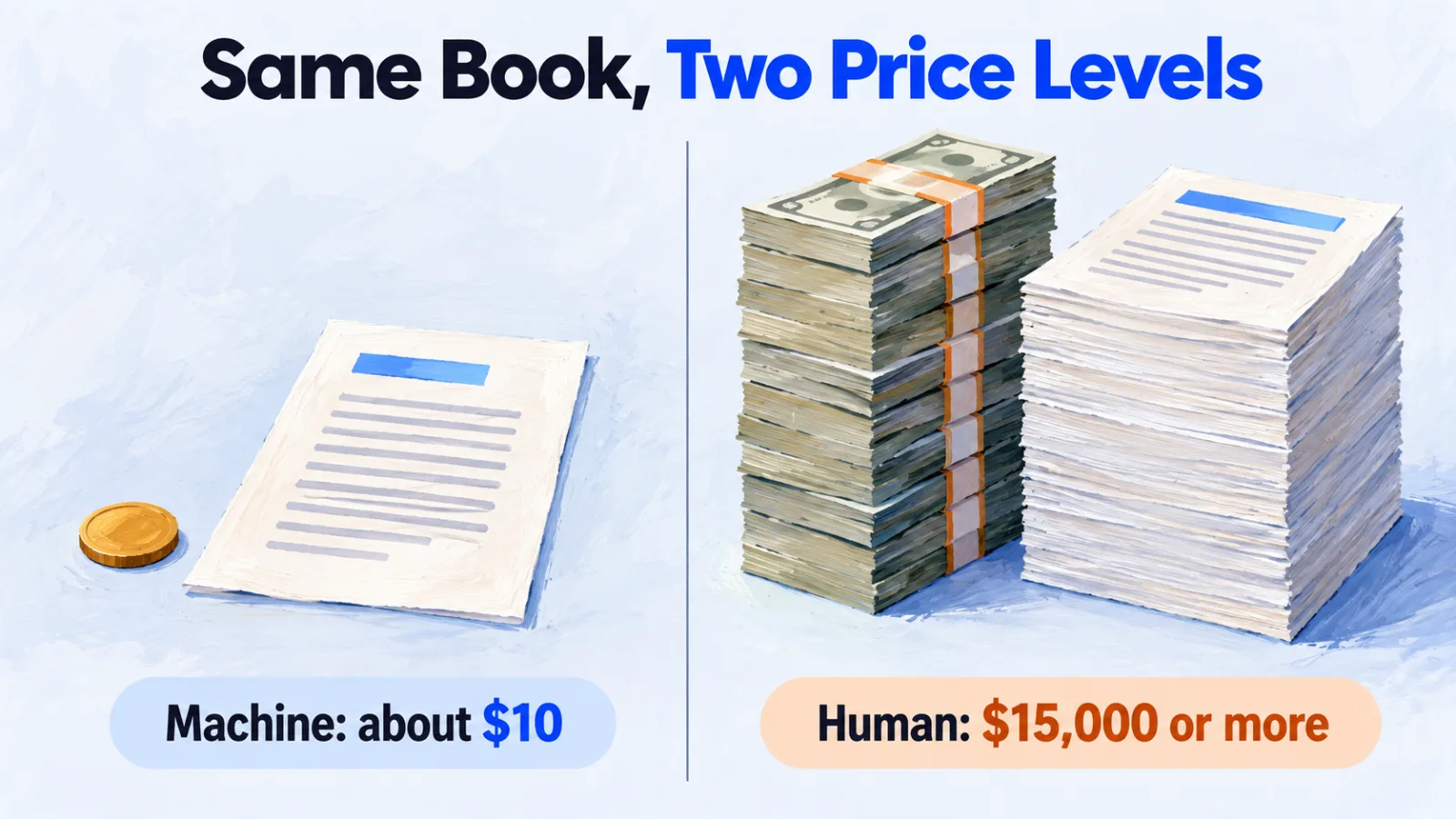
A million characters cost between 10 and 27.50 dollars. The same book done by a professional translator costs at least 15,000.
Key Takeaways
- Machine translation cost $10 to $27.50 per million characters, or about 6 to 17 cents per 1,000 words.
- A 100,000-word book cost $6 to about $17 by machine, against $15,000 to $30,000 by a human.
- Each service has a free allowance, and the four allowances work in four different ways.
- Custom models cost four times the standard rate on Google, Amazon and Azure.
- This compares price, not quality. Machine output can still need a human edit.
How We Priced a Word
Every machine translation rate below comes from the vendor’s own pricing page, linked beside it, as it read on 29 September 2026.
Those pages price characters, and readers think in words, so we needed a conversion. We assumed 6 characters per English word, spaces included. That assumption is ours, not the vendors’, and text with longer words or more punctuation will cost a little more.
Prices are US dollars before tax. DeepL’s page showed its plans in US dollars for our location, India.
What a Million Characters Costs
These are each service’s standard text translation rate, cheapest first.
| Service | Per million characters | Per 1,000 words | Free allowance |
|---|---|---|---|
| Azure Translator, pay as you go | $10 | $0.06 | 2 million characters a month |
| Amazon Translate, standard text | $15 | $0.09 | 2 million a month for 12 months |
| Google Cloud Translation, default model | $20 | $0.12 | 500,000 a month |
| DeepL API, Growth extra characters | $27.50 | about $0.17 | one-time 1 million on the Developer plan |
Google’s newer translation model, which it prices at $10 per million characters in and $10 out, comes to the same $20 for text of the same length.
A 100,000-Word Book
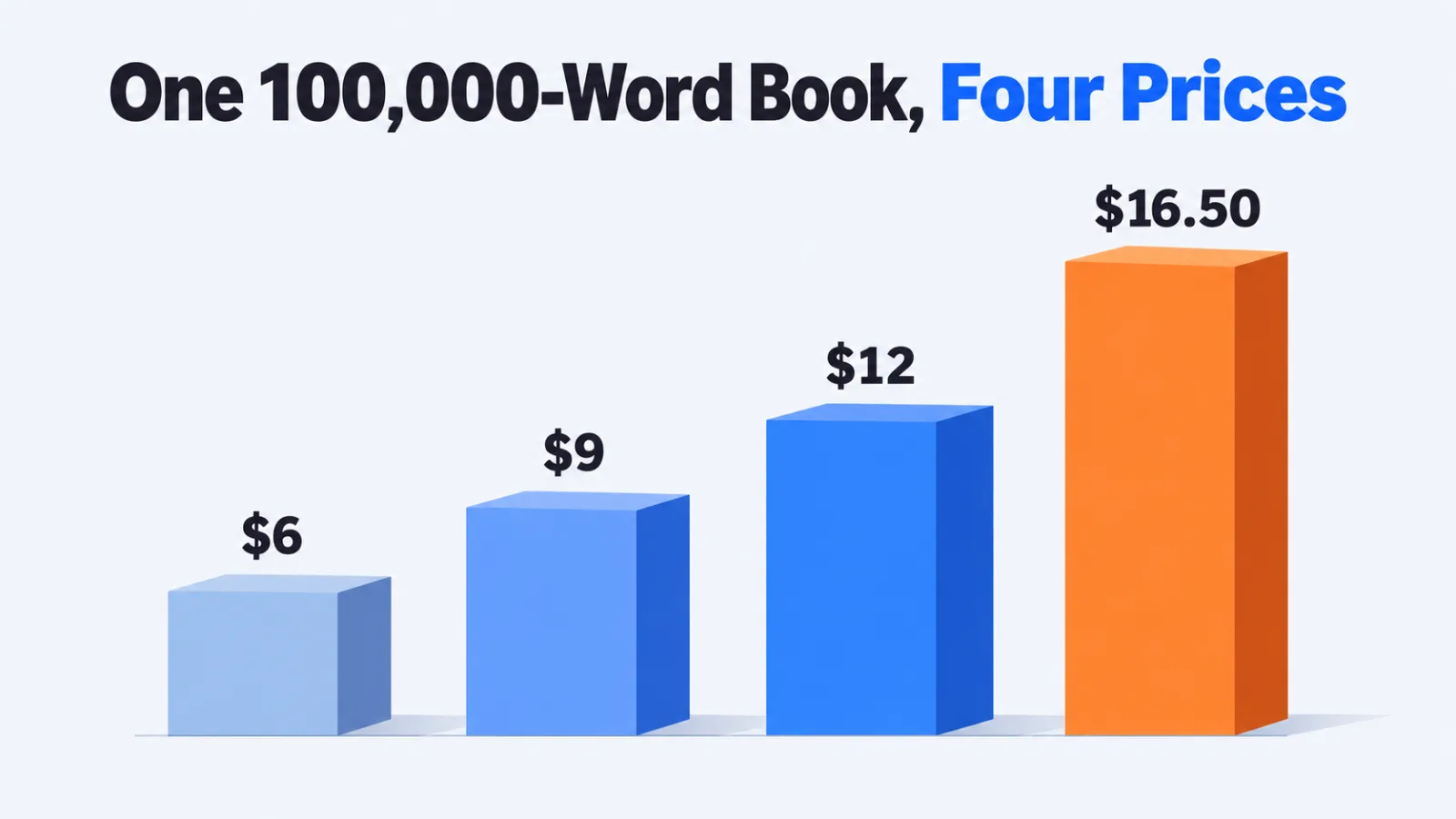
A book of that length runs to about 600,000 characters. Here is what one pass through each route costs.
| Route | Cost for 100,000 words |
|---|---|
| Azure Translator | $6.00 at list, or $0 inside the free allowance |
| Amazon Translate | $9.00 at list, or $0 in the first year’s free tier |
| Google Cloud Translation | $12.00 at list, or $2.00 after the free 500,000 characters |
| DeepL API | $16.50 at the extra-character rate |
| AI-powered human translation at 12 cents a word | $12,000 |
| Professional human translation at 15 to 30 cents a word | $15,000 to $30,000 |
The human rows come from Smartling’s translation rates page, which states both per-word prices. At list price, professional human translation costs at least 900 times the dearest machine route.
What That Gap Buys
The difference is a person reading the result. That’s the entire price of the human routes.
Raw machine output is fine for text you’ll read once and never publish: internal documents, support tickets, a first pass to see what a document says. It’s a risk for a contract, a product label or a homepage, where a wrong word is expensive.
The 12-cent hybrid route sits between them. A machine translates first, and a person edits what it produced.
Surcharges That Multiply the Rate
The headline rate is for plain text. Five things cost more.
- Custom models run $80 per million on Google, $60 on Amazon and $40 on Azure, four times each one’s standard rate.
- Amazon charges $30 per million for real-time Word documents, twice its plain-text rate.
- Azure charges $15 per million for document translation, against $10 for text.
- Google prices Word, PowerPoint and PDF files per page, at $0.08 a page.
- Azure adds $10 per custom model, per region, per month, for hosting it.
A team that translates spreadsheets, slide decks and Word files pays the document rate on most of its volume. Price the format you’ll send, not the cheapest one on the page.
Each Free Allowance Works Differently
All four services give some volume away, and no two do it the same way.
- Google gives 500,000 characters every month, with no end date.
- Azure gives 2 million characters every month on its free tier.
- Amazon gives 2 million characters a month, but only for 12 months from your first request.
- DeepL’s Developer plan gives a single one-time credit of 1 million characters.
For a small project that never grows, Google or Azure can stay free indefinitely. For a launch, the Amazon and DeepL allowances run out on a schedule you should put in the calendar.
Volume Commitments Lower the Rate
Large volume unlocks a lower price, but only if you commit to it.
Azure sells a commitment tier of 250 million characters a month for $2,055, or $8.22 per million, about 18 percent below the $10 list rate. It lists $6 per million at a billion characters and $5.50 at 4 billion.
Google’s page shows $18 per million on a one-year savings plan and $16 on a three-year plan, against $20 pay-as-you-go. Below tens of millions of characters a month, list price is usually the right choice.
Batch or Real-Time
How fast you need the answer can change the price too.
Amazon Translate lists batch document translation at $15 per million characters and real-time Word documents at $30, with no free tier for the real-time service. If the translation can wait, submit it as a batch.
Every Language Is Another Pass
The 100,000-word book above went into one language.
Google says it charges on input characters per target language. Translating the same book into five languages means five passes, so the $12 becomes $60.
Check the other services’ terms for the same rule before you budget a multi-language launch.
If the Source Is Audio or Video
Everything above prices written text.
Spoken content adds transcription and a voice, and its unit is the minute rather than the character. Our AI dubbing cost comparison prices that side, from five tools’ own pricing pages.
Which Route Fits Which Job
- Use raw machine translation for internal documents and first drafts, inside a free allowance where you can.
- Use the hybrid route for customer-facing text that must read well, with a person editing the output.
- Use a professional translator for contracts, labels and regulated content, priced per word.
- Use a custom model for a steady stream of similar text, once the volume covers its four-times rate.
Ways to Cut the Bill
- Translate only what changed, since every unchanged sentence is money spent twice.
- Remove text that never needs translating, such as code samples and boilerplate.
- Use the free allowance before paying, and note when it expires.
- Send plain text where you can, and skip the document rate.
- Ask for a volume price once you pass tens of millions of characters a month.
Questions to Ask Before Paying
- Ask what one million characters costs in the format you’ll send.
- Ask whether every target language is billed as its own pass.
- Ask when the free allowance ends, and whether it rolls over.
- Ask what a custom model costs to train and to host.
- Ask who reviews the output before it’s published.
Comparing Translation Tools
Once you know the volume, the format and the languages, comparing the tools themselves gets simpler.
The AI translation tools category lists the services side by side, so you can weigh language coverage and features against the rates above.
Questions People Ask About AI Translation Cost
How much does AI translation cost?
On the four services checked in September 2026, machine translation cost $10 to $27.50 per million characters. That works out to roughly 6 to 17 cents per 1,000 words.
Is AI translation free?
Each of the four has a free allowance, but they differ. Google gives 500,000 characters a month, Azure 2 million a month, Amazon 2 million a month for a year, and DeepL a one-time 1 million.
How much does human translation cost per word?
Smartling’s rates page puts professional human translation at 15 to 30 cents a word. It lists AI-powered human translation at 12 cents a word.
Is AI translation as good as human translation?
This comparison covers price only, so it doesn’t rank quality. Raw machine output is the cheapest route, and adding a human edit moves the price to about 12 cents a word.
Do I pay for each target language?
On Google, yes: it charges input characters per target language. Check whether the others do before budgeting a project that goes into more than one language.
Price the Pass, Not the Tool
The rate per million characters looks like the whole answer, and it isn’t.
Count your characters, multiply by your languages, and price the format you’ll send. On the four services checked here, that arithmetic changed the bill more than the vendor did.
Both were small next to the cost of paying a person to check the result.
Add SocialAtoZ as a preferred source
See us more often in your Google results.