
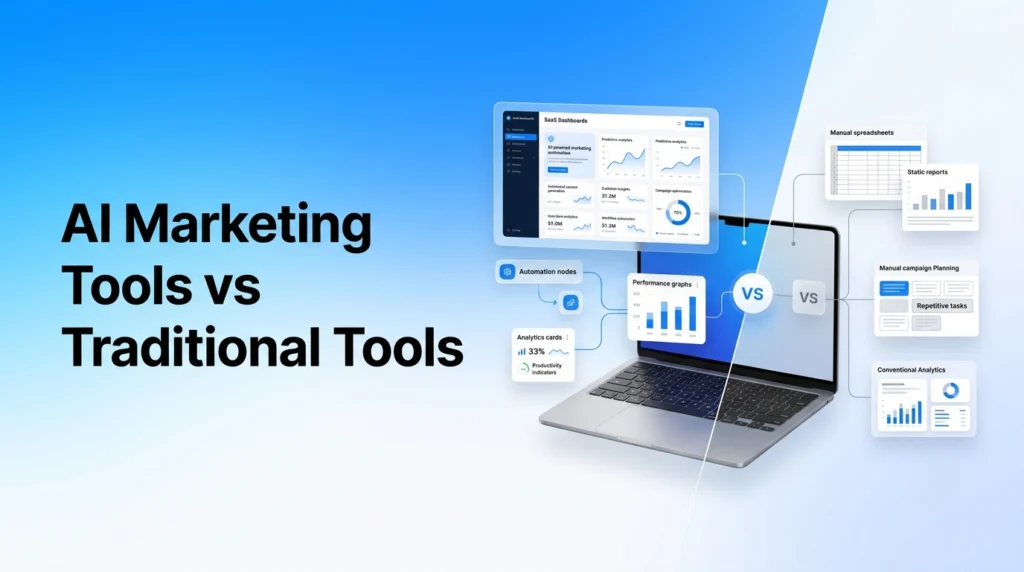
Marketing technology has evolved significantly, giving businesses more options for planning, executing, and measuring campaigns. Traditional marketing tools have long supported activities such as customer research, content planning, email campaigns, analytics, and advertising. However, AI-powered marketing tools, such as Aipeakflow, are changing how these tasks are performed by offering automation, predictive insights, personalisation, and faster content generation.
While AI tools can improve efficiency and handle large amounts of data, traditional tools continue to provide reliability, human control, and familiar workflows. Choosing between them depends on factors such as business goals, budget, team capabilities, marketing requirements, and desired level of automation.
Understanding the differences between AI and traditional marketing tools can help businesses select the right approach for their specific needs.
What Are Ai Marketing Tools?
AI marketing tools use artificial intelligence, machine learning, NLP, and data analytics to automate and improve marketing tasks. Platforms like Aipeakflow can help businesses analyze customer behavior, generate content, personalize campaigns, optimize ads, and make better decisions.
Unlike traditional tools, AI-powered platforms can process large amounts of data and provide automated recommendations or outputs. Common uses include content creation, SEO, chatbots, predictive analytics, email marketing, social media, and ad optimization.
These tools help marketing teams save time, improve productivity, and deliver personalized experiences. However, human oversight is still important for accuracy, creativity, brand consistency, ethics, and responsible data use.
What Are Traditional Marketing Tools?
Traditional marketing tools are established platforms that help businesses plan, execute, manage, and measure marketing activities without heavily relying on artificial intelligence. Marketers typically use them to create content, manage campaigns, analyze data, segment audiences, and make strategic decisions.
Common examples include email marketing platforms like Sender, keyword research tools, CRM systems, social media management software, analytics platforms, content management systems, and advertising tools.
Businesses using print advertising can also rely on bulk posters to promote their products, services, or events across multiple physical locations at a lower cost per poster. They remain popular because they offer direct control, predictable workflows, and familiar processes.
While many provide automation features, they generally rely more on predefined rules, manual inputs, and marketer expertise than modern AI-powered solutions.
Ai Marketing Tools Vs Traditional Tools: Key Differences
AI and traditional marketing tools differ mainly in how they process information, automate tasks, analyse data, and support marketing decisions. Understanding these differences helps businesses select tools that match their specific requirements.
| Feature |
AI Marketing Tools |
Traditional Marketing Tools |
|---|---|---|
| Automation |
Provide advanced automation and can perform tasks with minimal human intervention. | Offer basic automation and generally require more manual input. |
| Data Analysis |
Analyse large datasets quickly and identify patterns, trends, and predictions. | Depend more on manual analysis and predefined reporting systems. |
| Content Creation |
Can generate content ideas, drafts, captions, emails, and other marketing materials. | Usually provide tools for creating, editing, and managing content manually. |
| Personalisation |
Can automatically personalise content, recommendations, and campaigns based on customer data. | Personalisation generally requires manual segmentation and campaign customisation. |
| Decision-Making |
Provides recommendations and predictive insights to support marketing decisions. | Marketers primarily interpret data and make decisions themselves. |
| Speed |
Completes repetitive marketing tasks and processes data rapidly. | Tasks may take longer because of greater manual involvement. |
| Human Involvement |
Reduces manual effort but still requires human supervision and strategic direction. | Requires greater human involvement throughout planning and execution. |
| Creativity |
Generates creative suggestions but may lack human emotional understanding and originality. | Relies heavily on human creativity, experience, and brand understanding. |
| Cost |
Advanced tools can involve higher subscription or implementation costs. | Many established tools offer predictable and relatively affordable pricing. |
| Best Suited For |
Businesses seeking automation, personalisation, predictive insights, and greater efficiency. | Businesses prioritize control, established workflows, and human-led marketing strategies. |
Benefits and Limitations of Ai Marketing Tools
AI marketing tools are increasingly being adopted by businesses to automate repetitive tasks, analyse large datasets, personalise customer experiences, and improve marketing efficiency. However, despite their advantages, they also have limitations that businesses should consider before relying heavily on them.
Benefits of Ai Marketing Tools
- Automation: AI can automate repetitive tasks such as content creation, email campaigns, customer responses, and data analysis.
- Faster Content Creation: AI tools can quickly generate content ideas, captions, product descriptions, emails, and other marketing materials.
- Personalisation: AI analyses customer data to deliver more personalised recommendations, messages, and marketing experiences.
- Data Analysis: AI can process large amounts of marketing data and identify patterns, trends, and customer behaviour.
- Improved Efficiency: Automation reduces manual workload, allowing marketing teams to focus more on strategy and creativity.
- Better Targeting: AI can help identify relevant audiences and optimise campaigns based on customer interests and behaviour.
Limitations of Ai Marketing Tools
- Lack of Human Creativity: AI-generated content may lack the originality, emotional understanding, and creativity of human marketers.
- Accuracy Concerns: AI can sometimes produce incorrect, outdated, or misleading information that requires human verification.
- Data Privacy Risks: Using customer data with AI platforms can create privacy, security, and compliance concerns.
- Implementation Costs: Advanced AI tools may require subscription fees, technical expertise, training, or integration expenses.
- Overdependence on Automation: Excessive reliance on AI can reduce human oversight and potentially weaken brand authenticity.
- Limited Context Understanding: AI may struggle to fully understand cultural nuances, emotions, complex customer needs, or unusual business situations.
Benefits And Limitations of Traditional Marketing Tools
Traditional marketing tools continue to play an important role despite the growth of AI-powered solutions. They provide marketers with familiar workflows, direct control, and reliable methods for managing campaigns, but they may require more manual effort and offer less automation.
Benefits of Traditional Marketing Tools
- Greater Human Control: Marketers can directly manage campaigns, content, audience targeting, and strategic decisions.
- Established Workflows: Traditional tools often use familiar processes, making them easier for experienced marketing teams to adopt.
- Creative Flexibility: Human marketers can apply creativity, emotional understanding, and brand personality when developing marketing campaigns.
- Reliable Processes: Established tools generally provide predictable features and workflows that businesses can use consistently.
- Better Human Oversight: Marketers can review and approve content, campaign changes, and customer communications before publication.
- Lower Learning Barriers: Many traditional platforms are widely used and offer extensive training resources, tutorials, and community support.
Limitations Of Traditional Marketing Tools
- More Manual Work: Many tasks require marketers to manually create content, analyse information, manage campaigns, and generate reports.
- Time-Consuming: Managing large campaigns manually can take considerable time, particularly when multiple channels are involved.
- Limited Automation: Traditional tools may provide basic automation but generally cannot match the advanced automation offered by AI-powered platforms.
- Slower Data Analysis: Processing large datasets and identifying customer patterns may require significant human effort.
- Limited Personalisation: Creating highly personalised experiences for large audiences can be difficult without advanced AI capabilities.
- Higher Workforce Requirements: Businesses may need additional employees or specialists to manage extensive marketing activities efficiently.
Ai Vs Traditional Tools For Different Marketing Activities
1. Seo
AI-powered SEO tools can analyse search trends, identify keyword opportunities, suggest content topics, detect ranking patterns, and provide optimization recommendations quickly. They can also assist with content optimization and competitor analysis.
Traditional SEO tools primarily provide keyword research, backlink analysis, technical SEO audits, rank tracking, and website performance reports. Marketers generally interpret the data and decide what actions to take.
Best approach: Combining AI insights with traditional SEO data can provide faster analysis while keeping strategic decisions under human control.
2. Content Creation
AI content tools can generate blog ideas, outlines, social media captions, product descriptions, emails, and initial content drafts within seconds. They are particularly useful for producing content at scale.
Traditional content tools focus on writing, editing, grammar checking, design, and content management. They generally require marketers or writers to create the content themselves.
Best approach: Use AI for brainstorming and first drafts, followed by human editing to ensure originality, accuracy, tone, and brand consistency.
3. Social Media Marketing
AI-powered social media tools can analyse audience behaviour, recommend content ideas, identify trends, suggest posting times, and automate certain engagement activities.
Traditional social media management platforms allow marketers to schedule posts, monitor engagement, manage multiple accounts, and review performance metrics.
Best approach: AI can support content planning and audience analysis, while traditional platforms remain useful for scheduling, publishing, and monitoring campaigns.
4. Email Marketing
AI email marketing tools can analyse customer behaviour and help personalise subject lines, messages, product recommendations, audience segments, and campaign timing. Some platforms can also predict which content may generate better engagement.
Traditional email marketing tools provide campaign creation, contact management, segmentation, scheduling, automation, and performance reporting.
Best approach: Combining traditional email automation with AI-powered personalisation can help businesses deliver more relevant messages at scale.
5. Paid Advertising
AI-powered advertising tools can analyse campaign data and automatically optimize targeting, bidding, budgets, placements, and creative variations. This can help marketers respond quickly to changing campaign performance.
Traditional advertising platforms provide campaign management, audience targeting, budget controls, ad creation, and performance reports, with marketers making most optimization decisions manually.
Best approach: AI is particularly useful for optimising large campaigns, while human oversight remains important for budgets, messaging, targeting strategy, and brand positioning.
6. Analytics
AI analytics tools can process large datasets, identify unusual patterns, predict trends, and generate insights or recommendations automatically. This can make it easier to identify opportunities and potential problems.
Traditional analytics tools provide dashboards, reports, traffic data, conversion tracking, customer metrics, and other performance information that marketers analyse manually.
Best approach: AI can speed up data interpretation, while traditional analytics platforms provide the underlying data and detailed reporting needed for informed decisions.
Ai Or Traditional Tools: Which Should Your Business Choose?
Choosing between AI and traditional marketing tools depends on your business objectives, budget, team capabilities, marketing activities, and desired level of automation. There is no single solution that works for every business.
Choose AI Marketing Tools If:
- You Need Automation: AI tools are useful for automating repetitive tasks such as content creation, customer segmentation, reporting, and campaign optimization.
- You Handle Large Data Volumes: Businesses managing large amounts of customer or campaign data can benefit from AI-powered analysis and insights.
- You Want Personalisation: AI can help create personalised recommendations, messages, advertisements, and customer experiences at scale.
- You Need Faster Content Production: AI can assist with generating ideas, drafts, captions, product descriptions, and other marketing materials quickly.
- You Want Predictive Insights: AI tools can identify patterns and trends that may help marketers anticipate customer behaviour and optimize campaigns.
Choose Traditional Marketing Tools If:
- You Prefer Greater Control: Traditional tools allow marketers to manage campaigns and make decisions directly without extensive automation.
- Human Creativity Is Essential: Businesses focused heavily on storytelling, branding, and creative communication may benefit from human-led workflows.
- Your Marketing Requirements Are Simple: Smaller businesses with straightforward campaigns may not need advanced AI capabilities.
- You Have a Limited Budget: Established traditional tools may provide the essential features you need without investing in advanced AI solutions.
- Your Team Prefers Familiar Workflows: Traditional platforms can be easier for teams already experienced with their features and processes.
How To Choose The Right Marketing Tools for Your Business
Choosing the right marketing tools requires understanding your business goals, budget, target audience, team capabilities, required features, integration needs, and expected return on investment.
- Define Your Marketing Goals: Identify whether you need better SEO, lead generation, social media management, content creation, customer retention, or campaign automation.
- Assess Your Budget: Compare subscription costs, additional charges, available features, and potential returns before selecting a marketing tool.
- Consider Your Team’s Skills: Choose tools that match your team’s technical knowledge and provide adequate training, tutorials, and customer support.
- Evaluate Required Features: Prioritise essential features instead of paying for unnecessary capabilities that your business may rarely use.
- Check Integration Options: Ensure the tool integrates smoothly with your existing CRM, website, analytics platforms, advertising accounts, and other software.
- Compare AI Capabilities: If considering AI tools, evaluate automation, personalization, content generation, predictive analytics, accuracy, and customisation features.
- Consider Scalability: Select tools that can support increasing customers, campaigns, data volumes, users, and marketing requirements as your business grows.
- Check Security and Privacy: Review data protection policies, security measures, compliance standards, and how customer information is stored and processed.
- Test Before Purchasing: Use free trials, demos, or limited plans to evaluate usability, performance, integrations, and suitability before committing.
Conclusion
AI marketing tools and traditional marketing tools each offer distinct advantages, and the right The choice depends on a business’s goals, resources, and marketing strategy. AI tools offer faster automation, personalized campaigns, predictive insights, and efficient data analysis, while traditional tools provide greater human control and familiar workflows.
Businesses do not have to choose one over the other. Combining AI with traditional marketing practices can improve productivity while maintaining human creativity and strategic oversight.
Add SocialAtoZ as a preferred source
See us more often in your Google results.