
What is OpenFaaS?
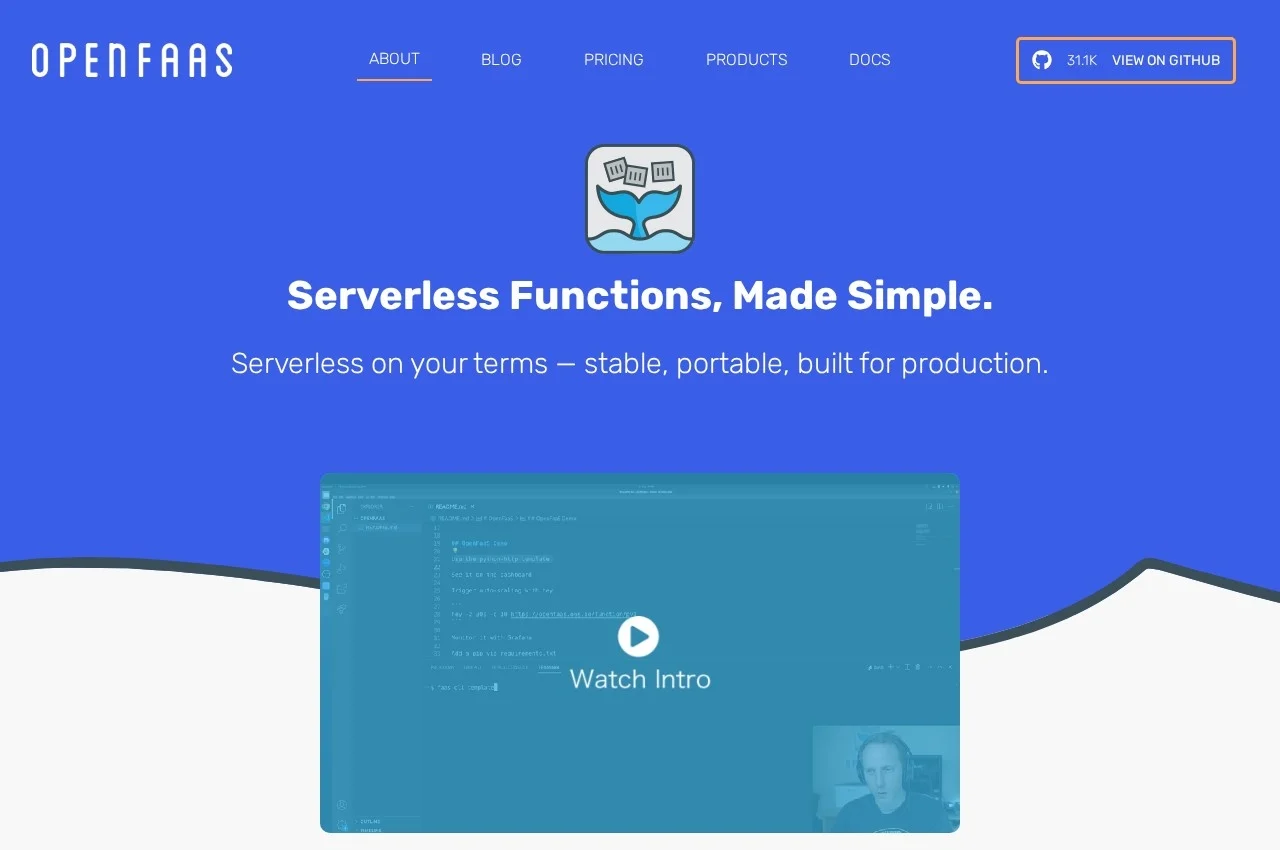
OpenFaaS is a serverless framework for Kubernetes, aimed at teams that want the developer experience of functions without handing their workloads to a public cloud provider. The tagline is serverless on your terms: deploy functions on-premises or in any cloud, as portable OCI images, on any Kubernetes cluster you already run.
The functional model is deliberately unopinionated about language. Official templates cover Node.js, Python, Go, Java, C#, Ruby and PHP, and you can create your own. Just as importantly, existing microservices built with Express.js, Flask, FastAPI, Django or ASP.NET Core can be deployed to OpenFaaS as-is, so adopting it does not require rewriting services into a function shape first. Events can invoke functions from Apache Kafka, AWS SQS and SNS, GCP Pub/Sub, RabbitMQ, PostgreSQL, Cron and MQTT.
Four use cases are called out. Multi-tenant extensibility lets your customers extend your product with custom code, turning snippets into isolated functions built and deployed through a REST API, with each tenant in its own namespace and security boundaries enforced at every layer. Batch and machine learning workloads fan out to thousands of parallel executions with built-in retries. Teams migrating off AWS Lambda to Kubernetes use it to keep the scaling and developer experience they had. And software vendors who must run on their own cloud, a customer's cloud and on-premises get one portable artifact for all three.
The Community Edition is free but limited to personal use, hobbyists and experimentation, explicitly not intended for commercial use. OpenFaaS Pro and Standard add autoscaling, scale-to-zero, event connectors, monitoring dashboards, SSO, RBAC and direct-to-engineering support. Production users named include Waylay, LivePerson, Cognite, RudderStack, Corva and Surge.
Key Features of OpenFaaS
- Runs on any Kubernetes cluster, on-premises or in any cloud
- Functions packaged as portable OCI images
- Official templates for Node.js, Python, Go, Java, C#, Ruby and PHP
- Existing Express, Flask, FastAPI, Django and ASP.NET Core services deploy as-is
- Event connectors for Kafka, AWS SQS and SNS, Pub/Sub, RabbitMQ, PostgreSQL, Cron and MQTT
- Autoscaling including scale-to-zero when idle
- Per-tenant namespaces with security boundaries at every layer
- REST API for building and deploying customer-supplied code
- Built-in retries for asynchronous and batch execution
- Pro tier adds SSO, RBAC, monitoring dashboards and direct engineering support
OpenFaaS Pricing
OpenFaaS Specifications
- Public API
- No
- Free trial
- No
- Free plan
- No
- Runs in browser
- No
- Customisable
- No
- Website
- openfaas.com
OpenFaaS Screenshots
OpenFaaS Comparisons


Used OpenFaaS? Write the first review.
OpenFaaS FAQs
Alternatives to OpenFaaS
Other Function as a Service (FaaS) Software recorded on the same fields.