
What is Azure Functions?
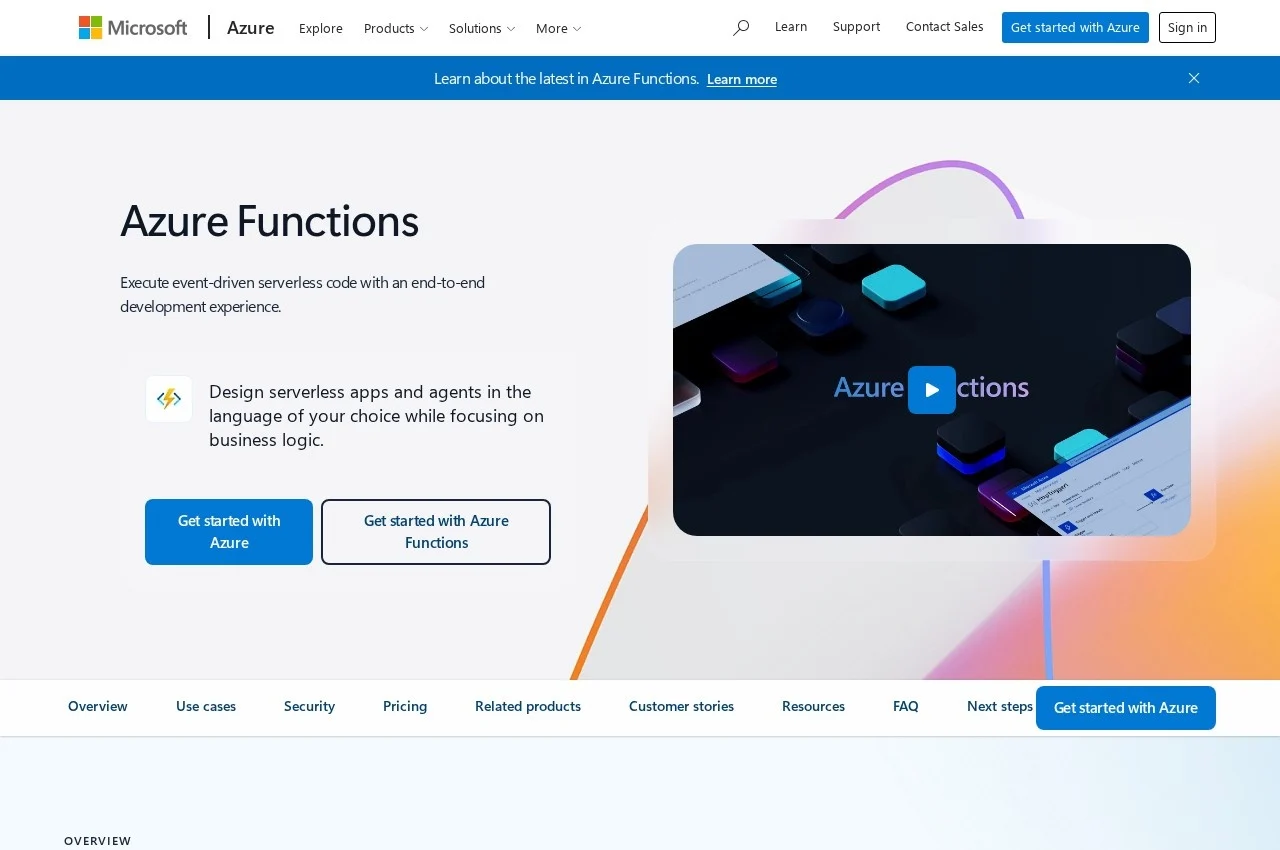
Azure Functions is Microsoft's event-driven serverless compute service, built so that a team can execute code in response to an event without provisioning or managing the machine that runs it. The product is positioned around writing business logic in the language of your choice and letting triggers and bindings handle the plumbing that connects a function to the rest of Azure.
The service leans heavily on two ideas. The first is triggers and bindings, a declarative way to wire a function to Azure services so that arriving data invokes your code and outbound data is written back without hand-rolled client code. The second is Durable Functions, an extension for stateful orchestration that handles long-running work, multi-step patterns and fault tolerance. Durable Functions performs automatic checkpointing, so an orchestration that fails part way through resumes from its last successful point rather than restarting, which is what makes distributed workflows practical to run on a serverless substrate at all.
Recent positioning is strongly oriented toward AI work. Microsoft describes building agents that integrate with Azure Foundry models and extending agent capability through remote Model Context Protocol servers, alongside more conventional uses such as retrieval augmented generation applications, chatbots, near real-time file and stream processing, and connecting microservices through Azure messaging.
Hosting is plan-based rather than one-size-fits-all. The Flex Consumption plan offers elastic scale with private networking, always-ready instances and concurrency control; an Azure Container Apps plan suits multitype microservices that want consistent networking, observability and billing with the rest of a container estate. Buyers should note a published deprecation: the Linux Consumption hosting plan retires in September 2028, with Flex Consumption named as the migration path. Microsoft was named a Leader in the Forrester Wave for Serverless Development Platforms, Q2 2025.
Key Features of Azure Functions
- Event-driven execution with triggers and bindings to Azure services
- Durable Functions for stateful, long-running orchestration
- Automatic checkpointing so failed orchestrations resume from the last success
- Flex Consumption plan with private networking and always-ready instances
- Azure Container Apps hosting plan for microservice estates
- Scale from zero and back with enterprise-grade networking
- AI agent support via Azure Foundry models and remote MCP servers
- Multi-language authoring for the language your team already uses
- Monthly free grant of up to 1,000,000 executions
- Compliance coverage spanning over 50 region-specific certifications
Azure Functions Pricing
Azure Functions Specifications
- Public API
- No
- Free trial
- No
- Free plan
- No
- Runs in browser
- No
- Customisable
- No
- Website
- azure.microsoft.com
Azure Functions Screenshots
Azure Functions Comparisons



Used Azure Functions? Write the first review.
Azure Functions FAQs
Alternatives to Azure Functions
Other Function as a Service (FaaS) Software recorded on the same fields.