
Every page answering this question was written by somebody who sells it.
Tool vendors quote tool prices. Agencies quote retainers. Both are accurate, and both describe a shape of spending that suits the seller.
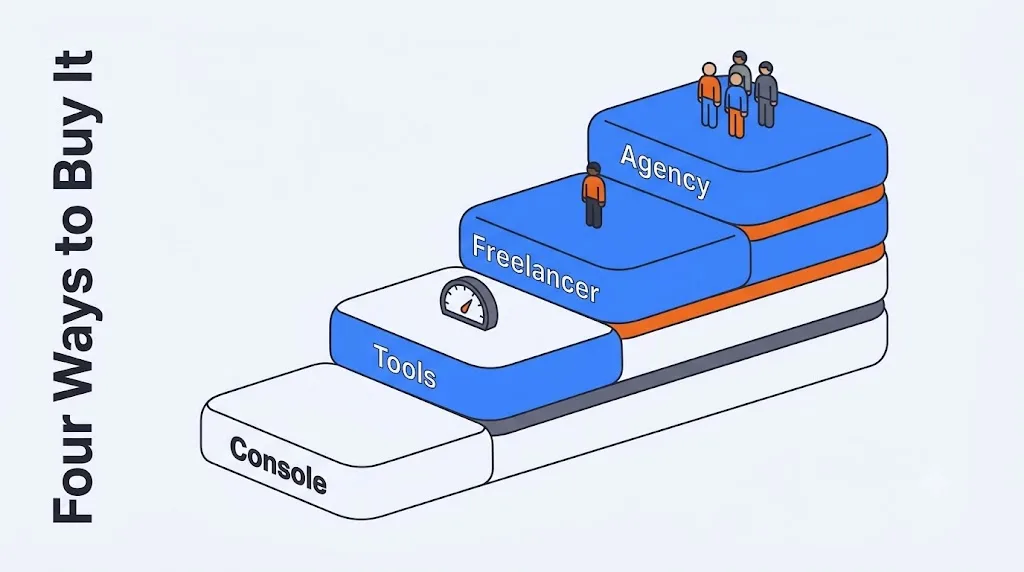
App store optimization pricing splits four ways, and which one fits you depends on how often your listing changes. That question decides more than any rate card.
Key Takeaways
- Four routes exist: the free console, tools plus your hours, a freelancer, or an agency.
- Creative production is usually the largest line and gets quoted separately.
- The work arrives in bursts, which is a poor match for a monthly retainer.
The Four Routes
Each buys a different thing, and the prices aren’t comparable without saying what.
| Route | Monthly | What you’re buying | Suits |
|---|---|---|---|
| Console only | Nothing | Your own store data | A first pass, pre-launch |
| Tools | 0 to 200 dollars | Keyword data and tracking | Someone with hours to spend |
| Freelancer | 500 to 2,000 dollars | Hours and judgment | Bursts around releases |
| Agency | 5,000 dollars and up | Hours, accountability, creative | Paid acquisition running alongside |
The gap between the tool row and the agency row is hours, not software. Both routes run the same three or four data sources underneath.
What the Free Route Gives You
More than the guides suggest, because the guides aren’t selling it.
Both stores hand you a console showing impressions, product page views, conversion rate and the search terms bringing people in.
For an app nobody has optimized, that data supports a first pass at the title, subtitle and keyword field without spending anything.
Where it runs out is competitors. Your console shows your app and says nothing about what anyone else ranks for, which is the point at which paid keyword data starts earning its cost.
What the Tools Cost
Keyword and tracking tools sit between nothing and a couple of hundred a month.
What you’re paying for is a keyword database, difficulty and volume estimates, and rank tracking over time. The cheaper tiers cap tracked keywords and competitors, which is the number to check before comparing prices.
Rank tracking is the piece people underestimate, because a change you can’t measure is a change you can’t repeat. That job is the same one rank tracking software does for web search, applied to a store listing instead.
What’s in an ASO Engagement
Six workstreams sit behind the word, and quotes differ mostly in which they include.
| Workstream | What it involves | How often |
|---|---|---|
| Keyword research | Terms, volume, difficulty, competitor overlap | Once, then per release |
| Metadata | Title, subtitle, keyword field, description | Per release |
| Creative | Screenshots, preview video, icon | Per major release |
| Localization | Metadata and creative per market | Per market added |
| Testing | Store experiments on listing variants | Where volume allows |
| Reporting | Rankings, conversion, organic installs | Monthly |
Two quotes at the same price routinely cover different rows of that table. Ask which are in and which are extra before comparing any numbers.
What More Money Buys in a Tool
Tool tiers differ on four limits rather than on features.
The keyword database is the first: how large it is, and which countries it covers. Tracked keywords come second, meaning the count you can watch daily rather than look up once.
Competitor slots are third, and they matter more than the keyword count in a crowded category. Localization support is fourth, because a tool covering three languages costs less than one covering thirty, and most apps need the cheaper one.
Check those four against your own list before paying for a higher tier. An app in one market watching forty terms fits inside almost every entry plan sold.
What Agencies Charge, and For What
Three shapes, and the differences matter more than the rates.
Retainer
A monthly fee, commonly starting around five thousand dollars, covering keyword research, metadata, competitor monitoring and reporting.
It suits an app shipping frequently, running paid acquisition alongside, or operating in three or four markets. It suits a stable app with two updates a year considerably less.
Project
A fixed fee for a defined piece of work: a full listing rebuild, a market launch, a localization round.
This is the shape most small apps need and the one least often offered, because it doesn’t give the agency a predictable monthly number.
Performance
A lower base plus a share of the improvement, priced against installs or conversion.
Read the attribution terms closely. Store rankings move for reasons nobody controls, including seasonality and a competitor’s mistake, and the agreement decides who gets credit for those.
Doing It In-House
The route that looks free and isn’t.
A first pass costs roughly fifteen hours: six on keyword research, four on writing and revising metadata, three on briefing creative and two on setting up tracking. At eighty dollars an hour that’s twelve hundred dollars of somebody’s time.
Maintenance runs three to five hours a month afterwards, so call it three hundred dollars monthly plus a tool subscription. The first year lands near five thousand dollars in time and tooling combined, below a single quarter of most agency retainers.
That assumes the hours exist. On a small team they’re the hours that were going to ship features.
In-house wins when the person already knows the product and the market. It loses when ASO is the fourth priority of somebody whose first three are shipping.
Hiring a Freelancer Without the Usual Risk
The middle row of that table is where most apps land, and it’s the least standardized.
Ask for one named app and the conversion rate before and after they worked on it. A freelancer who can’t show that is selling hours, not outcomes.
Check the store and the category match yours, because App Store and Play reward different signals and a games specialist is guessing in fintech. Then put the scope in writing: revisions per release, who writes the creative brief, and who has console access.
Pay per release rather than monthly unless you ship monthly. The work follows the release calendar, and a retainer in a quiet quarter buys reports nobody reads.
The Line Nobody Quotes
Creative production is usually the biggest number on the page.
Screenshots and a preview video are what move store conversion, and they’re quoted separately from the optimization work that recommended them. A set of localized screenshots runs from a few hundred dollars to a few thousand depending on how much design goes into them.
Ask whether creative is included before comparing two retainers. One agency quoting eight thousand with creative can be cheaper than another quoting five without it.
ASO Is Bursty and Retainers Are Not
Listing work clusters, and the clusters are predictable.
A launch, a major feature release, a seasonal push, a new market. Between those, the work is watching rankings and changing little, because store algorithms reward stability more than they reward constant editing.
That shape argues for project work punctuating cheap monitoring, rather than a flat monthly fee across quiet quarters. Sellers rarely present it that way, and it’s the single largest saving available to a small app.
The Two Stores Don’t Cost the Same
Play and the App Store index different fields, so an identical budget buys different work.
Apple gives you a hundred-character keyword field nobody sees, plus a title and subtitle carrying most of the weight. That work is compression, and it’s quick once the terms are settled.
Play indexes the long description instead, so the writing job is bigger and reads more like page copy. Budget more hours there and fewer on keyword-field puzzles.
Running both isn’t double. Research carries over between them, while writing and testing don’t, which is where the half-again figure below comes from.
What Multiplies the Bill
Four things scale the price whichever route you take.
- Two stores rather than one, adding roughly half again.
- Each additional language, which multiplies both metadata and creative.
- Update frequency, since every release is another optimization cycle.
- Category competitiveness, because crowded categories need more testing.
Localization is the one that surprises people. Ten markets is not ten times the metadata work, but it is close to ten times the creative, and creative is the expensive half.
What Each Extra Market Costs
Localization gets priced per market, and the creative half dominates.
Metadata translation and keyword research for one more language runs three to six hundred dollars with a specialist who knows the category. Screenshot localization costs double that, because every text overlay needs redrawing and checking.
Ten markets is a five-figure line that nobody quoted at the start. It’s the single most common reason an ASO budget ends the year at twice its opening number.
Add markets one at a time and measure each. A language that doubles installs justifies the next one, and a language adding forty installs a month tells you to stop.
What to Spend at Each Stage
Traffic decides the sensible budget more than company size does.
| Stage | Sensible spend | Why |
|---|---|---|
| Pre-launch | Your own hours | No ranking data exists yet |
| First year | Tools, plus a project per release | Volume too low to test on |
| Growing | Freelancer, project or retainer | Enough traffic to measure changes |
| Buying installs | An agency is worth pricing | Conversion lifts every paid install too |
Before launch the listing you write is a hypothesis, and you’ll rewrite it once real search terms arrive. Spending on it early buys a guess.
The last row is the honest trigger for an agency. Store conversion multiplies the return on ad spend, so identical work is worth more once you’re paying for traffic.
The First Ninety Days
Knowing the shape of the first quarter stops you judging it too early.
Weeks one and two go to research and a metadata rewrite. Store review adds days on top, and indexing takes a week or two to settle, so month one shows you nothing.
Month two is where ranking movement appears. Month three is where conversion work lands, because new screenshots need a release to ship inside.
Judge the engagement at ninety days rather than thirty. Anyone asking for six months before a first read is protecting themselves, and anyone promising week-two results is describing something the review queue won’t permit.
Telling Whether It Paid
Two numbers, and neither is your ranking.
Conversion rate on the product page is the first, because it moves fastest and is attributable to the listing itself. Organic installs is the second, measured against the same weeks last quarter rather than the week before you started.
A ranking that climbs while installs stay flat means you climbed for terms nobody searches. This is the same failure that makes generative engine optimization hard to judge, and the fix is the same: measure the outcome, not the position.
Putting a Number on the Gain
One calculation settles it, using three numbers you already have.
Take your monthly product page views, your conversion rate before, and your conversion rate after. An app with twenty thousand monthly views moving from three percent to three and a half gains a hundred extra installs a month.
Value those at whatever an install is worth to you, either the revenue per user or the paid cost of acquiring one. At two dollars an install, that improvement is two hundred dollars a month, which pays for tools and not for a retainer.
The same half-point at two hundred thousand monthly views is two thousand dollars a month. That’s why ASO advice varies so widely: an identical improvement is trivial or transformative depending on the traffic you already have.
The Costs That Arrive After Signing
Four of them appear after the first invoice.
- Language review, because translated metadata needs a native speaker to check it.
- Experiment tooling, since store-native tests are free and third-party testing is not.
- Guideline rewrites, forced by store policy changes that arrive without warning.
- Screenshot refreshes, because creative ages faster than the copy beside it.
Who Gets Credit in a Performance Deal
Attribution decides whether a performance deal is fair.
Store rankings move for reasons neither side controls: a competitor delisting, a seasonal surge, a feature placement, an algorithm change. A deal paying on installs with no baseline hands the agency credit for all of it.
Agree the baseline period and the metric in writing, and prefer conversion rate over installs. Conversion sits closer to the work being done and is less exposed to everything else.
Terms That Cost More Than the Rate
Four clauses decide what you’re left holding when the engagement ends.
- Notice period, since a ninety-day exit on a monthly retainer is a quarter you can’t cancel.
- Ownership of the keyword research, which should arrive as a file you keep.
- Access to creative source files, layered rather than exported images.
- Console permissions, granted at analyst level and revoked on the last day.
The keyword set is the one people forget. It’s the expensive half of the first pass, and losing it means paying to rebuild it with whoever comes next.
Proposals to Walk Away From
Three promises signal either inexperience or a guideline problem.
Guaranteed rankings come first, because nobody outside Apple and Google controls the ranking. Anyone promising a position is either guessing or planning something the stores forbid.
Incentivized installs and paid reviews come second, and both breach store policy. The downside isn’t a lost ranking, it’s removal, which costs more than every retainer you were weighing.
Pricing by keyword count is the third. It bills for a list, and a list is the cheap part. The expensive part is deciding which terms are worth the metadata you have.
Paid Install Ads Shift the Maths
Ad spend changes the answer more than app size does.
Apple Search Ads and Google App Campaigns send traffic to the same product page organic search does. A conversion improvement applies to both, so listing work you paid for once keeps discounting every install you buy.
That gives a threshold worth writing down. Once monthly ad spend passes the retainer you’re weighing, a percentage point of conversion is worth more than the retainer costs.
Search Ads also reports the terms that converted, which is competitor keyword data you can’t get from either console for free. Teams already running ads have paid for research they often forget they own.
Questions to Ask Before Signing
- Is creative production included, or quoted separately?
- Which stores and which languages does this cover?
- What happens in a month with no release?
- Who owns the keyword research if we stop?
- What will you report, and against which baseline?
The fourth question separates agencies quickly. Research you can keep turns a project into an asset, and research you can’t turns it into a subscription.
Watching What Gets Said Elsewhere
Store rankings aren’t the only signal your listing is working.
Reviews and the language people use about your app feed directly back into metadata, because the words customers choose are the words they search. Picking those up is the same discipline as social media listening, applied to a review feed.
Questions People Ask About ASO Pricing
How much does app store optimization cost per month?
Tools alone run from nothing to about two hundred dollars a month. A freelancer costs roughly five hundred to two thousand, and agency retainers commonly start around five thousand and climb from there.
Can you do ASO without paying for anything?
At the start, yes. Both stores give you free console data on impressions, conversion and search terms. That covers the first round of metadata work on an app nobody has optimized.
Why do agencies charge a monthly retainer?
Because it suits how an agency staffs and forecasts, rather than how the work arrives. Listing work clusters around launches and major updates, which is why a project rate frequently fits an app better.
What is the biggest hidden cost?
Creative production is the biggest hidden cost. New screenshots and a preview video are quoted separately from the ASO work itself, and they routinely cost more than the month of optimization that recommended them.
Does covering both app stores double the price?
Not double, but expect a premium of roughly half again. The keyword research differs by store and the creative has to be resized, while the strategy work behind both is shared.
Match the Spend to the Release Calendar
Before asking anyone for a price, write down the number of times your listing will change this year.
One or two changes means tools and a project. Monthly releases across five or six markets means a retainer earns its keep.
The gap between those two answers is wider than the gap between any two agencies.
The rate cards are all roughly the same. The shape of the engagement is where the money is won or wasted.
Add SocialAtoZ as a preferred source
See us more often in your Google results.