
ZooEasy
VerifiedBreeding and pedigree records for breeders and animal organisations, with a free 30 day trial
 See all screenshots
 - Deployment Cloud Based
- Starting price £504
- Free trial Available
- Best for Individuals, Freelancers, Small Business
What is ZooEasy?
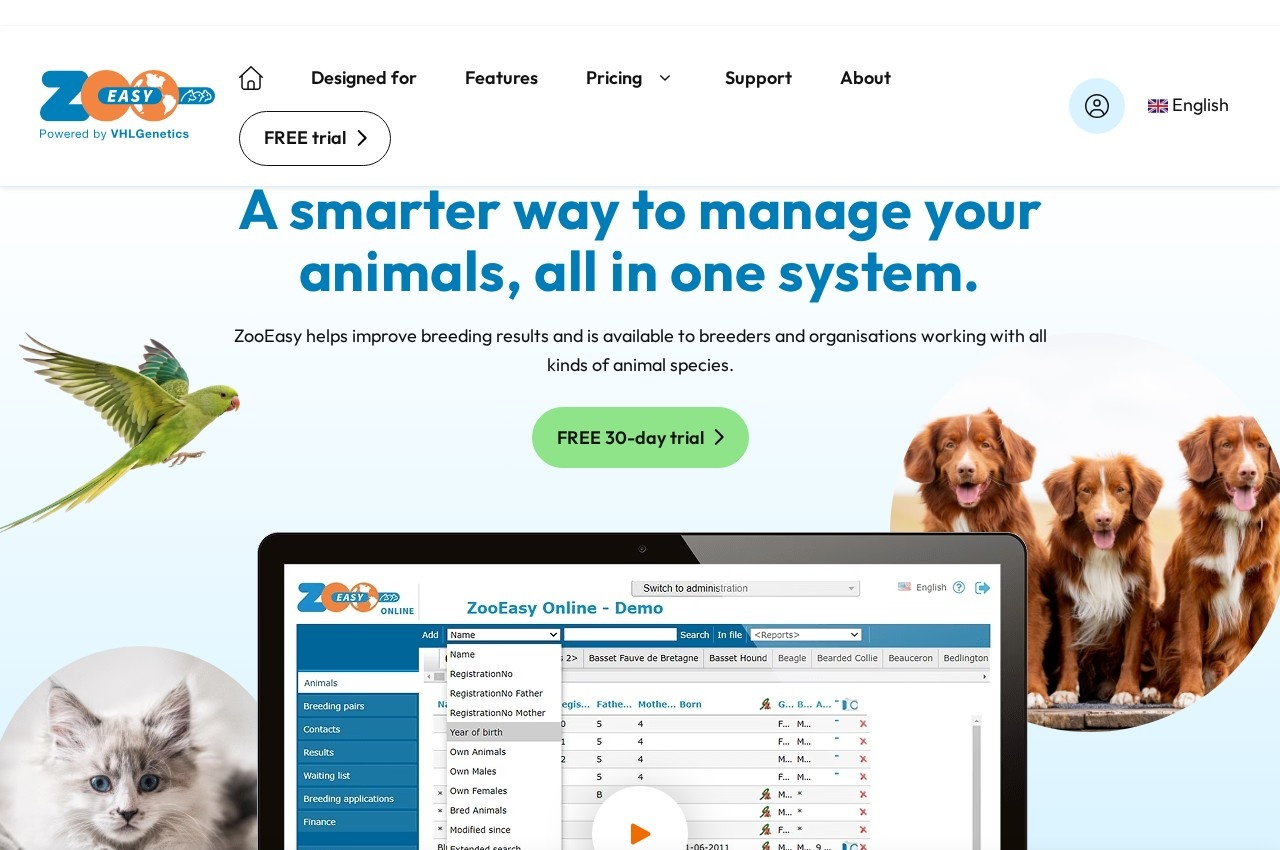
ZooEasy is animal administration software aimed at improving breeding results, available to breeders and organisations working with all kinds of animal species, published in English and Dutch with a free 30 day trial and both yearly and monthly billing.
Focusing on breeding rather than on collection management is what distinguishes this from the zoo software most people expect, and it addresses a genuinely technical problem.
Breeding decisions depend on pedigree analysis, and pedigree analysis is unforgiving arithmetic that people do badly by intuition. The central question is relatedness: how closely two candidate animals are related through every path in their shared ancestry, not just the obvious ones. Two animals with no common parent or grandparent can still be substantially related through repeated ancestors further back, and that is invisible without calculation.
Getting it wrong has consequences that appear generations later as reduced fertility, higher juvenile mortality and expressed genetic defects, by which point the affected animals exist and the decisions that produced them cannot be undone.
For small populations, which describes most conservation breeding programmes and many rare breed registries, managing relatedness across the whole population rather than pair by pair is the entire discipline. A programme that optimises each pairing individually will still lose genetic diversity if the same successful lines dominate.
Supporting all species rather than specialising matters for organisations holding mixed collections, and for breed societies whose data structure is the same regardless of what animal it describes.
Publishing in Dutch alongside English reflects a European base, which is relevant since pedigree registries and breed societies are strongly national in structure.
Pricing is published with yearly and monthly options and a free 30 day trial, with published figures around GBP 5,04 and GBP 16,96 written in European decimal notation, and subscriptions cancellable at any time.
Key Features of ZooEasy
- Pedigree and ancestry records
- Relatedness and inbreeding calculation
- Breeding pair evaluation
- Population-wide genetic management
- Support for all animal species
- Animal health and treatment records
- Data import from existing records
- English and Dutch interfaces
- Free 30 day trial
- Monthly or yearly billing
- Cancel at any time
ZooEasy Pricing
Monthly
£504
Published monthly rate in European decimal notation, cancellable at any time.
ZooEasy Specifications
- Deployment
- Cloud Based
- Desktop
- Web App
- Windows
- Built for
- Individuals
- Freelancers
- Small Business
- Medium Business
- Support
- Public API
- No
- Free trial
- Yes
- Free plan
- No
- Runs in browser
- No
- Customisable
- No
- Website
- zooeasy.com
ZooEasy Videos
ZooEasy Screenshots
ZooEasy Comparisons



ZooEasy Reviews
No reviews yet
Used ZooEasy? Share your experience and help other buyers decide.