

Fusion Risk Management
VerifiedEnterprise resilience decision system turning continuity data into answers about impact and dependency
 See all screenshots
 - Deployment Cloud Based
- Starting price Quoted on request
- Free trial Not offered
- Best for Medium Business, Large Enterprise
What is Fusion Risk Management?
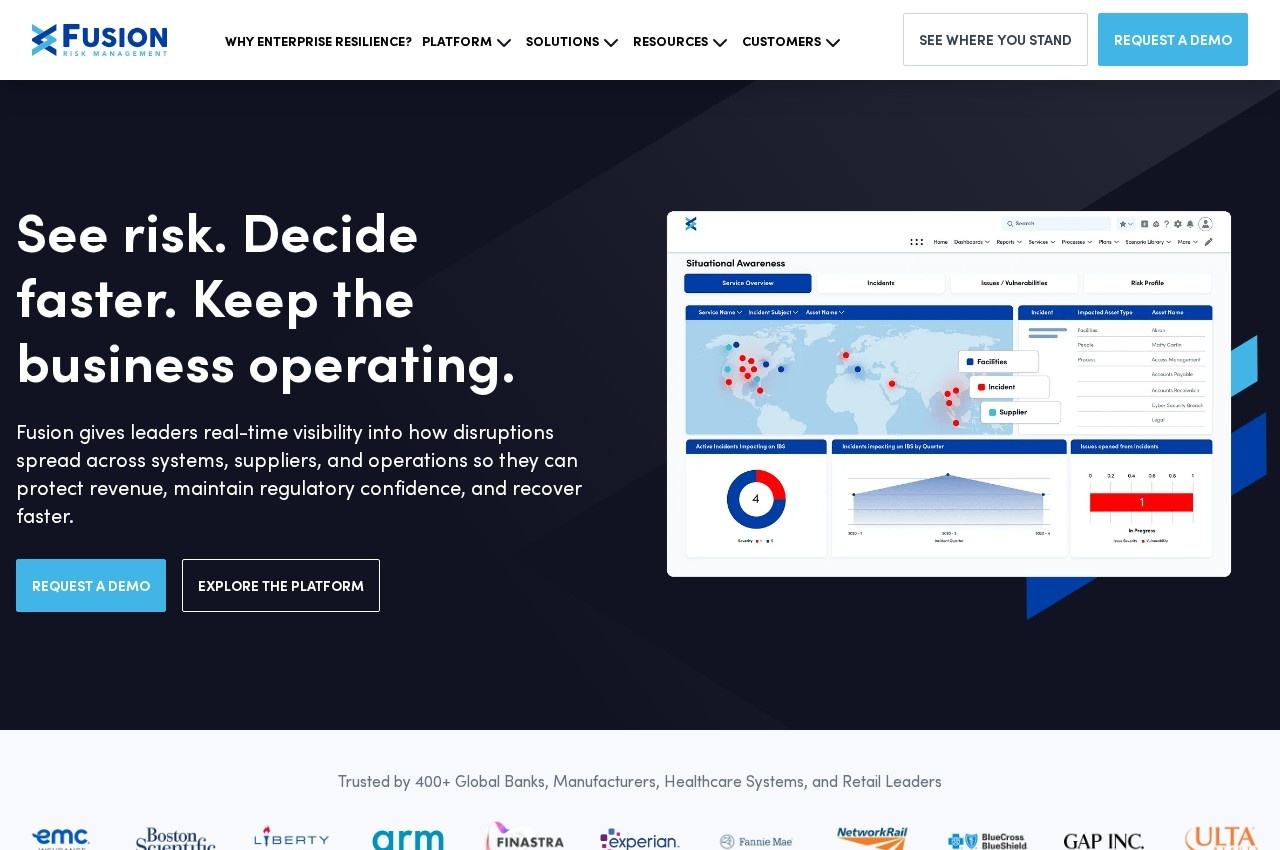
Fusion Risk Management describes its platform as an Enterprise Resilience Decision System, turning resilience data into decision-ready insight that helps leaders answer what is impacted and what happens next. That framing is the useful distinction in this category.
Most business continuity software is a document repository. It holds plans, contact lists and recovery procedures, all of which are necessary and none of which help during the twenty minutes when an executive is deciding whether to invoke a recovery site. The question in that moment is not where the plan is filed but which customers, processes and obligations are affected by this specific failure, and answering it requires the dependency map between systems, processes, suppliers and services rather than a document.
The core products reflect that structure: Business Continuity, IT Disaster Recovery, Crisis and Incident Management, Operational Resilience and Third-Party Risk Management, with Operational Risk alongside. Extensions cover Fusion Intelligence, Recovery Optimization and Scenario Testing.
Scenario testing is where continuity plans are validated or exposed. A plan that has never been tested against a specific scenario is an assertion, and the gaps found in a tabletop exercise are the ones that would otherwise be found during an actual incident.
Third-party risk sitting inside the same platform is increasingly the point, since most operational failures now arrive through a supplier rather than through the organisation's own systems, and continuity planning that stops at the perimeter misses where the risk actually lives.
Solutions are organised by challenge, including building and validating continuity plans, planning and testing IT disaster recovery, coordinating crisis response and meeting operational resilience regulations. Roles addressed include operations, supply chain, finance, IT and risk leaders. Pricing is not published.
Key Features of Fusion Risk Management
- Business continuity planning and validation
- IT disaster recovery planning and testing
- Crisis and incident management
- Operational resilience regulatory compliance
- Third-party and supplier risk management
- Operational risk management
- Dependency mapping across processes and systems
- Scenario testing and tabletop exercises
- Recovery optimisation
- Fusion Intelligence analytics
- Role-based views for operations, IT and risk leaders
Fusion Risk Management Pricing
Quoted
Quoted on request
No pricing is published. Normally quoted on users, processes covered and which core products and extensions are taken.
Fusion Risk Management Specifications
- Deployment
- Cloud Based
- Desktop
- Web App
- Built for
- Medium Business
- Large Enterprise
- Support
- Phone
- Public API
- Yes
- Free trial
- No
- Free plan
- No
- Runs in browser
- No
- Customisable
- No
- Website
- fusionrm.com
Fusion Risk Management Screenshots
Fusion Risk Management Comparisons



Fusion Risk Management Reviews
No reviews yet
Used Fusion Risk Management? Share your experience and help other buyers decide.
Fusion Risk Management FAQs
Alternatives to Fusion Risk Management
Other Business Continuity Management Software recorded on the same fields.