
LogicGate Risk Cloud
VerifiedNo-code GRC on a flexible graph database, with agentic AI and quantified risk in financial terms
 See all screenshots
 - Deployment Cloud Based
- Starting price Quoted on request
- Free trial Not offered
- Best for Medium Business, Large Enterprise
What is LogicGate Risk Cloud?
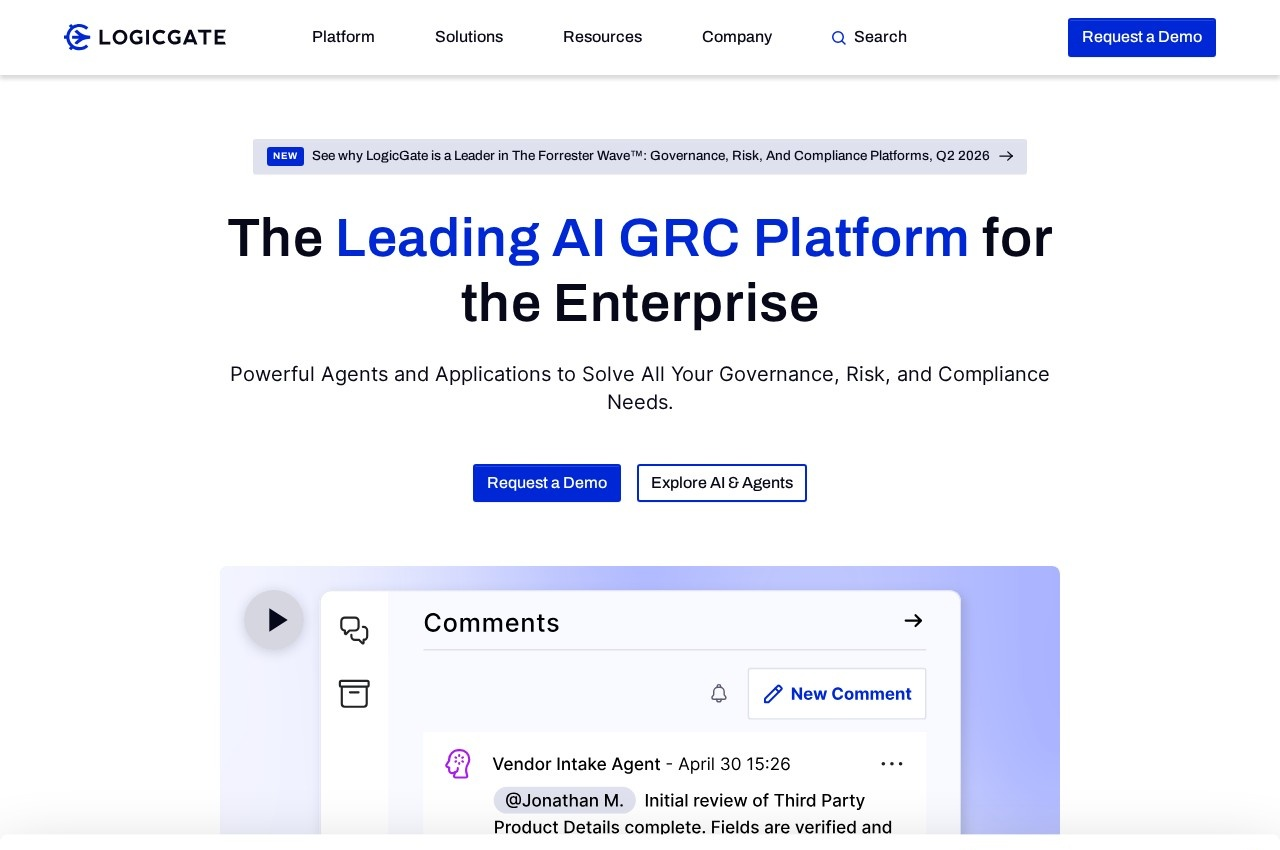
LogicGate Risk Cloud is a governance, risk and compliance platform built on a no-code flexible graph database, with operational resilience and business continuity among the risk programmes it supports.
The graph database is the architectural decision that shapes everything else, and it suits this problem unusually well. Risk information is a network rather than a hierarchy: a control mitigates several risks, a risk affects multiple processes, a process depends on several vendors, and a vendor supports many controls. Relational systems model that awkwardly and organisations end up maintaining the relationships in spreadsheets alongside the platform. A graph stores the relationships natively, which is what makes questions like which business processes are exposed if this vendor fails answerable rather than a manual exercise.
Risk Cloud Quantify addresses the other persistent problem in this discipline, which is that risk expressed as high, medium or low gives an executive nothing to decide with. Quantifying exposure in financial terms is what lets a board compare a risk against the cost of mitigating it, and it is the difference between a risk report that is read and one that is filed.
The AI capabilities are specific: AI Agents automate routine work and orchestrate workflows, and Config Newton is described as an agentic GRC engineer, aimed at the configuration burden that consumes GRC teams.
Automated evidence monitoring is the operationally significant feature, since collecting control evidence is the recurring drudgery of compliance, and monitoring it continuously beats gathering it before each audit.
Framework coverage includes SCF, ISO 27001-2, PCI DSS, SOC 2 TSC, NIST CSF, GDPR, HIPAA, NIST 800-53, CIS and CCPA, with DORA compliance addressed directly. A pricing page is published but no plan figure was retrievable.
Key Features of LogicGate Risk Cloud
- No-code GRC application building
- Flexible graph database for risk relationships
- Operational resilience and business continuity
- Risk Cloud Quantify for financial risk quantification
- AI agents for workflow automation
- Config Newton agentic GRC configuration
- Automated evidence monitoring
- Cyber, enterprise and third-party risk management
- Compliance and internal audit
- AI governance and policy management
- DORA compliance support
- Coverage of ISO 27001, PCI DSS, SOC 2, NIST and HIPAA
- Reporting and analytics
LogicGate Risk Cloud Pricing
Quoted
Quoted on request
A pricing page exists but publishes no retrievable figure. Normally quoted on applications deployed and user count.
LogicGate Risk Cloud Specifications
- Deployment
- Cloud Based
- Desktop
- Web App
- Built for
- Medium Business
- Large Enterprise
- Support
- Phone
- Public API
- Yes
- Free trial
- No
- Free plan
- No
- Runs in browser
- No
- Customisable
- No
- Website
- logicgate.com
LogicGate Risk Cloud Screenshots
LogicGate Risk Cloud Comparisons



LogicGate Risk Cloud Reviews
No reviews yet
Used LogicGate Risk Cloud? Share your experience and help other buyers decide.
LogicGate Risk Cloud FAQs
Alternatives to LogicGate Risk Cloud
Other Business Continuity Management Software recorded on the same fields.