

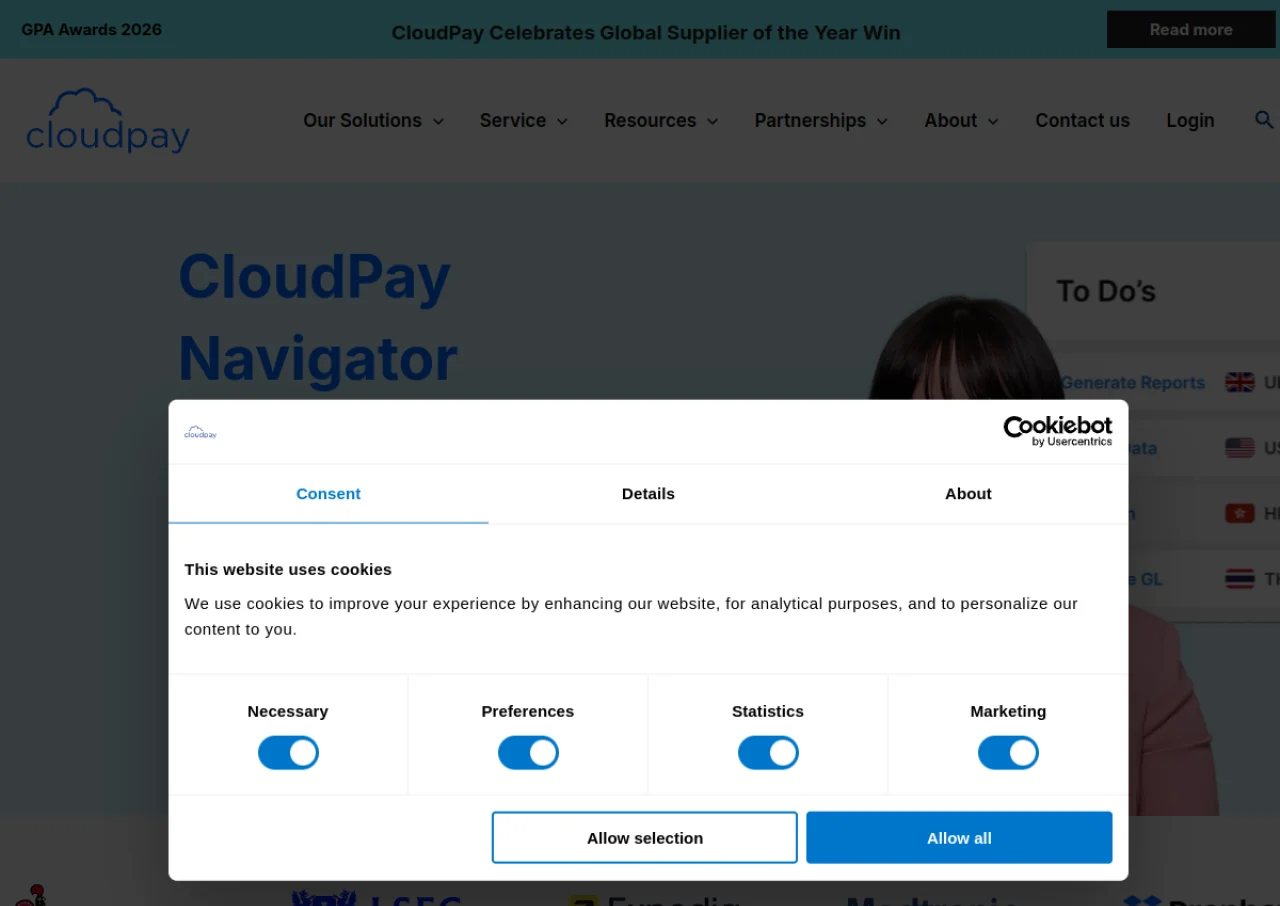
 See all screenshots
 - Deployment Cloud Based
- Starting price Custom
- Free trial Not offered
- Best for Enterprises
What is CloudPay?
CloudPay is a global payroll and payments platform that provides fully managed payroll services for multinational organizations. It processes payroll across 140+ countries and pays employees in 160+ currencies from a single unified platform, combining automated payroll software with in-country compliance expertise and dedicated payroll specialists. The platform integrates with major HCM systems such as Workday, Oracle, SAP SuccessFactors, and HiBob through bi-directional data connections.
Beyond core payroll processing, CloudPay offers global payments and funding services, on-demand pay (earned wage access) for employees, and analytics and reporting tools for payroll data visibility. It is aimed at large, multinational enterprises rather than small businesses, and pricing is customized per organization rather than published, since implementations vary widely by employee headcount and country complexity.
Key Features of CloudPay
CloudPay lists 9 documented features, including Multi-country payroll processing across 140+ countries, Global payments in 160+ currencies and Pay On-Demand / earned wage access via card-based payments. The list below covers what the product does rather than how it is marketed.
- Multi-country payroll processing across 140+ countries
- Global payments in 160+ currencies
- Pay On-Demand / earned wage access via card-based payments
- Bi-directional HCM system integrations (Workday, Oracle, SAP SuccessFactors, HiBob)
- CloudPay Connect data integration and automated validation
- Payroll analytics and reporting dashboards
- In-country compliance and regulatory support
- CloudPay mobile app for employee access
- Dedicated managed-service payroll specialists
CloudPay Pricing
CloudPay lists 1 plan without published figures. Pricing is quoted on request.
Custom
Custom
CloudPay does not publish standard pricing. Cost is quoted per organization based on employee count, number of countries, and services selected (payroll, payments, on-demand pay). Contact CloudPay sales for a quote.
CloudPay Specifications
CloudPay is available on web app and has iOS and Android apps. It offers an API.
- Deployment
- Cloud Based
- Billing cycle
- Monthly
- Desktop
- Web App
- Mobile
- iOS
- Android
- Languages
- English
- Built for
- Enterprises
- Support
- Phone
- Tickets
- Integrations
- Workday, Oracle, SAP SuccessFactors, HiBob, and other HCM/finance systems via CloudPay Connect API
- Public API
- Yes
- Free trial
- No
- Free plan
- No
- Runs in browser
- Yes
- Customisable
- Yes
- Website
- cloudpay.com
CloudPay Videos
CloudPay Screenshots
CloudPay Comparisons
Side by side comparisons of CloudPay against 3 other International Payroll Software options listed here.



Used CloudPay? Write the first review.
CloudPay FAQs
Alternatives to CloudPay
Other International Payroll Software recorded on the same fields.