

Azure Cosmos DB
VerifiedGlobally distributed JSON storage with vector search and enterprise SLAs
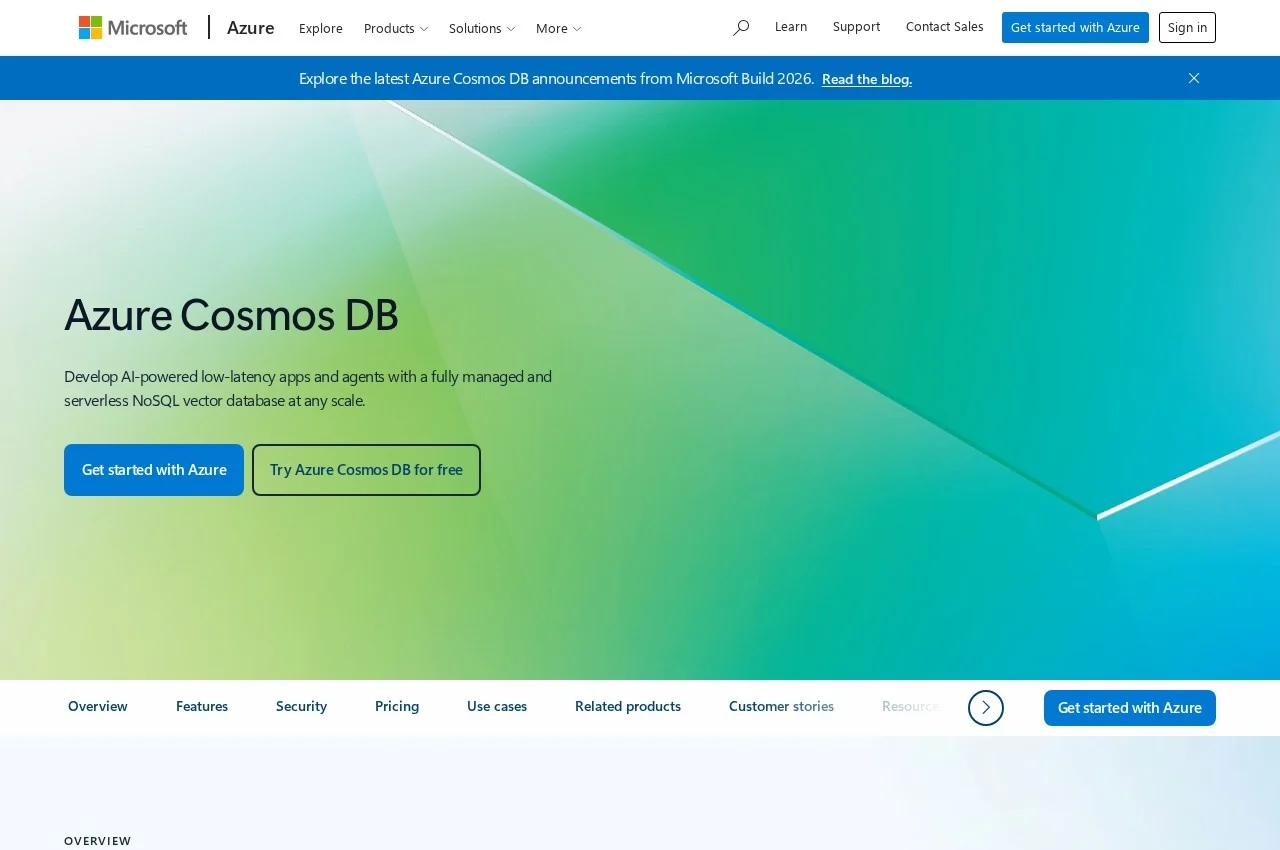 See all screenshots
- Deployment Cloud Based, SaaS
- Starting price Not published
- Free trial Available
- Best for Small Business, Medium Business, Large Enterprise
What is Azure Cosmos DB?
Azure Cosmos DB is a fully managed, cloud-native NoSQL database using a schema-agnostic JSON document model, designed for ultra-low latency and elastic scale globally, with software development kits for Python, Node.js, Java and .NET.
Global distribution as a first-class property rather than a configuration option is the defining characteristic. Most databases can be replicated across regions with enough work; Cosmos DB is built so that multi-region operation is the normal case, which matters for an application serving users on several continents where the alternative is either poor latency for most of them or a distributed system the team maintains itself.
Unifying transactions, search and embeddings in one service is the current positioning and it addresses a real architectural annoyance. An AI application typically needs an operational database, a search index and a vector store, which means three systems to keep consistent and three failure modes. Built-in vector and hybrid search on the operational data removes two of them, which is why Microsoft positions Cosmos DB for retrieval augmented generation and agentic applications.
One naming change is worth knowing before evaluating: Azure DocumentDB is the new name for vCore-based Azure Cosmos DB for MongoDB, a fully managed MongoDB-compatible database built on the open source DocumentDB engine under the Linux Foundation. Automatic indexing, integration with Microsoft Foundry and enterprise service level agreements complete the offer. Billing is by request units and storage through the Azure pricing calculator rather than as plan tiers.
Key Features of Azure Cosmos DB
- Schema-agnostic JSON document model
- Multi-region global distribution
- Ultra-low latency reads and writes
- Elastic scale on demand
- Built-in vector search
- Hybrid search support
- Automatic indexing
- Python, Node.js, Java and .NET SDKs
- Microsoft Foundry integration
- Enterprise service level agreements
- MongoDB-compatible option via Azure DocumentDB
- Request unit based billing
Azure Cosmos DB Pricing
Request unit billing
Not published
Charged on provisioned or consumed request units plus storage, calculated through the Azure pricing calculator rather than published as plan tiers. A free tier and a free Azure account credit are available.
Azure Cosmos DB Specifications
- Deployment
- Cloud Based
- SaaS
- Desktop
- Web App
- Built for
- Small Business
- Medium Business
- Large Enterprise
- Support
- Phone
- Knowledge Base
- Public API
- Yes
- Free trial
- Yes
- Free plan
- No
- Runs in browser
- No
- Customisable
- No
- Website
- azure.microsoft.com
Azure Cosmos DB Screenshots
Azure Cosmos DB Comparisons


Used Azure Cosmos DB? Write the first review.
Azure Cosmos DB FAQs
Alternatives to Azure Cosmos DB
Other Document Databases recorded on the same fields.