

Apache Cassandra
VerifiedMasterless distributed storage that survives losing an entire data centre
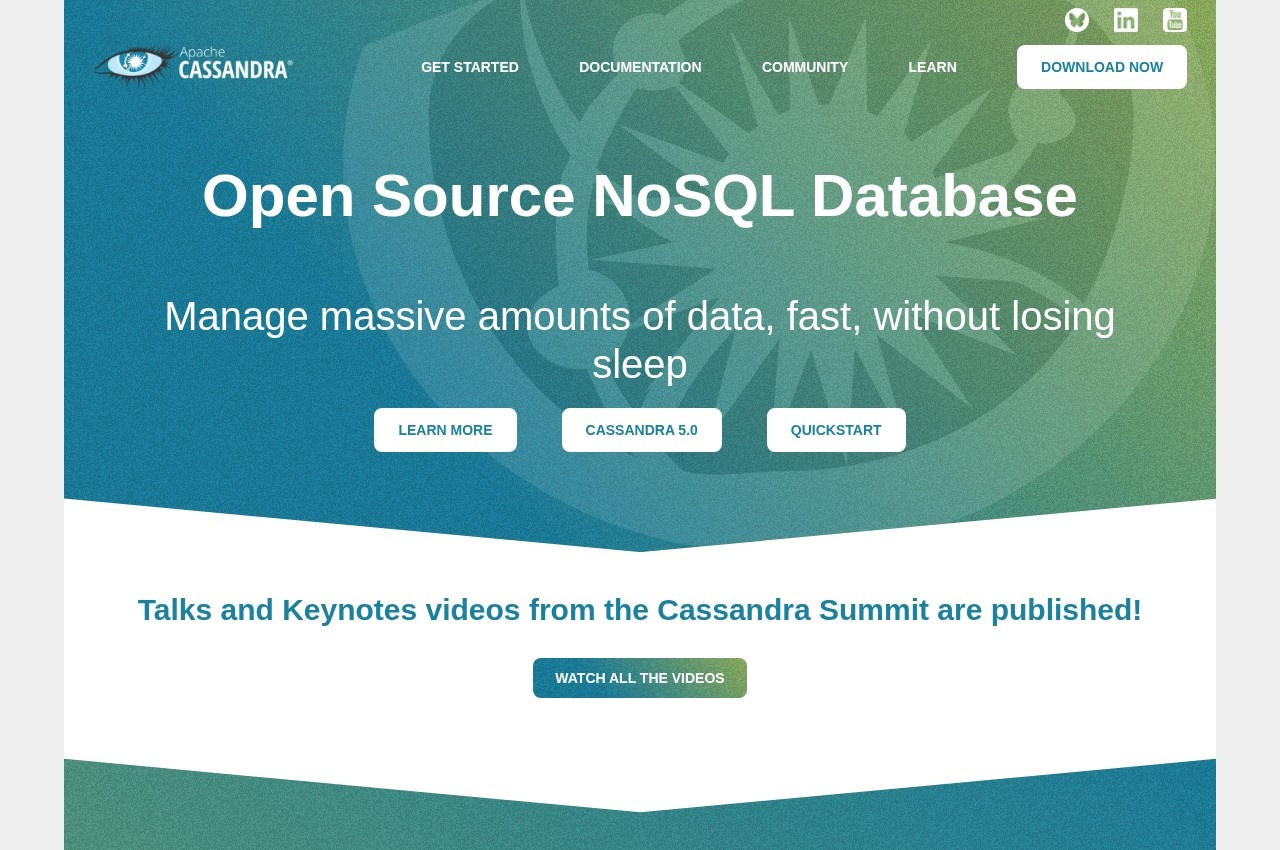 See all screenshots
 - Deployment On Premise, Cloud Based
- Starting price Free
- Free trial Available
- Best for Small Business, Medium Business, Large Enterprise
What is Apache Cassandra?
Apache Cassandra is an open source distributed NoSQL database built for scalability and high availability without sacrificing performance, running on commodity hardware or cloud infrastructure and used by thousands of companies for mission-critical data.
The masterless architecture is the design decision everything else follows from, and it is the reason Cassandra exists as a distinct category of database. A system with a primary node has a component whose failure stops writes, however good the failover is, and failover itself is an event with a duration and a risk. Every node in a Cassandra cluster accepts writes, so there is no such component and no failover to get wrong.
The consequence is stated plainly by the project: a cluster will withstand an entire data centre outage with no data loss, across public cloud, private cloud and on premises. Multi-datacentre replication is described as best in class, giving lower latency to users near each region and survival of a regional outage, and failed nodes can be replaced with no downtime at all.
Linear scalability is the other half of the proposition and the reason large deployments choose it: adding nodes adds throughput proportionally rather than hitting a coordination ceiling. The project takes verification seriously, testing on clusters as large as 1,000 nodes against hundreds of real world use cases, which is the kind of evidence that matters when the failure mode being claimed is rare by design. Cassandra 5.0 is the current release. It is free and open source under the Apache Software Foundation, with a Catalyst programme, published case studies and Cassandra Summit talks.
Key Features of Apache Cassandra
- Open source under Apache Foundation
- Masterless distributed architecture
- Every node accepts writes
- Linear scalability by adding nodes
- Multi-datacentre replication
- Survives a full data centre outage
- No-downtime node replacement
- Runs on commodity hardware
- Public, private and on-premises deployment
- Tested on 1,000 node clusters
- Cassandra 5.0 release
- Community governance and Catalyst programme
Apache Cassandra Pricing
Free and open source
Free
Free under the Apache Software Foundation with no licence cost. Expenditure is the infrastructure it runs on plus any commercial support or managed service chosen separately.
Apache Cassandra Specifications
- Deployment
- On Premise
- Cloud Based
- Desktop
- Linux
- Web App
- Built for
- Small Business
- Medium Business
- Large Enterprise
- Support
- Knowledge Base
- Public API
- Yes
- Free trial
- Yes
- Free plan
- No
- Runs in browser
- No
- Customisable
- No
- Website
- cassandra.apache.org
Apache Cassandra Videos
Apache Cassandra Screenshots
Apache Cassandra Comparisons

Apache Cassandra Reviews
No reviews yet
Used Apache Cassandra? Share your experience and help other buyers decide.