

Amazon SQS
VerifiedFully managed, pay-as-you-go message queuing service for decoupling cloud applications.
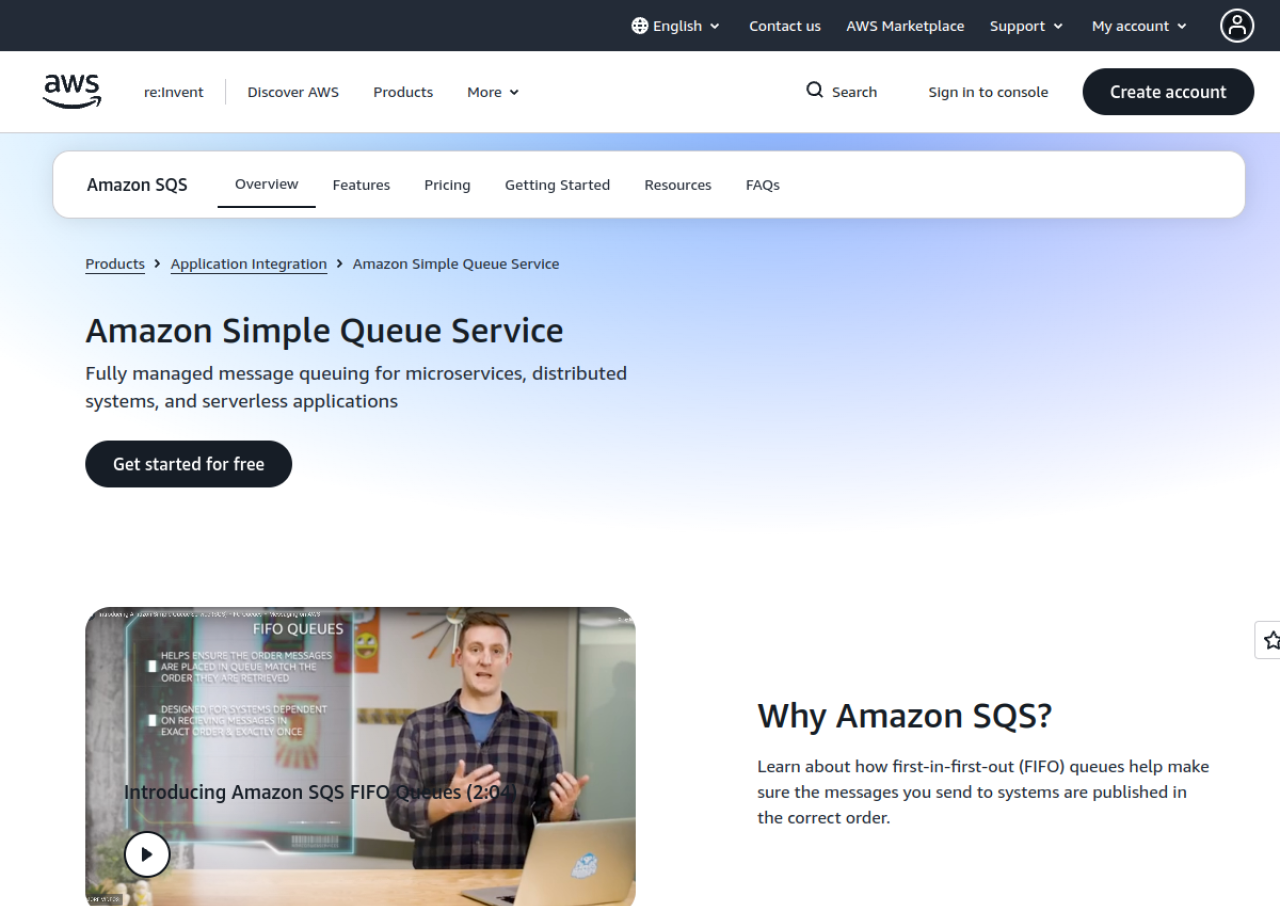 See all screenshots
 - Deployment Cloud Based
- Starting price Free
- Free trial Not offered
- Best for Freelancers, Startups, SMEs
What is Amazon SQS?
Amazon Simple Queue Service, or SQS, is a fully managed message queuing service from Amazon Web Services that lets distributed application components send, store, and receive messages without the customer managing any queue infrastructure. It offers standard queues for high throughput with at-least-once delivery and FIFO queues for strict first-in-first-out ordering with exactly-once processing. Messages can be retained from one minute up to 14 days, and dead-letter queues isolate messages a consumer fails to process.
SQS is billed per request rather than a flat subscription fee, and the first one million requests each month are free for every customer. It integrates closely with other AWS services such as Lambda, EC2, S3, DynamoDB, SNS, and CloudWatch, and it can encrypt messages using AWS Key Management Service.
Key Features of Amazon SQS
Amazon SQS lists 8 documented features, including Standard queues with at-least-once delivery and nearly unlimited throughput, FIFO queues with exactly-once processing and strict message ordering and Fair queues that reduce noisy-neighbor impact between tenants sharing a queue. The list below covers what the product does rather than how it is marketed.
- Standard queues with at-least-once delivery and nearly unlimited throughput
- FIFO queues with exactly-once processing and strict message ordering
- Fair queues that reduce noisy-neighbor impact between tenants sharing a queue
- Dead-letter queues for isolating and diagnosing messages that fail processing
- Configurable message retention from 1 minute up to 14 days
- Server-side encryption using AWS Key Management Service
- Extended payload support up to 2 GiB via the Amazon S3 Extended Client Library
- Native integration with AWS Lambda, EC2, DynamoDB, SNS, and CloudWatch
Amazon SQS Pricing
Amazon SQS lists 3 plans. One is free; the rest are quoted on request.
Free Tier
Free
1 million requests/month
Available to all customers every month; does not expire or roll over
Standard queue requests
From $0.40 per million requests
First 100 billion requests/month, lower tiered rates at higher volume
Pay-as-you-go billing per request beyond the free tier
FIFO queue requests
From $0.50 per million requests
First 100 billion requests/month, lower tiered rates at higher volume
Pay-as-you-go pricing for guaranteed ordering and exactly-once processing
Amazon SQS Specifications
Amazon SQS is available on web app. It offers an API and has a free plan.
- Deployment
- Cloud Based
- Billing cycle
- Transaction
- Desktop
- Web App
- Languages
- English
- Built for
- Freelancers
- Startups
- SMEs
- Enterprises
- Support
- Tickets
- Phone
- Training
- Integrations
- AWS Lambda, Amazon EC2, Amazon S3 (via the Extended Client Library), Amazon DynamoDB, Amazon SNS, Amazon CloudWatch, AWS Key Management Service, and AWS SDKs for Java, Python (Boto3), JavaScript/Node.js, .NET, Go, and other languages
- Public API
- Yes
- Free trial
- No
- Free plan
- Yes
- Runs in browser
- No
- Customisable
- Yes
- Website
- aws.amazon.com
Amazon SQS Videos
Amazon SQS Screenshots
Amazon SQS Comparisons
Side by side comparisons of Amazon SQS against 3 other Message Oriented Middleware options listed here.



Amazon SQS Reviews
No reviews yet
Used Amazon SQS? Share your experience and help other buyers decide.
Amazon SQS FAQs
Alternatives to Amazon SQS
Other Message Oriented Middleware recorded on the same fields.