

Apache Pulsar
VerifiedOpen-source, cloud-native distributed messaging and streaming platform with built-in multi-tenancy.
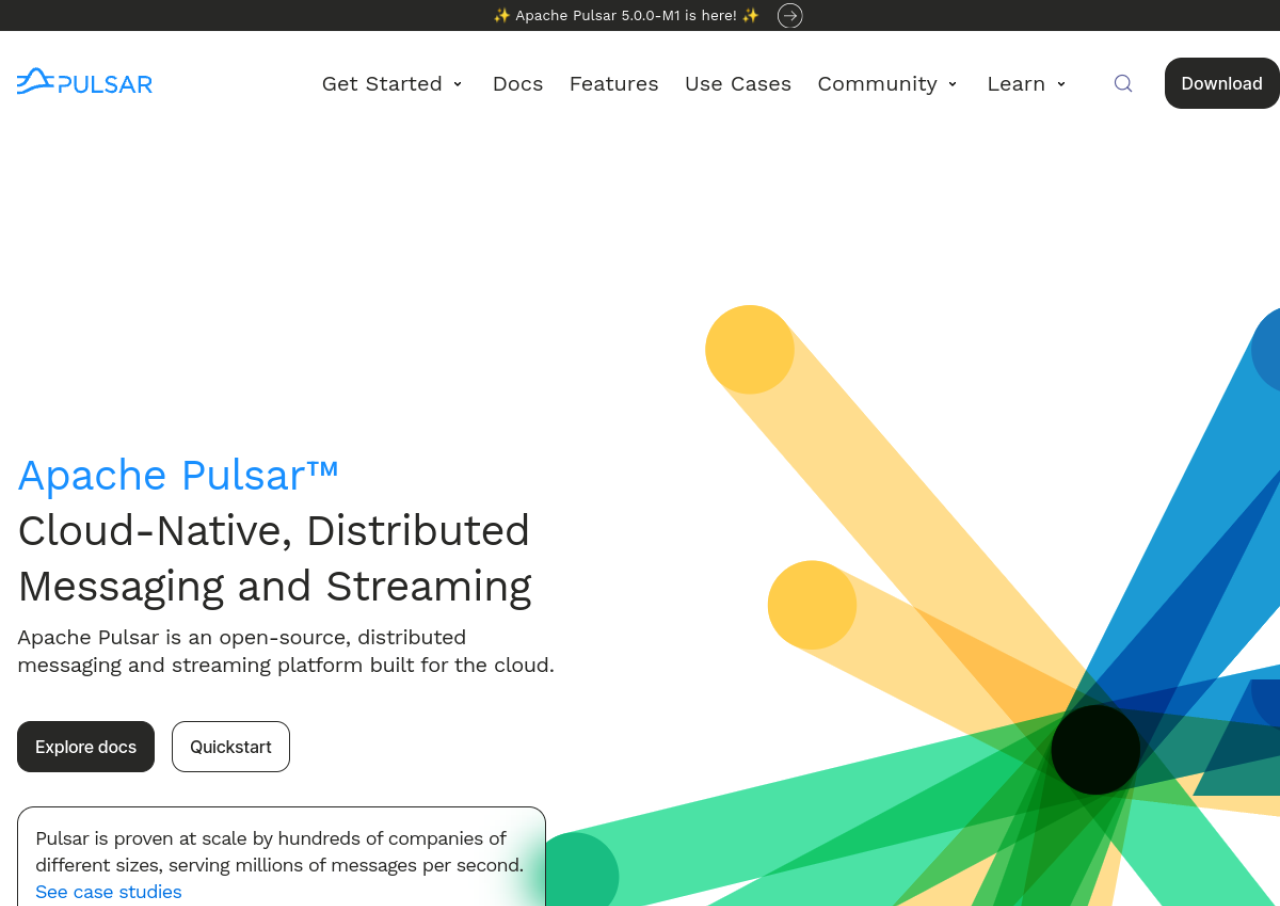 See all screenshots
 - Deployment On Premises, Cloud Based, Hybrid
- Starting price Free
- Free trial Not offered
- Best for Startups, SMEs, Enterprises
What is Apache Pulsar?
Apache Pulsar is an open-source, distributed messaging and streaming platform originally created at Yahoo and now maintained as a top-level Apache Software Foundation project. It combines traditional message queuing with stream processing in a single system, separating stateless brokers from an Apache BookKeeper storage layer so brokers can be added or removed without reshuffling data.
Pulsar supports multi-tenancy, geo-replication across clusters, and topic-level acknowledgment models similar to both Kafka and RabbitMQ. It offers official client libraries for Java, Go, Python, C++, Node.js, and C#, plus Pulsar Functions for lightweight serverless processing. Because it is licensed under Apache License 2.0, Pulsar can be self-hosted on premises or in any cloud at no licensing cost, with commercial managed offerings available from third-party vendors.
Key Features of Apache Pulsar
Apache Pulsar lists 10 documented features, including Unified messaging and streaming platform with pub-sub and queue semantics in one system, Multi-layered architecture separating stateless brokers from Apache BookKeeper storage and Native geo-replication across clusters and regions with automatic client failover. The list below covers what the product does rather than how it is marketed.
- Unified messaging and streaming platform with pub-sub and queue semantics in one system
- Multi-layered architecture separating stateless brokers from Apache BookKeeper storage
- Native geo-replication across clusters and regions with automatic client failover
- Multi-tenancy with built-in namespace isolation, quotas, and access control
- Supports up to a million topics per cluster with horizontal scalability across hundreds of nodes
- Pulsar Functions for lightweight serverless stream processing in Java, Go, and Python
- Individual and cumulative message acknowledgment models
- Official client libraries for Java, Go, Python, C++, Node.js, and C#
- Tiered storage offloading of older data to systems like S3 for cost-effective long-term retention
- Schema registry for enforcing structured data formats across producers and consumers
Apache Pulsar Pricing
Apache Pulsar lists one plan, at Free.
Apache Pulsar (Open Source)
Free
Unlimited
Released under the Apache License 2.0. Free to download, self-host, and modify with no usage limits imposed by the Apache Software Foundation.
Apache Pulsar Specifications
Apache Pulsar is available on web app. It offers an API and has a free plan.
- Deployment
- On Premises
- Cloud Based
- Hybrid
- Billing cycle
- Monthly
- Desktop
- Web App
- Languages
- English
- Built for
- Startups
- SMEs
- Enterprises
- Integrations
- Apache Kafka (via Kafka-on-Pulsar protocol handler), Apache Flink, Apache Spark, Presto/Trino, Debezium, Apache BookKeeper, JDBC, Elasticsearch, Cassandra, Java, Go, Python, C++, Node.js, C#
- Public API
- Yes
- Free trial
- No
- Free plan
- Yes
- Runs in browser
- No
- Customisable
- Yes
- Website
- pulsar.apache.org
Apache Pulsar Videos
Apache Pulsar Screenshots
Apache Pulsar Comparisons
Side by side comparisons of Apache Pulsar against 3 other Message Oriented Middleware options listed here.



Apache Pulsar Reviews
No reviews yet
Used Apache Pulsar? Share your experience and help other buyers decide.
Apache Pulsar FAQs
Alternatives to Apache Pulsar
Other Message Oriented Middleware recorded on the same fields.