
Ask five agencies what a payment gateway costs to build and you’ll hear numbers from 30,000 dollars to well over a million.
That spread isn’t about quality. It’s about what each quote counts, and the part most of them leave out is the part that makes something a payment gateway at all.
The software is the cheap part. Certification, a bank willing to settle your transactions, licensing and fraud liability all cost more than the code.
They also take longer to secure than the code takes to write.
Key Takeaways
- Building your own gateway costs a development quote plus certification, banking and licensing.
- Renting a white-label gateway puts your brand on someone else’s licensed infrastructure.
- Integrating an existing processor costs developer time, then only per-transaction fees.
- Paying transaction fees, not the build, is what decides the long-run bill.
What a Payment Gateway Does
It’s the piece that carries a card payment from the checkout to the networks that approve it.
When a customer pays, the gateway encrypts the card details, sends them to the processor, which routes them through the card network to the customer’s bank. The answer comes back the same way in about two seconds, approved or declined.
That round trip is the easy part to describe and the hard part to be trusted with. Everything that makes a gateway expensive exists because it touches card data and money that belong to other people.
The Three Routes
Every business accepting card payments takes one of three.
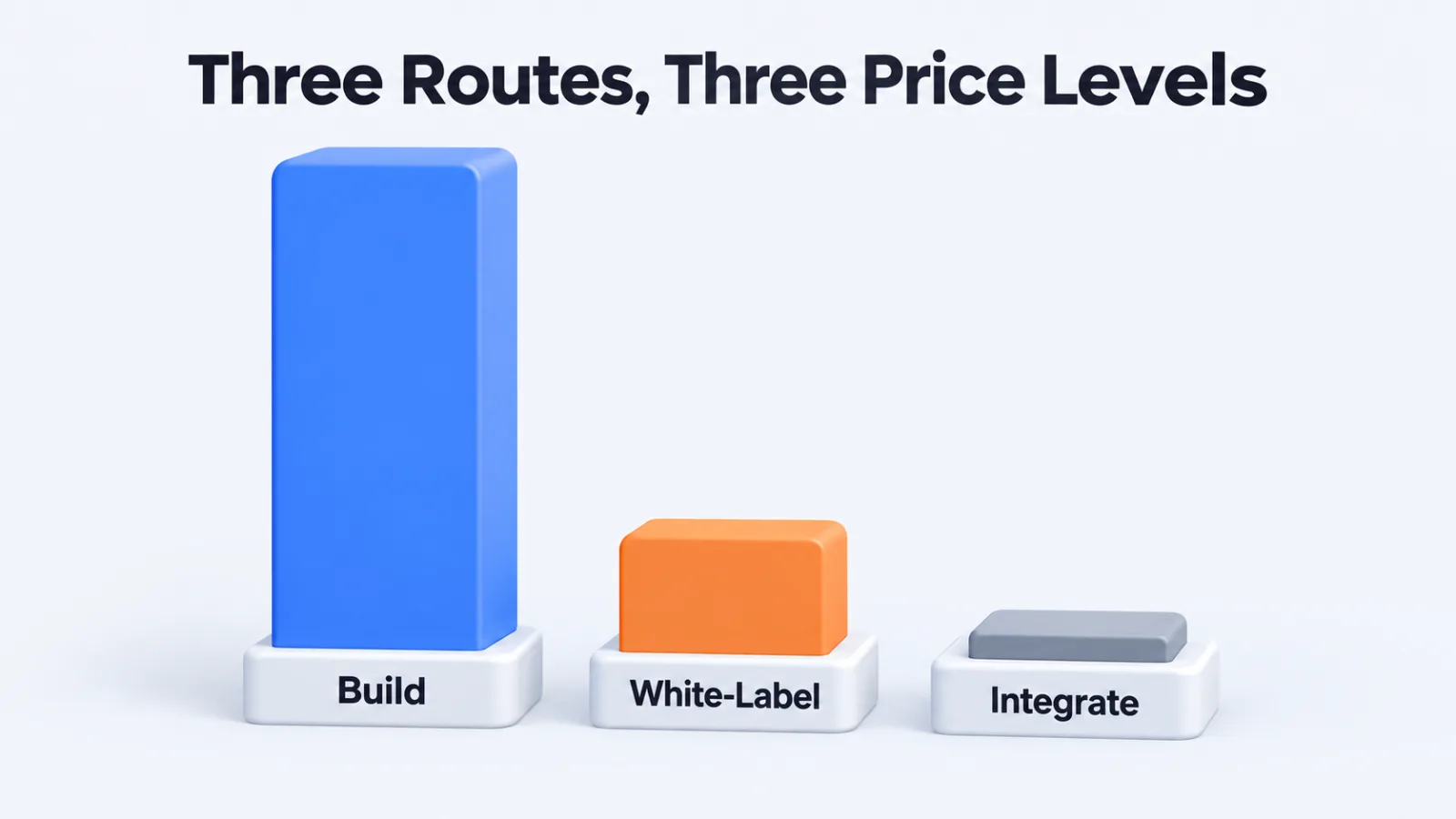
| Route | Upfront cost | Time to first payment | Suits |
|---|---|---|---|
| Build your own | 500,000 dollars and up, all in | 12 to 24 months | Companies whose product is payments |
| White-label | 5,000 to 50,000 dollars setup | 1 to 3 months | Platforms reselling payments to their users |
| Integrate a processor | Developer days to weeks | Days | Nearly every other business |
The first row is what the development agencies quote for, and the third is what most of the people searching for it need. The middle row is the one both camps tend to skip.
What a Build Quote Leaves Out
A development estimate prices the software, and a gateway is mostly not software.
Four things sit outside nearly every build quote.
- Certification at the card industry’s highest security level.
- Settlement through an acquiring bank that agrees to take you on.
- Registration with each card network you intend to accept.
- Licenses, required in most places for moving other people’s money.
Each of those takes months and none of them can be bought from an agency. They are relationships and audits, and they’re the reason a working prototype can sit for a year before it’s allowed to process a real card.
Certification Is Its Own Budget
Handling card numbers directly puts you under the strictest tier of the card industry’s security standard.
Reaching it means an on-site assessment by a qualified auditor, quarterly vulnerability scans, penetration testing, and documented controls across the whole organization rather than only the code. First-year certification commonly runs into six figures once remediation is counted.
It doesn’t end at year one. The assessment repeats annually, and any change to how card data flows can trigger another review. That’s a permanent line in the budget, not a launch cost.
The Bank Nobody Mentions
A gateway moves card data. Moving the money needs an acquiring bank.
Acquirers take on the risk of your transactions, so they vet a new gateway operator closely: its capital, its fraud controls, its compliance history. A new company with no processing track record often struggles to get one at all.
Without an acquirer, a finished gateway can authorize nothing. It’s the single dependency most build estimates don’t mention, and it’s the one that stops projects outright rather than delaying them.
What “Build a Gateway” Often Means
Read an agency proposal closely before comparing it to anything.
A quote to build a payment gateway frequently turns out to be something smaller. It’s a checkout, a merchant dashboard and some reporting, built on top of an existing processor.
That’s a reasonable thing to buy, and it costs a fraction of a real gateway.
Ask directly whose infrastructure authorizes the card. If the answer is a processor you’ll sign up with, you’re buying an integration with a custom front end, and it should be priced like one.

White-Label: Renting a Licensed Gateway
The middle route puts your brand on infrastructure somebody else has already certified.
A white-label provider has done the audits, holds the banking relationships and carries the licensing. You pay a setup fee, typically 5,000 to 50,000 dollars depending on how much customization you need, plus a share of every transaction or a monthly platform fee.
It suits a platform that wants to offer payments to its own users under its own name, such as a marketplace or a vertical software product. It’s rarely worth it for a business that only needs to take payments for itself.
Integrating a Processor
This is the route that fits nearly everyone, and its cost is mostly time.
A hosted checkout, where the processor’s page takes the card, can be live in a few days.
A fully embedded checkout puts the card form inside your own pages and takes a few weeks. Your certification burden stays low, because the card data still never touches your servers.
There’s no build fee and no fixed monthly platform cost on the standard plans. You pay per successful transaction, and that fee is where the real comparison belongs.
Chargebacks and Fraud Land on the Owner
Whoever runs the gateway carries the losses when payments go wrong.
A chargeback happens when a cardholder disputes a charge and the money is pulled back, usually with a fee on top. Fraudulent transactions generate them in bulk, and a gateway operator with a high chargeback rate risks losing its acquiring bank entirely.
An integrated processor runs the fraud screening and absorbs much of that risk inside its fee. An owned gateway has to build or buy fraud detection, staff the dispute process, and hold reserves against losses that arrive weeks after the sale.
Transaction Fees Decide the Long Run
Over years, the per-transaction fee dwarfs any build or setup cost.
Standard card processing runs around 2.9 percent plus a small fixed fee per transaction at list rates. On 5 million dollars a year of card volume, that’s roughly 150,000 dollars a year in fees, every year.
That number is the honest reason large companies consider building. Saving half a percentage point on hundreds of millions of volume can fund a gateway. On a few million, it can’t come close to covering the certification alone.
The same logic applies to payment processing as a second bill in property management software, where the processing fee can quietly exceed the subscription it sits beside.
What Integration Still Costs
The cheap route has its own smaller extras worth knowing before you sign.
- Chargeback fees, charged per dispute whether or not you win it.
- Currency conversion, added on top when customers pay in another currency.
- International card fees, usually a percentage point or so above domestic.
- Payout timing, since funds typically settle two to seven days after a sale.
None of these changes the answer for most businesses. They’re the lines that separate a quoted rate from an effective rate, and they’re worth adding before comparing two processors.
Negotiating the Rate Instead
Before building anything to cut fees, ask for a lower rate.
Processors publish list rates for small merchants and negotiate below them once volume justifies it. A business processing a few million a year can usually get a meaningful reduction simply by asking, with nothing built at all.
Interchange-plus pricing, where you pay the card network’s actual cost plus a fixed markup, is the structure to ask about at volume. It’s more transparent than a flat rate and usually cheaper past a certain size.
What Moves an Agency’s Estimate
Among build quotes, five inputs explain most of the spread.
- Team location, which moves the same work by a factor of three or four.
- Currency count, since each currency adds settlement and reconciliation work.
- Fraud tooling, built in-house or bought as a service.
- Card storage, which raises the certification burden when you hold card data.
- Integrations, meaning every processor, bank and accounting system connected.
Two quotes differing by ten times usually differ on three of those five. Line them up side by side before assuming either agency is overcharging or underbidding.
Time Is a Cost Too
The build route’s biggest expense may be the year it spends not processing anything.
Twelve to twenty-four months passes between starting a gateway and taking a first live payment, most of it spent on certification and banking rather than code. An integrated processor takes that first payment within the week.
Count the revenue the delay costs, not only the invoice. For a business that needs to take payments to operate, a year of waiting can cost more than the entire build budget.
Running Costs of an Owned Gateway
Owning a gateway turns five one-off costs into permanent monthly lines.
- Compliance staff and legal review, a standing cost rather than a launch cost.
- Annual security assessment, plus the quarterly scans that support it.
- Insurance against fraud and data-breach liability.
- Redundant hosting, since a payment outage stops every sale at once.
- Fraud monitoring, whether bought in or staffed.
Together these run into the low tens of thousands a month for a modest operation. An integrated processor absorbs every one of them into its transaction fee.
The Narrow Case for Building
It does, for a narrow set of companies.
Three conditions have to hold at once.
- Payments are your product, rather than a feature of it.
- Volume is large enough that saved fees clearly exceed a seven-figure build and its running costs.
- Control is needed over a payment flow that no processor offers.
Fail any one of those tests and the build is a cost center pretending to be an asset. Most businesses fail all three, which is why integration is the default for nearly everyone.
Two Kinds of Gateway
The word “gateway” means two different things, and the costs don’t overlap.
A payment gateway authorizes card transactions. An API gateway routes requests between services and is priced per call, a separate line covered in API gateway pricing. A payments platform may run both, and they belong in different parts of the budget.
Questions to Ask Before Choosing
- Ask whose infrastructure authorizes the card.
- Ask who holds the acquiring bank relationship.
- Ask what your certification burden will be under each route.
- Ask for the transaction rate at your projected volume, not the list rate.
- Ask what it costs to leave, including moving stored card data.
The last question matters more than it looks. Stored card details are held by whoever tokenized them, and moving them to a new provider needs cooperation you should confirm before you sign.
Comparing Gateway Options
Once the route is chosen, comparing the gateways themselves gets easy.
The payment gateway software category lists them side by side. For most readers that means comparing processors to integrate rather than platforms to build on, and filtering by the rate at your volume.
Questions People Ask About Payment Gateway Cost
How much does it cost to build a payment gateway?
A development quote runs from about 30,000 dollars to a few hundred thousand. The full cost, once certification, banking relationships and licensing are included, commonly passes 500,000 dollars before the first transaction.
What is a white-label payment gateway?
A white-label payment gateway is a licensed gateway you rent and present under your own brand. You pay a setup fee plus a share of each transaction, and the provider carries the certification.
How much does it cost to integrate a payment gateway?
Mostly developer time, from a few days for a hosted checkout to a few weeks for a fully embedded one. After that you pay per transaction rather than for the gateway itself.
What does a payment gateway cost per year to run?
An owned gateway carries compliance, audits, insurance and hosting in the low tens of thousands a month. An integrated processor costs nothing fixed, only per-transaction fees.
Should a business build its own payment gateway?
Almost never. It makes sense for a company whose product IS payments, processing volume large enough that saved fees outweigh a seven-figure build and its running costs.
Price the Route, Not the Build
Decide which of the three routes you’re on before collecting a single quote.
For nearly every business the answer is to integrate, negotiate the transaction rate, and put the build budget toward the product instead. The agencies quoting seven figures are pricing the one route that almost none of the people asking should take.
Add SocialAtoZ as a preferred source
See us more often in your Google results.