

The advertised rate is 1.50 to 3.50 dollars per unit per month.
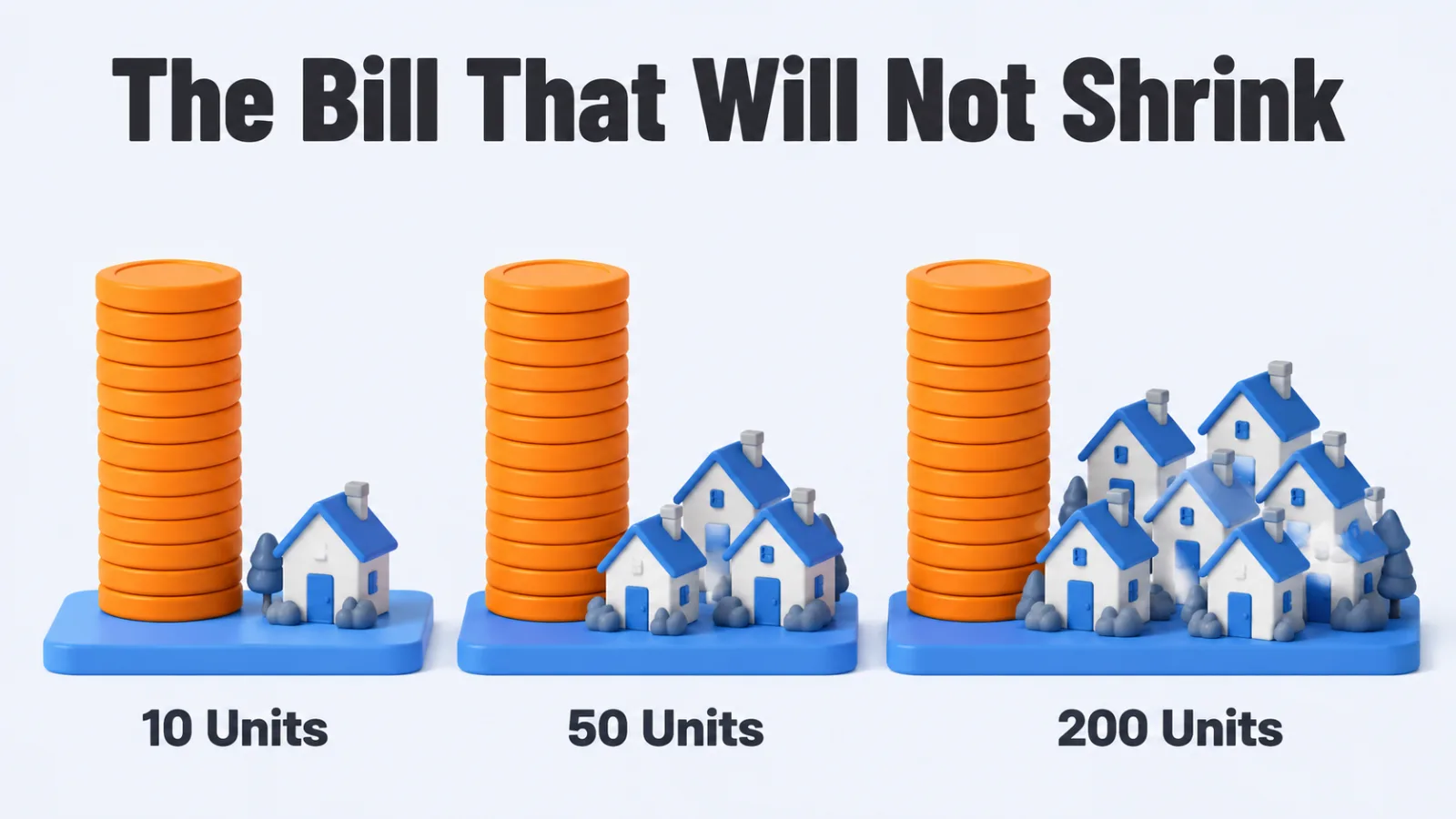
That number’s close to meaningless for most people reading it, because almost every vendor also charges a monthly minimum of 100 to 300 dollars.
Below roughly 80 units, the minimum is your price and the per-unit rate is decoration. Work out where you sit on that line before comparing any two quotes.
Key Takeaways
- Checking the monthly minimum matters more than comparing per-unit rates.
- Dividing the minimum by your unit count gives your real cost per unit.
- Adding payment processing produces a second bill that can exceed the first.
- Negotiating the onboarding fee works more often than negotiating the rate.
The Three Pricing Models
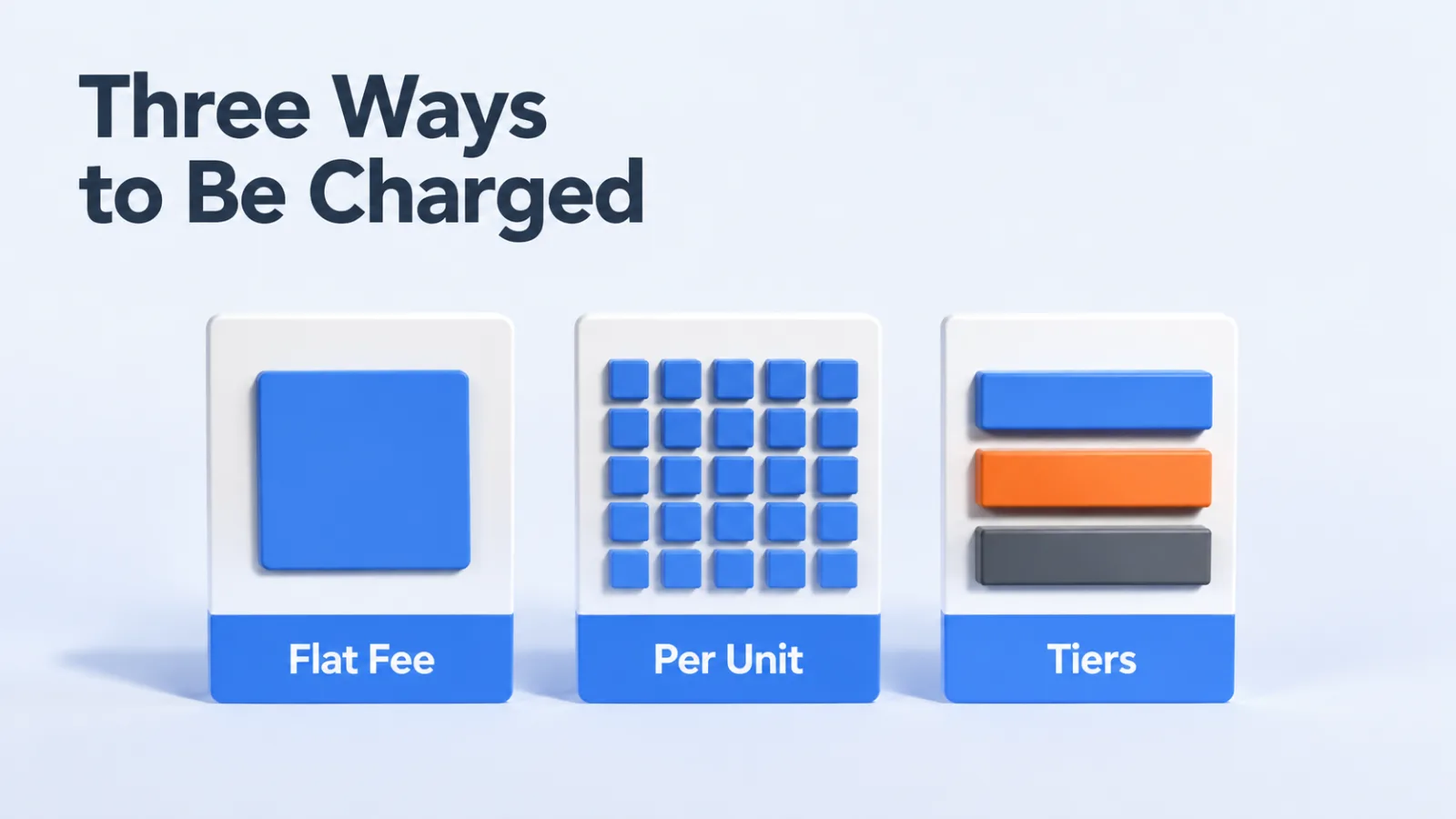
Vendors use one of three, and each favors a different portfolio size.
| Model | Typical shape | Suits |
|---|---|---|
| Flat monthly fee | 50 to 250 dollars, unit cap included | Under 50 units |
| Per unit per month | 1.50 to 3.50 dollars, plus a minimum | 150 units and up |
| Feature tiers | Bands with unit limits inside each | Portfolios needing few features |
A vendor selling per-unit pricing will describe it as the fair model, and it is, once you’re past the minimum. Before that point it’s the most expensive of the three.
The Minimum Decides Your Real Rate
One division sorts this out, and it takes ten seconds.
Take the monthly minimum and divide it by your unit count. A 150-dollar minimum across 20 units is 7.50 dollars a unit, which is four times the advertised 1.90.
The same 150-dollar minimum across 100 units is 1.50 a unit, which is what the marketing said. Nothing about the vendor changed between those two sentences except your portfolio.
What You Pay by Portfolio Size
The effective rate falls fast and then flattens.
| Units | Monthly bill | Effective per unit |
|---|---|---|
| 10 | 150 dollars, the minimum | 15.00 dollars |
| 25 | 150 dollars, the minimum | 6.00 dollars |
| 50 | 150 dollars, the minimum | 3.00 dollars |
| 80 | 152 dollars, the crossover | 1.90 dollars |
| 200 | 380 dollars, rate applies | 1.90 dollars |
The crossover point is the number to ask for. Any vendor can tell you the unit count at which the minimum stops binding.
That single figure tells you whether their pricing was built for a portfolio like yours.
Payment Processing Is a Second Bill
For most portfolios this costs more than the subscription does.
ACH bank transfers are often free, or a flat one to three dollars per transaction.
Card payments run 2.5 to 3.5 percent. On a 1,500-dollar rent that’s 37 to 52 dollars for a single payment.
Who absorbs that is a setting rather than a law. Some vendors pass card fees to the tenant, some bill you, and some make it configurable, which is a question worth asking before the demo ends.
The same rates apply across payment processing software generally. If you’re already running payments elsewhere, compare the two rather than assuming the bundled option is cheaper.
What Else Sits Outside the Rate
Five line items are commonly billed separately.
- Screening tenants, at 20 to 45 dollars an applicant, usually recoverable from them.
- Signing leases electronically, either bundled or charged per document.
- Exporting to accounting, sometimes gated behind a higher tier.
- Giving owners a portal, priced per owner on some platforms.
- Buying premium support, meaning phone access rather than email only.
None of these is unreasonable on its own. Together they’ll routinely add 30 to 60 percent to a quoted subscription, which is why comparing subscriptions alone misleads.
Onboarding and Migration
The one-off charge is where the negotiating room lives.
Setup runs 200 to 2,000 dollars, scaling with portfolio size and with whether historical transactions get migrated. Vendors discount it more readily than they discount the monthly rate, because it doesn’t set a precedent for renewal.
Migrating history is the part worth paying for. Start fresh and your first year of reporting compares against nothing, which shows up every time an owner asks how the year went.
A Spreadsheet Still Wins Below Ten Units
Below about ten units, honestly.
The software earns its place through rent collection, maintenance tracking and owner reporting, and those get painful somewhere between ten and twenty units. Under that, a spreadsheet plus a bank’s own transfer tools costs nothing and takes an hour a month.
The exception is anyone managing units for other people. Owner statements are the feature that justifies the spend at any portfolio size, because producing them by hand is the job.
Free Tiers and What They Cap
Free plans are common, and the cap on them is always the same shape.
Free tiers typically stop at one to three units and exclude the accounting exports, owner statements and support that make the software worth having. They’re built for a landlord with a single rental, and they work well for exactly that person.
Treat a free tier as a trial with no deadline rather than as a plan. If you’ll cross the unit cap inside a year, price the paid tier now, because migrating later costs the onboarding fee you were avoiding.
Reading a Vendor’s Pricing Page
Three things are worth finding before you talk to anyone.
The first is whether a minimum appears at all. Pages that show only a per-unit rate usually disclose the floor further down or at the demo, and its absence isn’t evidence it doesn’t exist.
The second is what the unit definition covers. A vacant unit still counts on most platforms, and a few count doors rather than properties, which changes the bill for anyone managing multi-family buildings.
The third is the renewal term. An introductory rate that reverts after twelve months is common enough that it’s worth asking about even when nothing on the page mentions one.
Who Pays, and Who Benefits
For managers running units on behalf of owners, some of this cost is recoverable.
Tenant screening bills to the applicant almost everywhere, and card processing can pass to the tenant too.
Some management agreements also let a technology fee flow to the owner. That turns a subscription into a line on a statement rather than a cost on your own books.
Check your management agreement before assuming that. Recovering costs the agreement doesn’t provide for is the kind of thing that surfaces during an owner dispute.
The Rate Card Disappears Above 500 Units
Above roughly 500 units, published pricing stops applying.
Vendors move large portfolios onto negotiated contracts, and the per-unit rate drops well below the advertised floor. What replaces it is an implementation project with its own cost, usually a percentage of first-year subscription, plus a named contact and a service agreement.
The negotiating levers change too. Term length, payment timing and the number of user seats all become tradeable, and the headline per-unit rate becomes the least interesting number in the conversation.
Ask for a reference at your portfolio size before signing anything at this end. A platform that runs 200 units smoothly can behave differently at 2,000, and the difference shows up in reporting speed rather than in the demo.
Annual Commitments
Paying yearly saves 10 to 20 percent and removes your room to negotiate.
Take the discount once the product has been through a full quarter, including one round of owner statements and one maintenance season. Signing annually at the demo trades a fifth of the price for the ability to leave.
What to Ask Before Signing
- Ask what the minimum is, and at what unit count it stops binding.
- Ask what the ACH and card rates are, and who absorbs them.
- Ask which of the five items above sit outside the quoted rate.
- Ask what setup costs, and whether migrating history is included.
- Ask whether you can export tenants, leases and ledgers, and in what format.
The export question is the one people skip. Your rent ledger is the record you’ll need if a dispute reaches a court, and it should not live only inside a subscription.
Sizing It Against Other Software Spend
A useful sanity check: this should be a small fraction of what you collect.
At 1,500 dollars average rent and 25 units, you’re collecting 37,500 a month and paying 150 for the software, which is 0.4 percent. Anything past about 1.5 percent deserves a second look.
The same ratio test works for buying CRM software as a small business, and it travels further than feature comparisons do. Plenty of small operators also list and sell, not just manage, and the same test applies to their real estate marketing spend — measure it against the deals it closes, not against the feature list.
It asks what the tool is worth to you, rather than what it does.
Questions People Ask About Property Management Software Pricing
How much does property management software cost per unit?
Between 1.50 and 3.50 dollars per unit per month at list price. Below roughly 80 units the monthly minimum overrides that rate, so your effective cost per unit is higher.
What is a monthly minimum?
A monthly minimum is the floor a vendor charges regardless of portfolio size, usually 100 to 300 dollars. A 20-unit landlord on a 2-dollar rate still pays the floor.
Which pricing model is cheapest for a small portfolio?
A flat monthly fee, in most cases. Per-unit pricing only beats it once the portfolio is large enough that the minimum stops applying.
Are payment processing fees included?
Rarely. ACH transfers are often free or a flat 1 to 3 dollars. Card payments run 2.5 to 3.5 percent, charged either to you or passed to the tenant.
Is there an onboarding fee?
Frequently, from 200 to 2,000 dollars depending on portfolio size and whether historical data gets migrated. It is negotiable more often than the subscription rate is.
Start With Your Unit Count
Write down your unit count, then ask each vendor for the minimum and the crossover point.
Those two numbers turn a page of pricing tiers into one comparable figure, and they’ll frequently reorder your shortlist. The method is the same one that works for supply chain management software cost: find the line item the rate card is hiding behind.
Add SocialAtoZ as a preferred source
See us more often in your Google results.