

Portainer
VerifiedContainer and Kubernetes management extending to industrial IoT and OT edge fleets
- Deployment Cloud Based, On Premise
- Starting price $105
- Free trial Available
- Best for Small Business, Medium Business, Large Enterprise
What is Portainer?
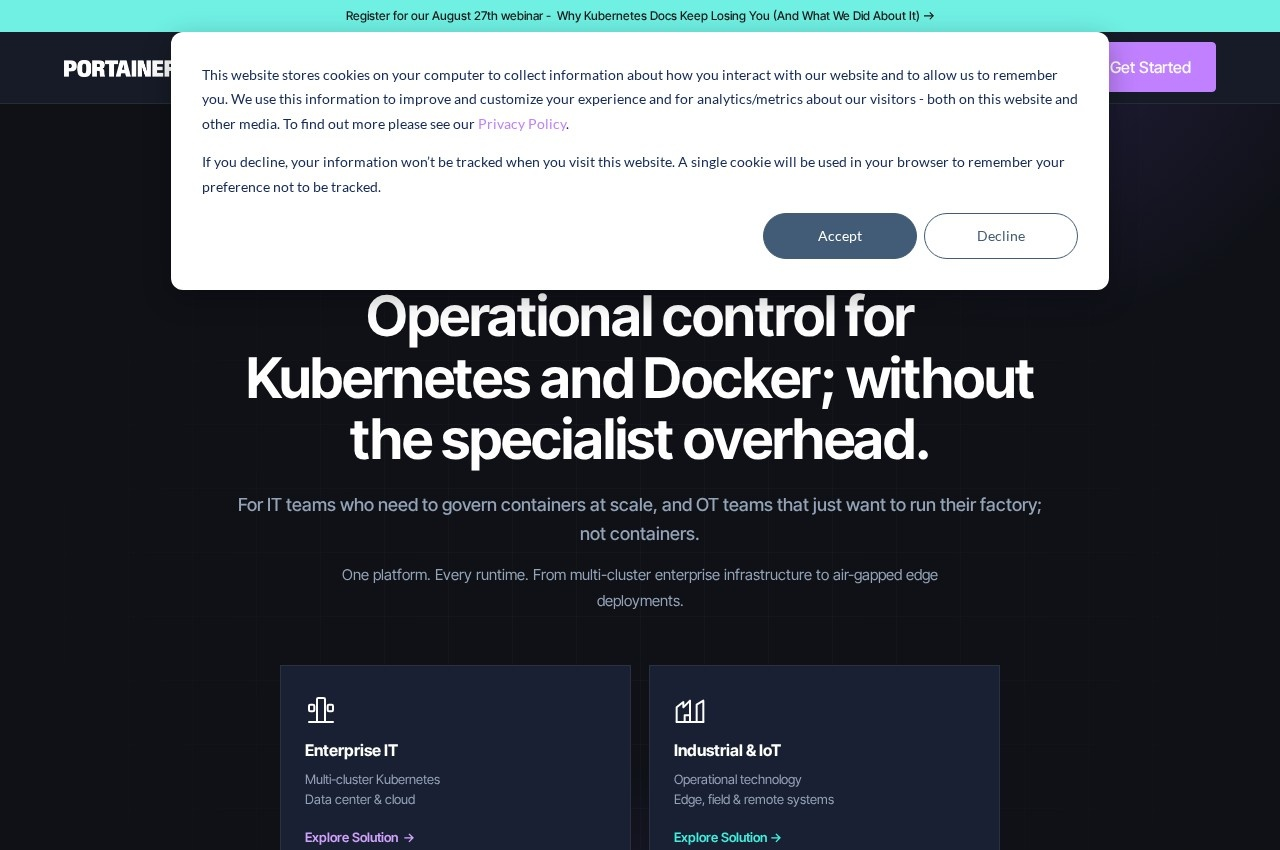
Portainer is container management software, and its relevance to IoT comes from the edge rather than the data centre. Alongside enterprise IT and multi-cluster Kubernetes governance, it addresses industrial IoT and operational technology edge as a named solution, covering distributed operations across sites. For organisations already running containers, extending the same management plane to edge devices avoids introducing a second, unfamiliar tool for the field estate.
The vendor is unusually candid about what makes edge licensing awkward, noting that its model reflects the real-world constraints of industrial and IoT hardware, where a node might be a 30 dollar sensor. That is the crux of the problem: per-node pricing designed for servers becomes absurd when applied to cheap distributed hardware, and any platform being evaluated for edge use should be checked against that arithmetic with your own device count.
KubeSolo is the specific edge product, providing single-node Kubernetes for edge IoT, which suits hardware too constrained for a full cluster. Portainer-Run addresses deploying AI-built applications safely, and ISV Solutions cover shipping software into any customer environment, useful for vendors distributing to sites they do not control. Managed Services provide expert Kubernetes operations alongside your own team, and Skunkworks offers free tools from the engineering team.
Pricing is published with both monthly and annual figures and the scale implications discussed openly, including a published webinar on what changes at 20, 50 and 200 nodes. A feature comparison across plans, resource hub, guides, documentation and case studies are all available, and a partner network can be searched.
Key Features of Portainer
- Container management across environments
- Multi-cluster Kubernetes governance
- Industrial IoT and OT edge management
- Distributed operations across sites
- KubeSolo single-node Kubernetes for edge IoT
- Portainer-Run for deploying AI-built applications
- ISV Solutions for shipping into customer environments
- Managed Kubernetes operations services
- Skunkworks free engineering tools
- Published feature comparison across plans
- Documentation, guides and learning paths
- Partner network
Portainer Pricing
Starter
$105
From this rate, or 1,045 dollars per year. For getting started with container management, described as simple and cost-effective to grow from.
Business
$209
From this rate, or 2,095 dollars per year. Larger deployments receive tailored pricing by email on request.
Portainer Specifications
- Cloud Based
- On Premise
- Web App
- Linux
- Small Business
- Medium Business
- Large Enterprise
Portainer Screenshots
Overall Portainer Reviews
No reviews yet
Used Portainer? Share your experience and help other buyers decide.
Portainer FAQs
Alternatives to Portainer
Other IoT Device Management Software products listed on SocialAtoZ.