
ZeroMQ
VerifiedA brokerless, embeddable networking library for building fast, distributed, concurrent applications.
 See all screenshots
 - Deployment Any
- Starting price Free
- Free trial Not offered
- Best for Freelancers, Startups, SMEs
What is ZeroMQ?
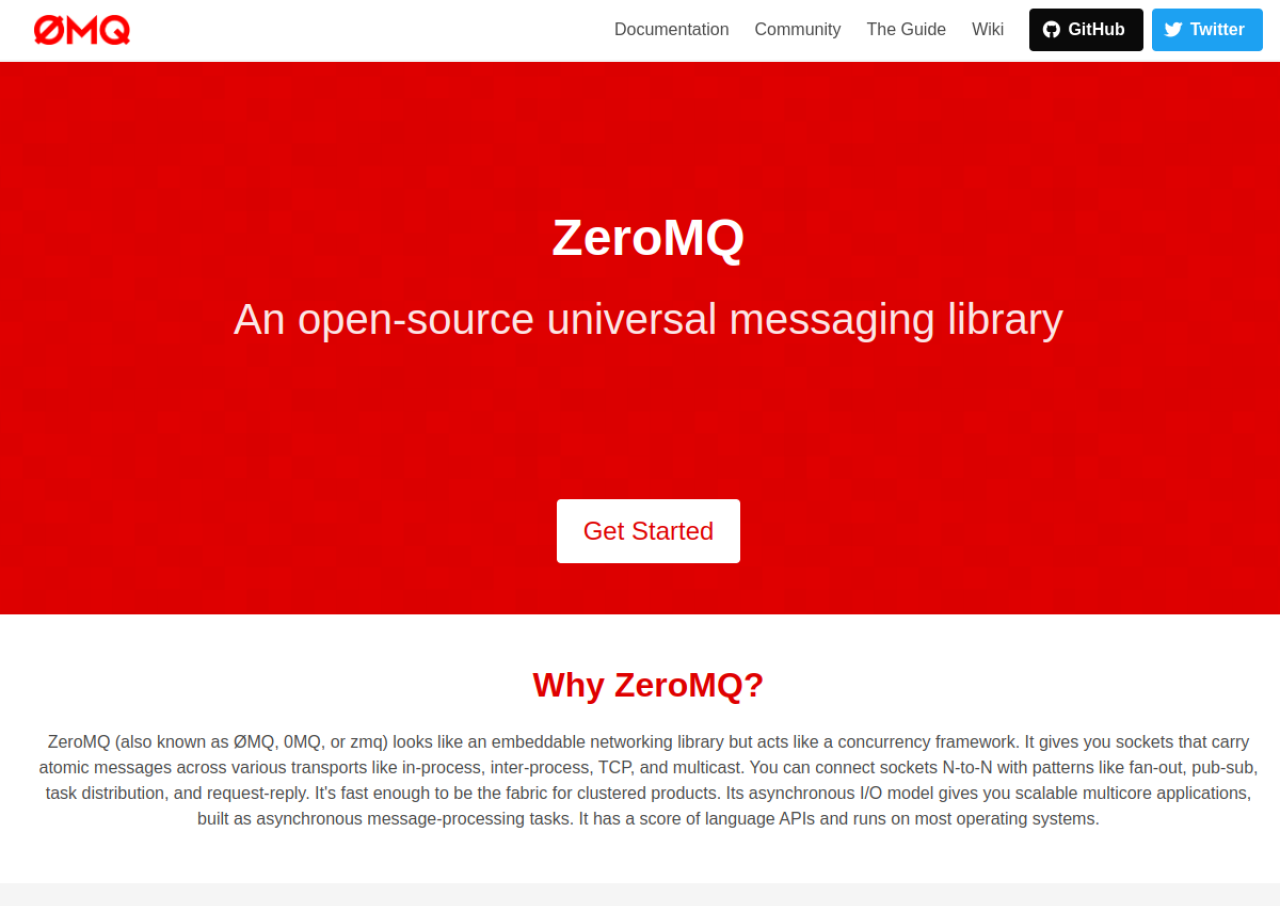
ZeroMQ, also written as ØMQ, is an open-source networking library that provides messaging sockets without requiring a central message broker or daemon process. Applications link the library directly and use it to build custom messaging patterns such as publish-subscribe, request-reply, and push-pull over transports including TCP, in-process, inter-process, and multicast.
Because it runs as an embedded library rather than a hosted server, ZeroMQ works on Linux, Windows, and macOS and offers bindings for more than twenty programming languages, including C, C++, Python, Java, and Go. It is free to use under LGPL licensing terms, and is used by companies such as Microsoft, Spotify, and Samsung to build low-latency, distributed, and concurrent systems.
Key Features of ZeroMQ
ZeroMQ lists 9 documented features, including Brokerless, embeddable messaging library with no central server required, Asynchronous I/O engine built for scalable multicore applications and Multiple built-in messaging patterns: pub-sub, push-pull, request-reply, and router-dealer. The list below covers what the product does rather than how it is marketed.
- Brokerless, embeddable messaging library with no central server required
- Asynchronous I/O engine built for scalable multicore applications
- Multiple built-in messaging patterns: pub-sub, push-pull, request-reply, and router-dealer
- Supports numerous transports: in-process, inter-process (IPC), TCP, multicast (PGM), and WebSocket
- Language bindings for over 20 languages including C, C++, Python, Java, C#, Rust, Go, and Node.js
- Runs on Linux, Windows, macOS, and most POSIX systems
- N-to-N socket connectivity for building custom network topologies
- Lightweight C++ core with no external dependencies for the base library
- Free and open source under LGPL, usable in proprietary applications
ZeroMQ Pricing
ZeroMQ lists one plan, at Free.
ZeroMQ Library
Free
Unlimited
Open-source library licensed under LGPL, free to embed in personal, commercial, and proprietary applications with no usage limits.
ZeroMQ Specifications
ZeroMQ is available on web app. It offers an API and has a free plan.
- Deployment
- Any
- Billing cycle
- Monthly
- Desktop
- Web App
- Languages
- English
- Built for
- Freelancers
- Startups
- SMEs
- Enterprises
- Integrations
- C, C++, Python, Java, C#, Rust, Go, Node.js, Erlang, F#, Haskell, Dart, Perl, Zig
- Public API
- Yes
- Free trial
- No
- Free plan
- Yes
- Runs in browser
- No
- Customisable
- Yes
- Website
- zeromq.org
ZeroMQ Videos
ZeroMQ Screenshots
ZeroMQ Comparisons
Side by side comparisons of ZeroMQ against 3 other Message Oriented Middleware options listed here.



ZeroMQ Reviews
No reviews yet
Used ZeroMQ? Share your experience and help other buyers decide.
ZeroMQ FAQs
Alternatives to ZeroMQ
Other Message Oriented Middleware recorded on the same fields.