

Fortinet FortiGate
VerifiedNext-generation firewall with published hardware price guidance from $700 for small business
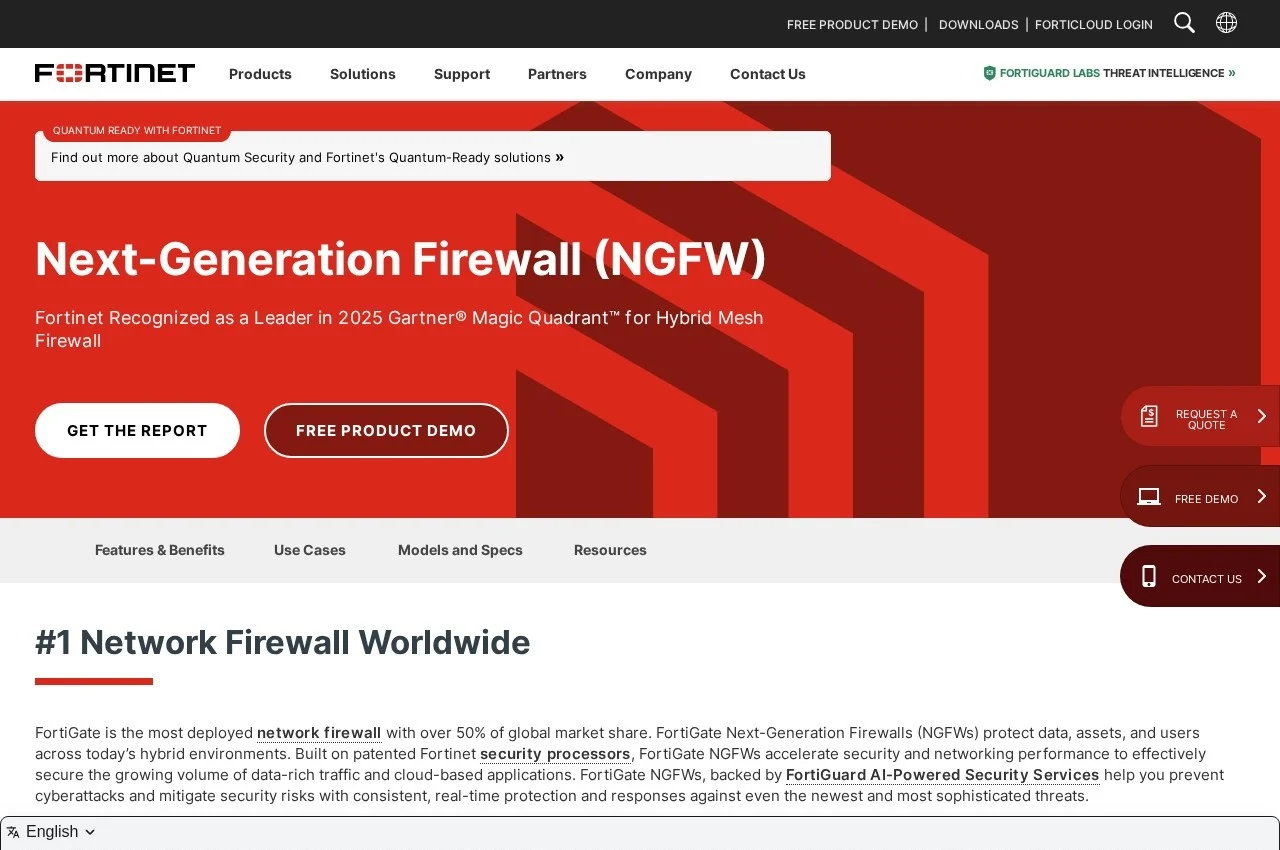 See all screenshots
 - Deployment On Premise, Cloud Based
- Starting price $700
- Free trial Not offered
- Best for Small Business, Medium Business, Large Enterprise
What is Fortinet FortiGate?
FortiGate is Fortinet's next-generation firewall, published within a hybrid mesh firewall platform alongside AI-powered security services, secure ethernet switches, secure wireless LAN and the FortiAI range, with the vendor publishing price guidance rather than hiding cost behind a quote.
Publishing indicative pricing at all is unusual for enterprise network security and worth crediting, because it lets a buyer establish the order of magnitude before entering a sales process. The guidance is banded by organisation size, with hardware for a small business firewall in the region of $700 to $1,000, and businesses with roughly 15 to 100 users addressed at a higher band around $1,500.
Understanding what that figure does and does not include is the important part, and it applies to every vendor in this category rather than to this one alone. The hardware price is the beginning. Next-generation firewalls are sold with subscription security services layered on top, covering intrusion prevention, application control, web filtering, antivirus and increasingly sandboxing and AI-driven analysis. Those subscriptions typically cost a meaningful fraction of the hardware every year, and they are what makes the device a next-generation firewall rather than a packet filter.
A firewall without current subscriptions still passes traffic and still enforces rules, but it stops recognising new threats, which is the failure mode that catches organisations that budgeted for hardware and treated renewals as optional.
The hybrid mesh firewall framing reflects where this category has moved. Enforcement now has to happen consistently across data centre, branch, cloud and remote workers rather than at a single perimeter, because there is no longer a single perimeter to defend.
Fortinet's platform breadth across switching, wireless and security services is the practical argument for the range, since a single vendor across the network layer means policy and identity are consistent rather than approximately aligned across three consoles.
Pricing guidance is published at $700 to $1,000 for small business hardware and around $1,500 for larger user counts.
Key Features of Fortinet FortiGate
- Next-generation firewall enforcement
- Intrusion prevention
- Application control
- Web filtering
- Antivirus and sandboxing services
- Hybrid mesh firewall architecture
- Consistent policy across data centre, branch and cloud
- Secure SD-WAN
- Integration with Fortinet switching and wireless
- FortiAI security services
- Published price guidance by organisation size
Fortinet FortiGate Pricing
Small business hardware
$700
Published guidance for small business firewall hardware, quoted in a $700 to $1,000 range.
Small business hardware, upper
$1,000
Upper end of the published small business hardware guidance.
15 to 100 users
$1,500
Published guidance for businesses with approximately 15 to 100 users. Security subscriptions are additional.
Fortinet FortiGate Specifications
- Deployment
- On Premise
- Cloud Based
- Desktop
- Web App
- Built for
- Small Business
- Medium Business
- Large Enterprise
- Support
- Phone
- Public API
- Yes
- Free trial
- No
- Free plan
- No
- Runs in browser
- No
- Customisable
- No
- Website
- fortinet.com
Fortinet FortiGate Videos
Fortinet FortiGate Screenshots
Fortinet FortiGate Comparisons

Used Fortinet FortiGate? Write the first review.
Fortinet FortiGate FAQs
Alternatives to Fortinet FortiGate
Other Firewall Software recorded on the same fields.