
 See all screenshots
 - Starting price Free
- Free trial Not offered
What is Angular?
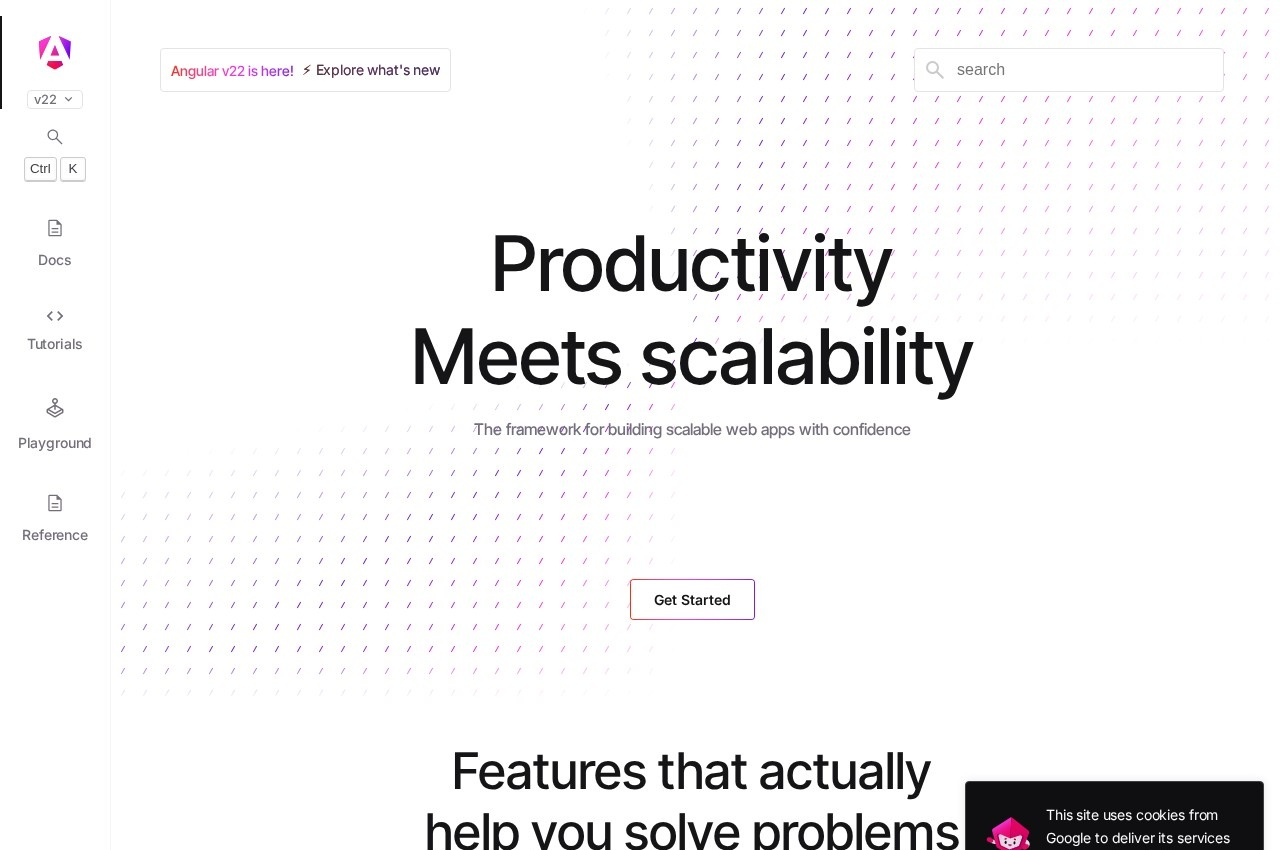
Angular is a framework for building scalable web applications with confidence, maintained by Google. Its defining characteristic among the major JavaScript frameworks is that it is opinionated: rather than assembling a stack from independent libraries, a team adopts a fully featured platform where everything works together.
That completeness is the practical argument. Angular ships first-party modules for forms, routing and the other concerns an application needs, so those pieces are maintained together and version-matched rather than reconciled by the team. For a large or long-lived codebase, having the framework own those decisions removes a recurring source of upgrade pain.
Angular describes itself as opinionated and versatile, and organised yet modular, achieved through Angular components and dependency injection. Dependency injection in particular is unusual in this category and is what makes large Angular codebases testable, since a component's dependencies are declared rather than imported directly.
Angular Signals provide fine-grained reactivity for reactive and fast state updates, which is the framework's answer to the change-detection performance problems that affected earlier versions. The project also publishes AI-forward resources and integrations aimed at development assisted by AI tools. Angular states it is trusted by millions to build fast, reliable applications that scale with the size of the team, and the emphasis on team scale rather than application scale is deliberate. It is free and open source.
Key Features of Angular
- Opinionated framework covering the whole application
- First-party modules for forms, routing and more
- Everything version-matched and maintained together
- Dependency injection for testable large codebases
- Component architecture that is organised yet modular
- Angular Signals for fine-grained reactivity
- Fast and reactive state updates
- AI-forward resources and integrations
- Designed to scale with team size, not just application size
- Free and open source, maintained by Google
Angular Pricing
Angular Specifications
- Public API
- No
- Free trial
- No
- Free plan
- No
- Runs in browser
- No
- Customisable
- No
- Website
- angular.dev
Angular Screenshots
Angular Comparisons

Angular Reviews
No reviews yet
Used Angular? Share your experience and help other buyers decide.